
Here's Another Group of Stocks Getting Hammered by Soaring Yields
Key Points
Bank stocks have been getting slammed.
Rising interest rates tend to depress loan demand.
It's not clear when yields or interest rates will stabilize.
Bond yields continue to soar, damaging interest rate-sensitive sectors of the economy.
I recently wrote that rising yields are killing homebuilder stocks because mortgage rates are linked to the 10-year Treasury yield, which this week hit 5.31%, 1.15 percentage points above where it stood at the beginning of 2026. That's very bad news for a housing market that was already suffering from affordability issues.
Missed Nvidia in 2009? This Rare Signal Is Flashing Again. In 2009, a "Double Down" signal flashed for a little-known chipmaker called Nvidia. For the first time in years, that same "Total Conviction" signal is flashing for a company 1/100th the size of Nvidia. Continue »
Well, misery loves company, and homebuilders are not alone. Bank stocks have also tanked over the past month due to rising yields and the prospect of multiple interest rate hikes by the Federal Reserve.
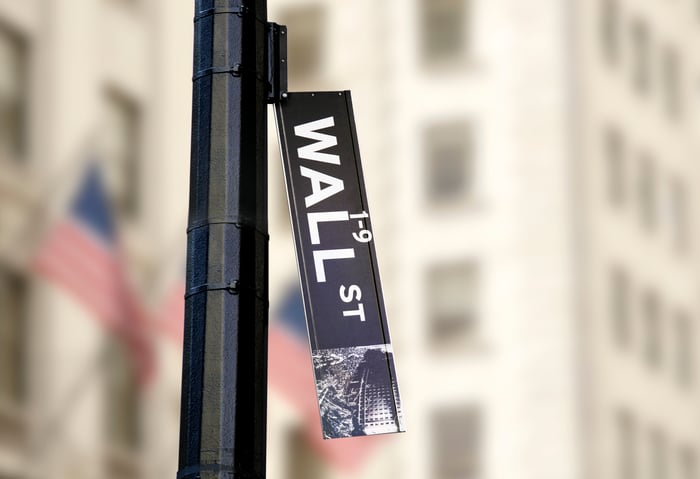
Image source: Getty Images.
The KBW Nasdaq Bank index is down 9.7% over the past month, while the broader market, as measured by the S&P 500 index, is up about 1.5%. The KBW Index tracks 24 U.S. banking stocks, including large national money centers, regional banks, and thrifts.
Some of the hardest hit banks include Bank of America (NYSE: BAC), down 13.3% over the past month, Bank of New York Mellon (NYSE: BNY), down 12.2%, Goldman Sachs (NYSE: GS), down 13.1%, Morgan Stanley (NYSE: MS), down 11.7%, Charles Schwab (NYSE: SCHW), down 10.2%, and PNC Financial Services Group (NYSE: PNC), down 10.1%.
In fact, bank stocks had the worst September compared to the S&P 500 since 1990.
When yields and interest rates rise, bank profits are squeezed for multiple reasons. Banks' net interest margins, the difference between what they lend at and what they pay on deposits, shrink. Plus, as bond yields rise, deposit accounts face growing competition from Treasury bills, so banks eventually have to pay more for their main funding source.
Also, rising interest rates depress demand for bank loans, such as mortgages and consumer loans. And rapidly rising rates can slow dealmaking and trading activity on Wall Street. Indeed, mergers and acquisitions in North America fell 23% in the third quarter.
Finally, the sell-off in bonds, which has pushed yields higher, can decrease the value of a bank's bond portfolio. Eventually, of course, banks will rebuild their portfolios at higher yields, which can boost earnings in the longer run. But if yields continue to rise, as they have in recent weeks, rebuilding will take longer, and there will need to be more deposit repricing.
Watch the yield curve to see where bank profitability is heading
One important factor to watch for bank profitability is the yield curve, which is the difference between long- and short-term bond yields. It's often measured as the difference between the yields on two-year and 10-year Treasury securities. When that difference in long and short yields narrows, which is known as a flattening yield curve, it cuts their net interest margins and their profitability, as banks borrow at short rates (deposits) and lend at longer rates (mortgages and commercial loans, for example).
As I wrote last week, the yield curve had been flattening as yields on short-term Treasuries rose much faster than those on long-term Treasuries. But that changed in recent days, as the yield on the 10-year note climbed and the two-year yield actually dropped a bit. So that's good for banks, at least for the moment.
Plus, the Federal Reserve raised its target interest rate in mid-September, and all indicators suggest that the hike is not a one-and-done increase. The futures market, the bond market, and the Fed's own projections suggest the September hike was the first in a series, which could amount to a full-on rate-hiking cycle.
It's very hard to predict what bond investors will do -- and even exactly what's causing the global bond sell-off. Until yields stabilize, presumably at a higher level, I would be wary of investing in bank stocks and bank ETFs.
Bank of America is an advertising partner of Motley Fool Money. Charles Schwab is an advertising partner of Motley Fool Money. Matthew Benjamin has no position in any of the stocks mentioned. The Motley Fool has positions in and recommends Goldman Sachs Group. The Motley Fool recommends Charles Schwab and recommends the following options: short September 2026 $95 calls on Charles Schwab. The Motley Fool has a disclosure policy.