
How Investors Are Reacting To Columbia Sportswear (COLM) 10 Year GXO Deal
- GXO Logistics announced that it has taken over management of Columbia Sportswear's primary European distribution hub in Cambrai, France, under a new 10 year agreement covering inbound logistics, storage, order fulfillment and outbound distribution for e commerce, retail and wholesale customers across multiple European markets.
- The long duration logistics partnership centralizes Columbia Sportswear's European operations in a single hub, which could influence cost efficiency, inventory discipline and service reliability at a time when international regions are an important counterweight to softer U.S. demand.
- We will now explore how Columbia Sportswear's 10 year European logistics partnership with GXO could influence the existing investment narrative.
Columbia Sportswear Investment Narrative Recap
For Columbia Sportswear, the core belief is that the outdoor brand can turn heavy work on product, marketing and cost control into steadier earnings, even as growth expectations stay modest. The GXO logistics deal plugs directly into that story, because Europe already accounts for a meaningful share of sales and now runs through a single hub that can tighten inventory and delivery execution.
Right now, the key short term swing factor is whether international demand and higher value categories like footwear and women’s offset softer U.S. activity and compressed margins. The biggest risk is that shipment delays, tariffs and freight costs keep eating into gross margin. In that case, a more efficient European warehouse is helpful but not transformational.
The new 10 year GXO partnership lines up cleanly with Columbia Sportswear’s reliance on international regions that already contribute over 40% of revenue. A centralized European warehouse that supports e commerce, wholesale and retail should make it easier to keep those markets supplied without overbuilding inventory or relying on fragmented local distribution fixes.
That matters for the existing catalysts around ACCELERATE, footwear and women’s, because better inbound and outbound logistics can reduce the odds that product and marketing progress gets undercut by shipment timing issues. It also touches the margin story. Freight, tariffs and logistics are called out as key risks, so any operational improvement in Cambrai gives management one more lever as it works through those pressures.
What The GXO Deal Means Against Columbia Sportswear’s Analyst Numbers
Columbia Sportswear’s long term logistics shift in Europe now sits alongside a consensus model that is fairly restrained on growth and profitability. Analysts are assuming revenue grows at 3.0% a year over the next three years, profit margins edge down from 6.0% today to 5.7%, and earnings move from US$206.0 million today to US$211.3 million by 2029. That is a small earnings step up, not a big reset, which gives the new Cambrai hub a clear job. It needs to help the business hit targets that are already modest, rather than rescue an overly optimistic plan.
The GXO partnership plugs into that framework in practical ways. A single distribution center handling inbound logistics, storage, and outbound orders for e commerce, wholesale and retail should support tighter inventory levels and more predictable freight spending across Europe. That type of discipline matters if analysts are already baking in some margin compression, because any reduction in stock write offs, rush shipments or split deliveries can make a 5.7% margin feel more achievable without relying only on price increases or deeper cost cuts.
Forecasts also rely on Columbia Sportswear reaching US$3.7b of revenue and the same US$211.3 million of earnings by 2029, with the valuation case built on a P/E multiple of 18.7x rather than the current 14.2x. A cleaner, centralized European operation can support that thesis by making international sales streams more reliable and less prone to one off shipping or customs issues. If Cambrai keeps product flowing more consistently into higher value footwear and women’s lines, it can help the narrative that global categories carry more of the earnings load even when U.S. activity is under pressure.
None of this makes logistics a silver bullet. The risk list that analysts highlight, from tariffs and freight to shipment timing around geopolitical events, still applies to Columbia Sportswear even with GXO on board. The difference is that a 10 year agreement on a key region gives management more control over variables that would otherwise remain scattered across multiple third parties. For readers tracking the stock, the practical question is how far to credit a single hub and a specialist logistics partner for reducing that operational noise around a relatively cautious earnings path.
Columbia Sportswear’s narrative projects US$3.7b revenue and US$211.3 million earnings by 2029. This assumes 3.0% yearly revenue growth and an earnings increase of about US$5.3 million from US$206.0 million today.
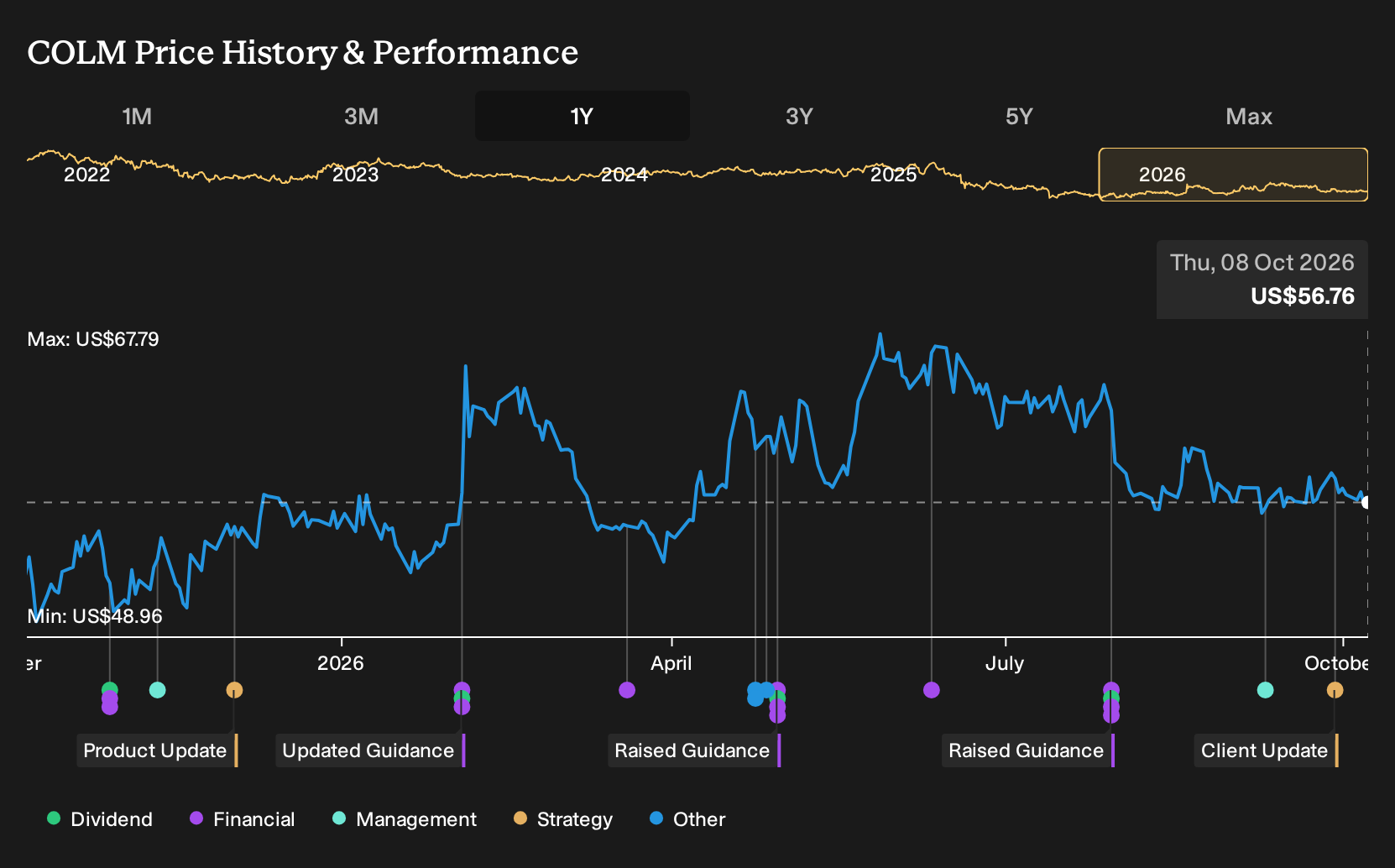
Uncover why Columbia Sportswear's fair value indicates a 23% potential upside to its current price before that valuation gap closes.
Exploring Other Perspectives
You might read the Columbia Sportswear story very differently if you focus on margin expansion as the main catalyst. The most optimistic analysts were already penciling in earnings of about US$244.0 million on US$3.8b revenue by 2029, compared with the consensus US$211.3 million and US$3.7b. This new GXO logistics agreement could influence either narrative, so it is useful to compare both views before forming your perspective on the stock’s long term potential.
Explore 2 other Columbia Sportswear fair value estimates, including one that suggests as much as 31% potential upside from the current price.
Form Your Own Verdict
Don't just follow the ticker. Dig into the data and build a conviction that's truly your own.
- A great starting point for your Columbia Sportswear research is our analysis highlighting 1 key reward and 2 important warning signs that could impact your investment decision.
- See our latest analysis for Columbia Sportswear. The report includes a comprehensive fundamental analysis summarized in a single visual, the Snowflake, making it easy to evaluate Columbia Sportswear's overall financial health at a glance.
Looking for more investment ideas beyond Columbia Sportswear?
Once you have a view on Columbia Sportswear, it can help to set it beside a wider watchlist so you see how its risks, balance sheet and potential stack up against other businesses.
- If resilience matters most to you, check out a curated 31 resilient stocks with low risk scores that may suit a more defensive approach.
- For readers hunting for stronger balance sheets and cleaner fundamentals, the list of solid balance sheet and fundamentals (25 results) can be a useful place to start building comparisons.
- Those who care most about valuation can scan a focused 27 high quality undervalued stocks and see how Columbia Sportswear’s profile lines up against other candidates.
This article by Simply Wall St is general in nature. We provide commentary based on historical data and analyst forecasts only using an unbiased methodology and our articles are not intended to be financial advice. It does not constitute a recommendation to buy or sell any stock, and does not take account of your objectives, or your financial situation. We aim to bring you long-term focused analysis driven by fundamental data. Note that our analysis may not factor in the latest price-sensitive company announcements or qualitative material. Simply Wall St has no position in any stocks mentioned.
Have feedback on this article? Concerned about the content? Get in touch with us directly. Alternatively, email editorial-team@simplywallst.com