
These Defensive Stocks Are Top Of The Class For October 2026
Bond yields have climbed sharply since the war with Iran began, and investors are being reminded that government borrowing costs can move fast while balance sheets cannot. In a world where 10 year Treasuries could see even higher yields, sturdier businesses with strong finances and lower risk profiles can look more appealing to cautious money. This article walks through three such low risk leaders that may warrant a closer look.
The stocks highlighted below are just a starting sample, and the full Low Risk Leaders screen surfaced 28 more businesses with equally compelling narratives that are not covered in this article. To identify and analyze those higher conviction candidates with stronger balance sheets and lower risk scores, head straight into the Low Risk Leaders screener.
Microsoft (MSFT)
Overview: Microsoft is a global technology giant whose Azure cloud and broader software platforms power business computing, productivity and consumer experiences at scale.
Operations: Microsoft generates about US$140b from Productivity and Business Processes, US$138b from Intelligent Cloud, and US$54b from More Personal Computing, with revenue broadly split between the United States and other countries.
Market Cap: US$3.93 trillion
Microsoft matters for a low risk foundation because its Intelligent Cloud segment, especially Azure, supports recurring, consumption based services that underpin long contracts and sizable committed spend.
"Microsoft isn't spending $37.5 billion a quarter because Satya Nadella lost his mind. It is spending $37.5 billion a quarter because customer demand for Azure cloud computing is growing at 39% per year and the company literally cannot build servers fast enough."
For long term investors, the real story turns on how one unseen pressure shapes the balance between future cash generation and reported profitability.
That tension between future cash engines and today’s margins is exactly what the full narrative for Microsoft unpacks, including how Microsoft’s capital surge could be masking the real earnings power.

Ross Stores (ROST)
Overview: Ross Stores runs Ross Dress for Less and dd’s DISCOUNTS off price chains, selling discounted apparel and home goods to value focused US shoppers.
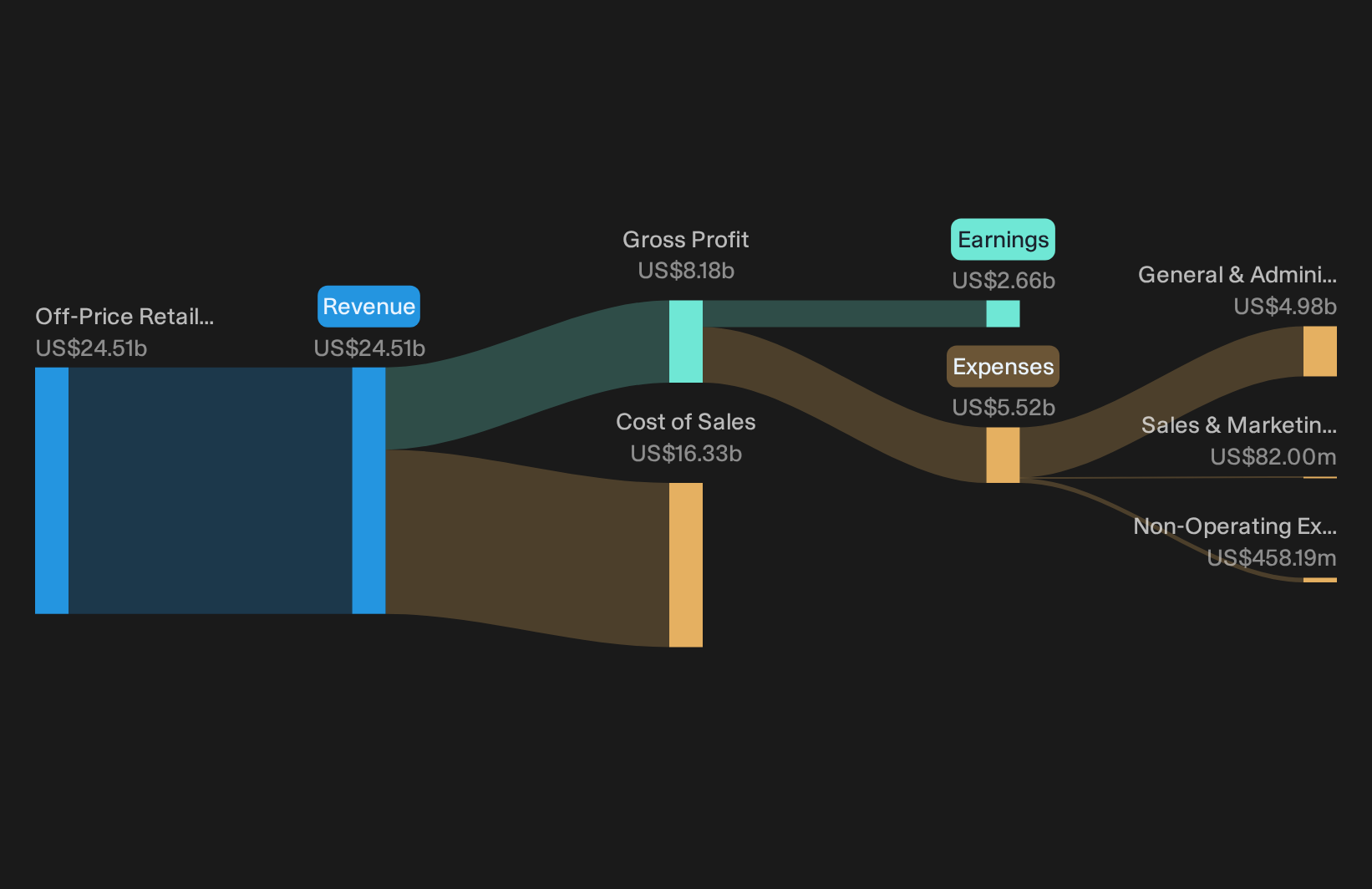
Operations: Ross Stores generates about US$24.5b in off price retail revenue, entirely from United States stores serving cost conscious households.
Market Cap: US$72.0b
Ross Stores matters for the Low Risk Leaders theme because its off price model funnels everyday value hunting into dependable cash flow and a disciplined balance sheet, which is the sort of boring reliability that can steady a portfolio when trends swing.
"The reason to own it is that the downside is unusually well defended, with a net cash balance sheet of roughly $3.1B, no owned real estate obligation, no e-commerce cost structure, and 40 years of audited results through four recessions."
The real question is what happens to Ross Stores’ carefully managed margins if a single key assumption about shopper demand or closeout supply breaks.
If that core assumption really matters to you, the full narrative for Ross Stores breaks down where Ross Stores’ downside protection could crack and where upside may be quietly accelerating.
Vertiv Holdings Co (VRT)
Overview: Vertiv Holdings Co supplies power, cooling, and lifecycle services that keep data centers and communication networks running reliably around the world.
Operations: Vertiv generates about US$7.5b in the Americas, US$2.7b in Asia Pacific, and US$2.4b in Europe, Middle East and Africa.
Market Cap: US$94.9b
Vertiv matters for Low Risk Leaders because its power and thermal hardware, paired with lifecycle services, anchors mission critical data center infrastructure that customers depend on to stay online.
"The liquid cooling market is already growing at roughly 20% to 30% annually as hyperscalers like Microsoft, Google, and Amazon race to build AI infrastructure. Vertiv's Q4 2025 organic orders surged 252% year over year, and its $15 billion backlog is equivalent to roughly 1.5 years of trailing revenue."
For a cautious investor, the real swing factor is what happens if one key assumption about AI buildout intensity and timing eventually shifts.
If that assumption feels too binary, the full narrative for Vertiv Holdings Co shows how Vertiv’s AI exposure, backlog quality and risk profile could be decoupling from headline hype.

Seeking Fresh Alternatives Before They Fly
Fresh ideas tend to move first, and the market rarely waits. Spot potential breakouts with early momentum while they are still under the radar for now, then consider your options promptly.
- Use the list of solid balance sheet and fundamentals (25 results) to find companies with reliable cash generation and sturdy balance sheets before they become widely followed.
- Explore the curated list in 35 profitable AI stocks that aren't just burning cash to track early AI momentum where profits already play a role, not just promises.
- Run the 20 high quality undiscovered gems to scan for under the radar opportunities that show real business traction.
This article by Simply Wall St is general in nature. We provide commentary based on historical data and analyst forecasts only using an unbiased methodology and our articles are not intended to be financial advice. It does not constitute a recommendation to buy or sell any stock, and does not take account of your objectives, or your financial situation. We aim to bring you long-term focused analysis driven by fundamental data. Note that our analysis may not factor in the latest price-sensitive company announcements or qualitative material. Simply Wall St has no position in any stocks mentioned.
Have feedback on this article? Concerned about the content? Get in touch with us directly. Alternatively, email editorial-team@simplywallst.com