
Could Materials Group Alter The Investment Case For Regions Financial (RF)?
- Regions Financial, through Regions Bank, recently launched a Materials and Infrastructure Group within Corporate Banking to serve building products, packaging and infrastructure clients, led by Ryan Franco under Leo Loughead.
- This move concentrates sector expertise around capital-intensive industrial clients. It could influence how Regions Financial balances fee income ambitions with credit risk discipline and capital use.
- We will now look at how Regions Financial's new Materials and Infrastructure Group could influence its existing investment narrative and risk profile.
Scan how Regions Financial’s new sector focus compares with peers by sizing up 43 power grid technology and infrastructure stocks that could also benefit from long-term spending on infrastructure and essential networks.
Regions Financial Investment Narrative Recap
To own Regions Financial, you need to believe the bank can turn Sun Belt scale, technology spending and fee businesses into steadier earnings, even as recent revenue sat at US$1.91b and was flat year over year. The new Materials and Infrastructure Group fits that story by concentrating on capital intensive clients, but on its own it does not change the near term picture.
The key short term swing factor is whether revenue and fee trends improve after the recent miss, while expenses move closer to management’s efficiency ambitions. The biggest risk is that costs and competitive deposit pricing stay sticky, which would keep margins tight and make the required earnings progress harder to deliver.
With no other fresh announcements around earnings or capital returns tied directly to this launch, the Materials and Infrastructure Group itself is the main development to watch. Management is expanding a Specialized Industries franchise that already spans capital markets, advisory and other fee oriented activities, which are important given prior revenue softness.
For you as a shareholder, the question is execution. Regions Financial now has another sector focused team that plugs into its commercial lending system, digital platform work and fee income ambitions. If credit discipline remains intact and operating costs are contained, this build out could matter for future noninterest income and perceived earnings quality.
What The Current Forecasts Assume For Regions Financial
Consensus forecasts for Regions Financial rest on a few clear numbers rather than vague optimism. Analysts are penciling in revenue growth of 7.1% a year over the next three years and are working from current earnings of about US$2.1b. Their central case points to earnings of roughly US$2.4b by 2029, which implies an increase of about US$0.3b from earnings today. The same group expects profit margins to be lower by then, so the story relies more on top line expansion and share count reduction than on higher margins.
Regions Financial's narrative projects about US$8.9b revenue and roughly US$2.4b earnings by 2029. This rests on 7.1% yearly revenue growth and an earnings increase of about US$0.3b from US$2.1b today.
Those earnings projections are tied to a P/E multiple shift. The current P/E is 10.7x, while the analyst framework uses a 12.7x multiple on those 2029 earnings. That is higher than the 11.5x figure cited for the wider US banks group in the same report. For shareholders, the key question is not whether that exact number is right but whether a richer multiple feels reasonable if Regions Financial meets its profit and fee income targets and integrates sector teams like Materials and Infrastructure without loosening credit standards.
Discover how Regions Financial's fair value indicates an 18% potential upside to its current price, which could narrow quickly if sentiment shifts.
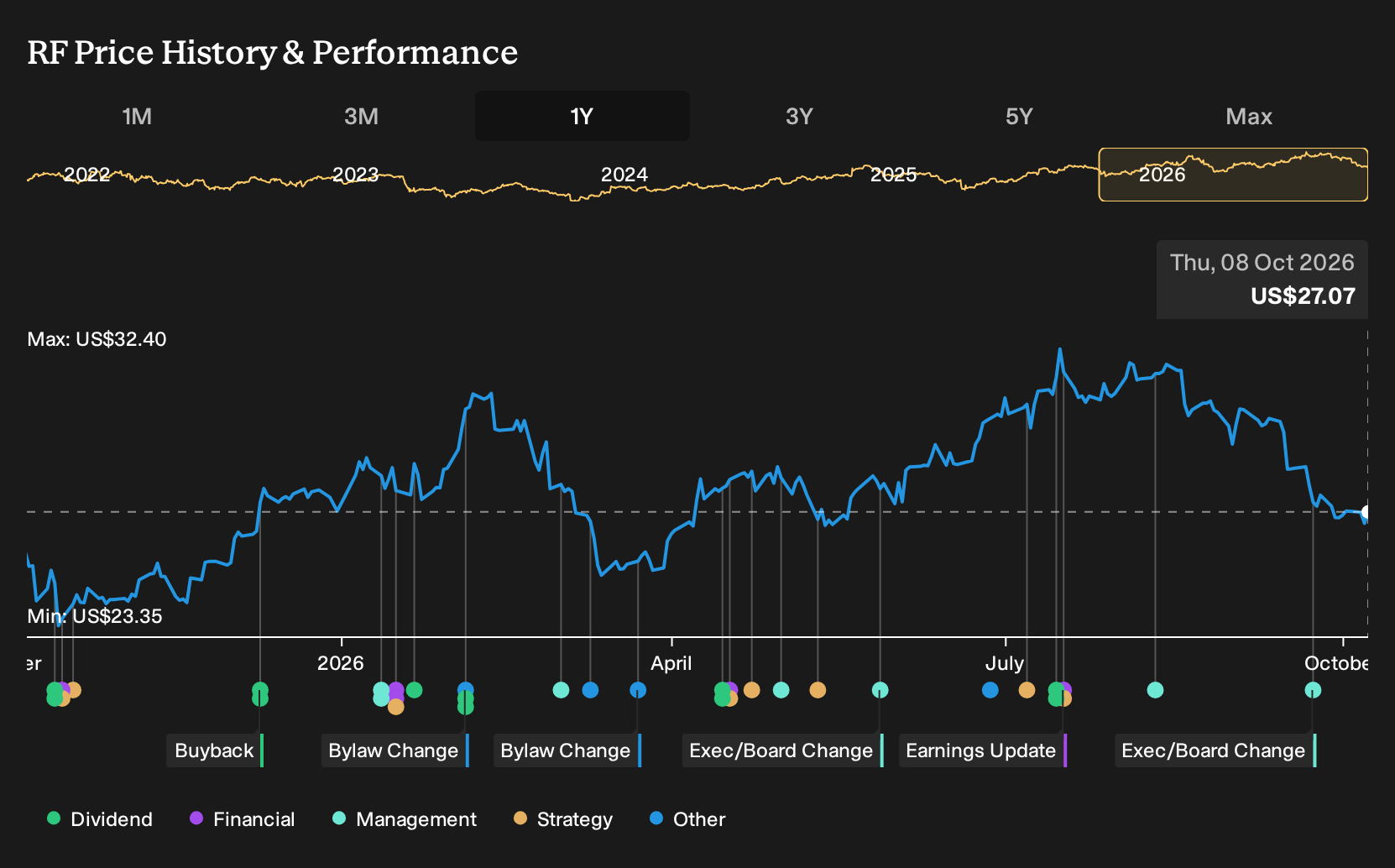
Exploring Other Perspectives
Fair value estimates for Regions Financial from the Simply Wall St Community cover only 2 submissions, yet they already stretch from about US$32.03 to roughly US$59.52 per share. That gap reflects how differently retail investors can frame the same revenue and fee story, especially when recent revenue softness and efficiency questions still hang over the outlook. Readers who want to stress test their own thesis may find it useful to compare these contrasting views against the potential catalysts around Sun Belt growth, digital investments and the newer fee initiatives such as the Materials and Infrastructure Group.
Explore another Regions Financial fair value estimate, including one that suggests potential upside of as much as 120% from the current price.
The Verdict Is Yours
Don't just follow the ticker. Dig into the data and build a conviction that's truly your own.
- A great starting point for your Regions Financial research is our analysis highlighting 4 key rewards that could impact your investment decision.
- See our latest analysis for Regions Financial. The report includes a comprehensive fundamental analysis summarized in a single visual, the Snowflake, making it easy to evaluate Regions Financial's overall financial health at a glance.
Looking for more investment ideas beyond Regions Financial?
Once you understand where Regions Financial fits in your portfolio, it can help to scan a wider field of opportunities using the Simply Wall St Screener so you are not relying on a single thesis.
- If you want potential mispricing with quality behind it, start by reviewing a curated set of 27 high quality undervalued stocks that combine stronger fundamentals with a discounted share price.
- If capital preservation matters more to you than chasing every rally, consider focusing on a 31 resilient stocks with low risk scores that screens for steadier balance sheets and lower risk scores.
- If you are hunting for lesser known opportunities, broaden your watchlist with a 20 high quality undiscovered gems that highlights high quality businesses still off most investors’ radar.
This article by Simply Wall St is general in nature. We provide commentary based on historical data and analyst forecasts only using an unbiased methodology and our articles are not intended to be financial advice. It does not constitute a recommendation to buy or sell any stock, and does not take account of your objectives, or your financial situation. We aim to bring you long-term focused analysis driven by fundamental data. Note that our analysis may not factor in the latest price-sensitive company announcements or qualitative material. Simply Wall St has no position in any stocks mentioned.
Have feedback on this article? Concerned about the content? Get in touch with us directly. Alternatively, email editorial-team@simplywallst.com