
Learn Why The Bull Case For Omnicell Stock Could Change Following Weak EBITDA Guidance
- Omnicell recently reported quarterly revenue that slightly exceeded analyst expectations, while guiding next quarter EBITDA to a level below market forecasts. This points to pressure on profitability despite solid sales.
- The contrast between better than expected revenue and weaker EBITDA guidance highlights rising cost and pricing challenges that could weigh on Omnicell's ability to convert top line traction into stronger operating earnings.
- We will now explore how Omnicell's investment narrative could be reshaped by strong revenue alongside a weaker near term EBITDA outlook.
Omnicell Investment Narrative Recap
For an investor to back Omnicell, the core belief is that hospitals and pharmacies will keep leaning on automation, software, and services to manage medication complexity, and that this business can convert that demand into healthier earnings. The recent quarter supports the demand side, since revenue came in slightly ahead of expectations, but the softer EBITDA outlook puts the focus squarely on execution.
Right now the key near term catalyst is progress on the shift toward higher margin recurring software and services, including OmniSphere and related platforms. The biggest risk is that cost inflation, tariffs, and pricing pressure offset that mix improvement. The latest EBITDA guidance reinforces that risk rather than changing it in a material way.
Recent commentary around OmniSphere remains the most relevant backdrop for this earnings update, because it ties directly to Omnicell’s effort to improve predictability and margins. As more customers adopt the cloud platform, the mix of software, analytics, and services has the potential to matter more than any single hardware cycle.
That same transition comes with real execution questions. Hospitals dealing with tight budgets might take longer to commit to enterprise wide rollouts, even when demand for automation is there. For you as a shareholder, the link between OmniSphere uptake, recurring contracts, and how quickly that flows into EBITDA is likely to be the operational thread to track most closely after this guidance reset.
Omnicell Forecasts and What They Imply
Analysts are effectively asking you to underwrite a very different Omnicell by the end of the decade. The projections rely on steady revenue expansion, higher profit margins, and a business mix that leans much more heavily on recurring software and services than it does today.
Starting with the top line, the consensus view builds in 4.4% yearly revenue growth over the next three years. That pace reflects expectations that hospitals and pharmacies keep spending on automation and that OmniSphere and related cloud tools gain broader adoption across existing customers rather than relying solely on fresh hardware cycles.
Earnings expectations are doing even more of the heavy lifting. Analysts see profit rising from $20.4 million today to $71.2 million by 2029, helped by a projected margin shift from 1.7% to 5.1%. That margin step up assumes Omnicell can hold the line on tariffs and input costs while scaling higher margin SaaS, analytics, and services contracts.
Omnicell's narrative projects $1.4b revenue and $71.2 million earnings by 2029. This relies on 4.4% yearly revenue growth and an earnings increase of about 3.5x from $20.4 million today.
Those same figures feed directly into how the stock is being framed. On the current consensus, the shares would trade on a P/E of 47.5x 2029 earnings, down from 93.2x today but still well above the 24.3x level quoted for the broader US medical equipment group. That gap underlines how much of the thesis depends on the recurring revenue story actually translating into sustained profitability rather than just higher sales.
Forecasts also assume a small tailwind from capital allocation. The analyst model calls for shares outstanding to shrink by roughly 1% each year for the next three years, which would amplify earnings per share if the buybacks occur at or below intrinsic value. For you as an investor, the key check is whether that capital return makes sense while Omnicell is still balancing tariff costs, cloud investments, and the EBITDA pressure flagged in the latest outlook.
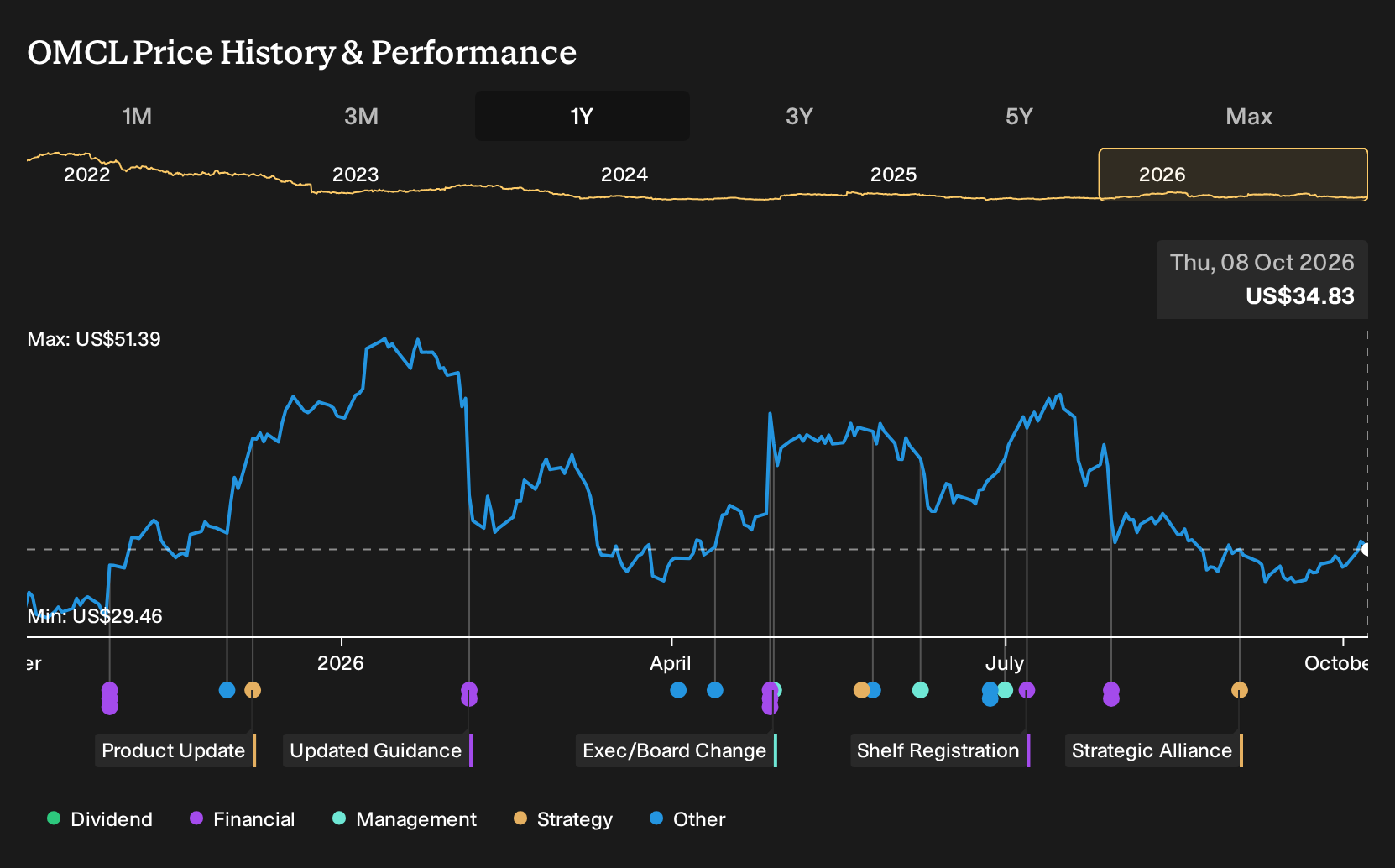
Uncover why Omnicell's fair value points to a 76% potential upside to its current price that could narrow quickly as expectations catch up.
Exploring Other Perspectives
One sharper risk in the alternate Omnicell story is buyer consolidation. The most cautious analysts were already assuming only 2.1% yearly revenue growth and earnings of about US$74.8 million by 2029, paired with a lower 33.6x P/E. That paints a more margin squeezed future, and the latest EBITDA guidance could push those views even further apart.
Explore 3 other Omnicell fair value estimates, including one that suggests it could be worth just $57.86!
Form Your Own Verdict
Disagree with existing narratives? Extraordinary investment returns rarely come from following the herd, so go with your instincts.
- A great starting point for your Omnicell research is our analysis highlighting 4 key rewards that could impact your investment decision.
- See our latest analysis for Omnicell. The report includes a comprehensive fundamental analysis summarized in a single visual, the Snowflake, making it easy to evaluate Omnicell's overall financial health at a glance.
Looking For More Investment Ideas Beyond Omnicell?
If Omnicell has sharpened your focus on pricing power, balance sheet strength, and earnings quality, it can be useful to line it up against other candidates with different strengths. A targeted stock screener helps you quickly spot businesses that better match the risk and return trade off you want.
- For investors who want income resilience, focus on companies with higher yields and sturdier payouts through the 8 dividend fortresses.
- If capital preservation matters most to you, narrow in on businesses with stronger financial footing using the list of solid balance sheet and fundamentals (25 results).
- When you are hunting for mispriced opportunities, cast a wider net across quality franchises trading below their implied worth via the 27 high quality undervalued stocks.
This article by Simply Wall St is general in nature. We provide commentary based on historical data and analyst forecasts only using an unbiased methodology and our articles are not intended to be financial advice. It does not constitute a recommendation to buy or sell any stock, and does not take account of your objectives, or your financial situation. We aim to bring you long-term focused analysis driven by fundamental data. Note that our analysis may not factor in the latest price-sensitive company announcements or qualitative material. Simply Wall St has no position in any stocks mentioned.
Have feedback on this article? Concerned about the content? Get in touch with us directly. Alternatively, email editorial-team@simplywallst.com