
What Wells Fargo (WFC)'s Fair Lending Probe Means For Shareholders
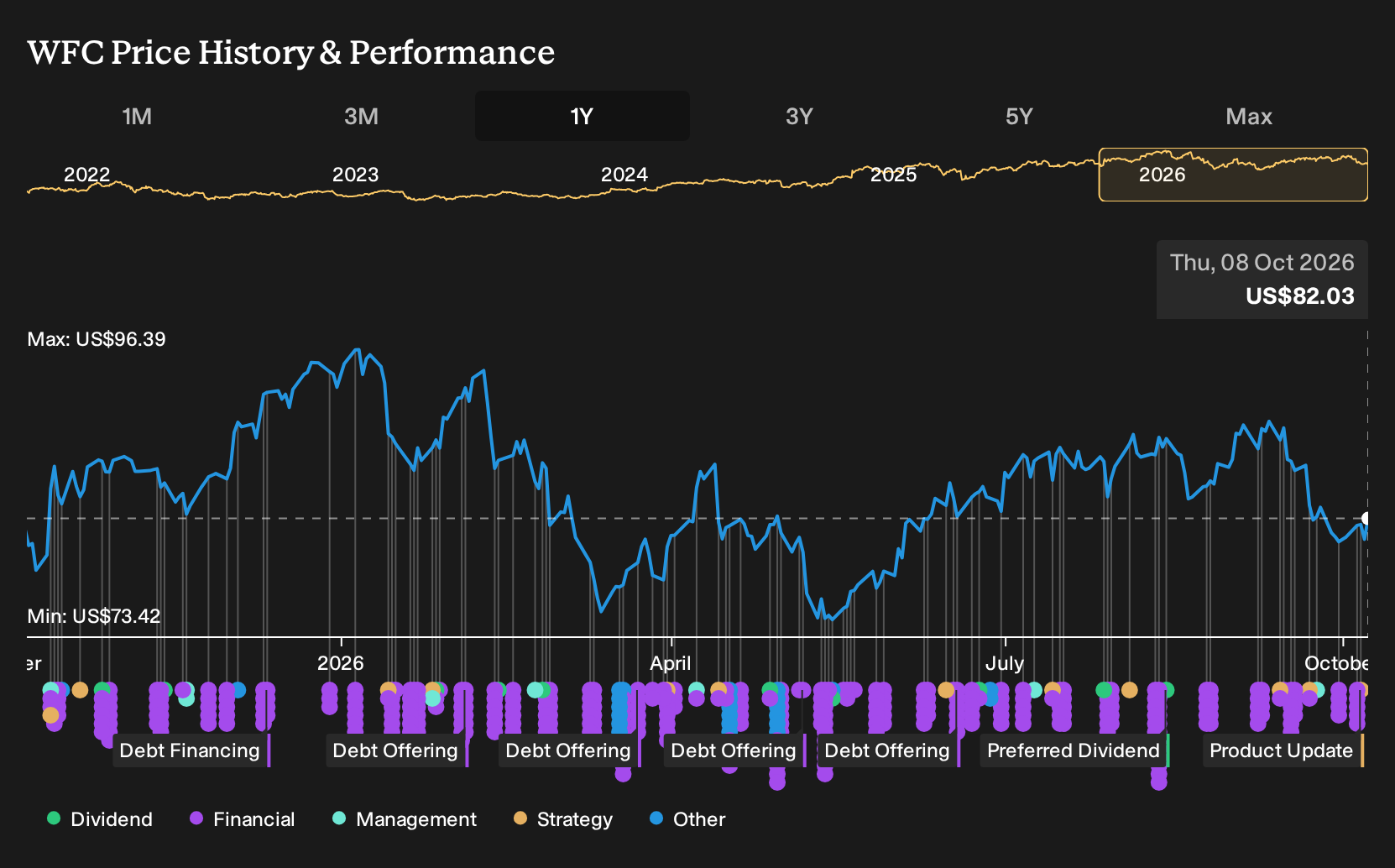
- In early October 2026, the U.S. Department of Housing and Urban Development began investigating Wells Fargo over past mortgage lending programs and whether efforts to support Black and other minority homeownership complied with fair-lending laws.
- The review raises questions about how potential legal findings, remediation costs and changes to mortgage practices could influence Wells Fargo's long term housing finance strategy and risk controls.
- We will now examine how the federal fair lending probe could reshape Wells Fargo's investment narrative around regulation, costs and growth.
Wells Fargo Investment Narrative Recap
To own Wells Fargo, you need to be comfortable with a large, regulated bank leaning on loan growth, fee businesses and cost control while net interest margin stays under pressure. The HUD fair lending probe sits alongside existing regulatory history and, in the near term, the biggest swing factor remains how funding costs and lower spread Markets balances affect net interest income.
The short term upside catalyst is still execution on balance sheet deployment, Corporate and Investment Banking expansion and efficiency work that keeps noninterest expense around the US$55.7b target. The HUD investigation mainly adds headline and potential compliance cost risk rather than changing those near term earnings drivers, unless it results in materially tighter mortgage rules.
The most relevant recent development here is not a headline grabbing product, but Wells Fargo’s continued build out of digital services such as the enhanced Mobile Card Design Studio and expanded ExpressSend access in the app. These moves reflect how the bank is trying to keep day to day customers more engaged with its ecosystem.
For you as a shareholder, that operational focus matters because the core thesis relies on growing fee income, scaling Wealth and Investment Management and supporting card economics after heavy 2025 to 2026 acquisition spending. Stronger digital usage can support those fee streams and retention, which sit alongside the fair lending review, margin pressure and Markets mix shift as key execution tests over the next few years.
Wells Fargo's narrative projects US$100.9b revenue and US$23.7b earnings by 2029, which aligns with analyst assumptions of 6.7% yearly revenue growth and an earnings increase of about US$2.1b from US$21.6b today.
Uncover why Wells Fargo's fair value indicates a 22% potential upside to its current price, which could narrow quickly.
Exploring Other Perspectives
The Simply Wall St Community adds two retail fair value estimates for Wells Fargo, stretching from about US$100.46 to US$119.22 per share. You are seeing only a small sample, yet that span already shows how far opinions can drift. Layer on the HUD probe, crypto liquidity talks with Payward and upcoming Q3 results, and you have multiple moving pieces to test your own view against.
Explore another Wells Fargo fair value estimate, including one that suggests it could be worth just $100.46!
The Verdict Is Yours
Don't just follow the ticker; dig into the data and build a conviction that's truly your own.
- A great starting point for your Wells Fargo research is our analysis highlighting 4 key rewards and 1 important warning sign that could impact your investment decision.
- See our latest analysis for Wells Fargo. The report includes a comprehensive fundamental analysis summarized in a single visual, the Snowflake, making it easy to evaluate Wells Fargo's overall financial health at a glance.
Looking for more Wells Fargo sized investment ideas?
If the Wells Fargo story has sharpened your thinking about risk, earnings power and regulation, it can be useful to test that framework on other businesses using the Simply Wall St Screener.
- For investors who want potential value combined with quality fundamentals, scan through our 27 high quality undervalued stocks and see which companies fit your risk and return checklist.
- If capital preservation and financial resilience sit high on your priority list, filter for sturdier balance sheets and steady cash profiles using the list of solid balance sheet and fundamentals (25 results) to widen your watchlist beyond Wells Fargo.
- For those who prefer a more cautious ride through the cycle, shortlist companies with more measured risk characteristics by checking the 31 resilient stocks with low risk scores and compare how their profiles differ from large banks.
This article by Simply Wall St is general in nature. We provide commentary based on historical data and analyst forecasts only using an unbiased methodology and our articles are not intended to be financial advice. It does not constitute a recommendation to buy or sell any stock, and does not take account of your objectives, or your financial situation. We aim to bring you long-term focused analysis driven by fundamental data. Note that our analysis may not factor in the latest price-sensitive company announcements or qualitative material. Simply Wall St has no position in any stocks mentioned.
Have feedback on this article? Concerned about the content? Get in touch with us directly. Alternatively, email editorial-team@simplywallst.com