
Should Google Nuclear Deal Require Action From Constellation Energy Stock Investors?
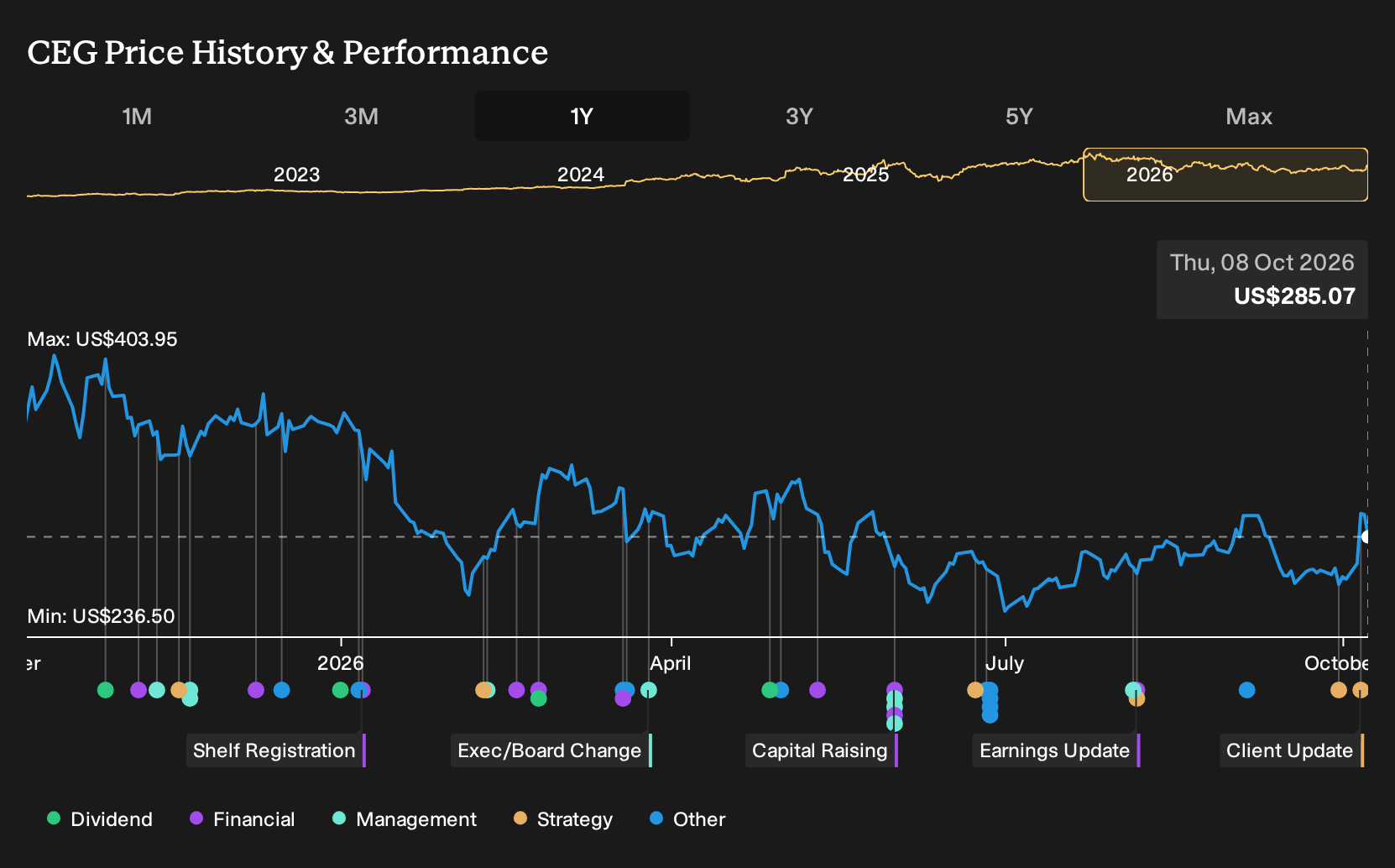
- On 6 October 2026, Google and Constellation Energy announced long duration power agreements that support 890 MW of new nuclear uprates and a further 2,700 MW of supply in PJM, underpinning more than US$4.3b of investment across 11 reactors in Illinois, Pennsylvania and New Jersey.
- The Google deal signals that large AI and data center customers are now directly funding nuclear efficiency upgrades, effectively turning Constellation Energy’s uprate program into a repeatable product that ties long term carbon free capacity to hyperscaler demand.
- Next, the focus turns to how Constellation Energy’s long dated Google nuclear contract could reshape its investment narrative around contracted earnings visibility.
Scan how the Google and Amazon nuclear deals with Constellation Energy compare with other grid and AI power plays by reviewing our hand-picked 43 power grid technology and infrastructure stocks
Constellation Energy Investment Narrative Recap
To own Constellation Energy, you need to be comfortable with a nuclear heavy business model that leans on long dated contracts, policy support and large corporate buyers to keep cash flows predictable. The Google agreement adds more contracted nuclear output and reinforces that data center demand is becoming central to the story.
Near term, the key swing factor is how consistently Constellation Energy converts this demand into similar long term deals while executing uprates and life extension projects on time and on budget. The biggest risk still sits with nuclear policy changes, state level credit roll offs and any cost creep that would pressure margins and limit financial flexibility.
The Google clean energy collaboration is the announcement that matters most for this catalyst set. It links 890 MW of new nuclear capacity and a further 2,700 MW of supply to specific pricing and terms for 15 to 20 years. That directly supports revenue visibility from a material slice of the fleet.
This structure also partially offsets future uncertainty around programs such as Illinois Zero Emissions Credits by anchoring some units with corporate contracts rather than state support. Execution risk is still real, including project timing and any new compliance requirements on uprated reactors, but the operational blueprint now looks clearer for how Constellation Energy might replicate this model with other large buyers.
What The Constellation Energy Consensus Story Is Really Pricing In
Constellation Energy's story in the analyst models is built around compounding revenue and thicker profit margins over several years, tied to long duration clean power deals like the Google contract. The sell side is not just sketching a loose narrative. The numbers are specific and they matter for how you judge the risk and payoff of a nuclear heavy utility that is courting AI data center demand.
Analysts are assuming Constellation Energy can lift its top line by 8.5% a year for the next three years while shifting profit margins from 11.1% today to 16.2% by around 2029. That would take earnings from US$3.5b now to US$6.5b, roughly a US$3.0b step up in profit that hinges on execution across nuclear uprates, life extensions and the integration of newly acquired assets. Those forecasts are not uniform, with the highest estimates at US$7.1b and the lowest at US$5.5b, so the Google nuclear deal is arriving into a framework that already assumes a wide range of outcomes.
Valuation work on Constellation Energy then layers these operating assumptions into a P/E story. To reach the current consensus price target of US$341.53 on a share price of US$257.49, analysts are effectively asking investors to underwrite a 2029 setup where revenue hits US$39.9b, earnings come in at US$6.5b and the stock trades on 28.3x those profits. That multiple would sit above the 19.6x P/E quoted for the wider US electric utilities peer group in the same set of estimates, so investors are paying up for the combination of contracted carbon free supply and growth in earnings tied to AI related power demand.
Constellation Energy's narrative projects US$39.9b revenue and US$6.5b earnings by 2029. This lines up with assumed 8.5% yearly revenue growth and an earnings increase of about US$3.0b from US$3.5b today.
Contracted nuclear deals like the Google agreement fit directly into this framework by potentially supporting both the revenue growth path and the margin lift that analysts have assumed. Long dated power purchase agreements with investment grade buyers can improve visibility on cash generation, which feeds into confidence around future earnings per share and supports arguments for a premium P/E. If Constellation Energy can replicate the Google structure with other data center operators and large industrial customers, those incremental contracts could make the consensus path toward US$6.5b in earnings feel more grounded in signed cash flows rather than just modelled scenarios.
None of this removes the policy and cost risks attached to nuclear heavy portfolios. Changes to state level support programs such as zero emissions credits, new compliance rules on uprated reactors or higher than expected capex on life extension projects could all compress the 16.2% margin assumption that underpins the 2029 earnings figure. The tension for readers sizing up Constellation Energy is whether the Google deal and similar data center linked agreements do enough to offset those uncertainties by hard wiring more of the future earnings profile into long term contracts.
Uncover why Constellation Energy's fair value indicates a 20% potential upside to its current price, which could narrow quickly.
Exploring Other Perspectives
One alternate view focuses less on data center contracts and more on pressure from distributed energy, with the most bearish analysts sketching a Constellation Energy story where 2029 earnings reach about US$5.5b on roughly US$35.3b of revenue. That is a much cooler outlook than consensus and it was set before the Google nuclear deal, so you should expect these opinions to evolve as new information lands and weigh several angles for yourself.
Explore 7 other Constellation Energy fair value estimates, including one that suggests it could be worth just $290.00.
Form Your Own Verdict
Disagree with existing narratives? Extraordinary investment returns rarely come from following the herd, so go with your instincts.
- A great starting point for your Constellation Energy research is our analysis highlighting 3 key rewards and 2 important warning signs that could impact your investment decision.
- See our latest analysis for Constellation Energy. The report includes a comprehensive fundamental analysis summarized in a single visual, the Snowflake, making it easy to evaluate Constellation Energy's overall financial health at a glance.
Looking For More Investment Ideas Beyond Constellation Energy?
If the Constellation Energy story has sharpened your thinking about long term contracts, capital intensity and risk, you can use that same framework to hunt for other opportunities on the Simply Wall St Screener. You can filter for different styles of companies and let the data surface ideas that match how you prefer to invest.
- If you want to focus on potential mispricings with solid fundamentals, start by scanning our 27 high quality undervalued stocks and see which businesses line up with your expectations on cash generation and balance sheet strength.
- If dependable income is your priority, shortlist candidates through the 8 dividend fortresses and compare payout profiles, yields and consistency across multiple sectors.
- If capital preservation matters most to you, narrow the field using the 31 resilient stocks with low risk scores and concentrate your research on companies with steadier financial and risk scores.
This article by Simply Wall St is general in nature. We provide commentary based on historical data and analyst forecasts only using an unbiased methodology and our articles are not intended to be financial advice. It does not constitute a recommendation to buy or sell any stock, and does not take account of your objectives, or your financial situation. We aim to bring you long-term focused analysis driven by fundamental data. Note that our analysis may not factor in the latest price-sensitive company announcements or qualitative material. Simply Wall St has no position in any stocks mentioned.
Have feedback on this article? Concerned about the content? Get in touch with us directly. Alternatively, email editorial-team@simplywallst.com