
World Gold Council: Global central banks continued the summer gold buying boom in August, net gold purchases reached 39 tons
The Zhitong Finance App learned that by the end of September, the People's Bank of China's gold reserves were 2,409.59 tons, an increase of about 23.02 tons over the previous month, increasing its gold holdings for 23 consecutive months. In August, global central banks continued to maintain the pace of gold purchases, with a net purchase volume of 39 tons. Among them, China (20 tons) ranked first, followed by Uzbekistan and Poland (8 tons each). Russia was the largest net seller in August (6 tons), followed by Jordan (3 tons). From January to August of this year, the central banks reported a total purchase volume of about 170 tons.
Global central banks report monthly gold purchase activity (tons)

Looking at the total amount of funds purchased by central banks in August in a broader context, an analysis of the gold purchase situation reported by central banks from 2016 to 2025 shows that there was a certain degree of seasonal change in gold purchase activity, but the differences between years are still large. Increased economic or geopolitical uncertainty may be one of the factors, but further analysis is needed to see if there are strong and continuing potential drivers.
Purchase activity is usually strongest in June and September-October
Average reported net purchase volume for each month from 2016 to 2025

The structure and total volume of gold purchases in August are also noteworthy — demand for gold purchases was once again dominated by central banks that have implemented long-term plans to increase their gold holdings, which shows that the central bank's gold purchase activity continues to reflect its long-term reserve targets, while monthly fluctuations are more likely to reflect differences in implementation, market conditions, and liquidity requirements among countries.
Gold purchase trends by central banks
In August, the National Bank of Poland continued its gold buying trend (8 tons). From January to August, Poland purchased a total of 98 tons of gold, which still ranks first in the world in terms of gold purchase volume.
The People's Bank of China purchased gold (20 tons) for the 22nd month in a row. In the first eight months of this year, China reported a cumulative increase of 80 tons of gold reserves, second only to Poland in terms of volume of gold purchases.
The Central Bank of Uzbekistan bought 8 tons of gold this month. In January-August of this year, the amount of gold purchased was close to 50 tons.
The Central Bank of Turkey purchased 3 tons of gold in August, and had previously been selling net gold for three consecutive months. From January to August, Turkey reported a net sale of 82 tons of gold.
In August, each central bank reported gold purchase activity, the size of each central bank's gold reserves as of August, and its share in total foreign exchange reserves
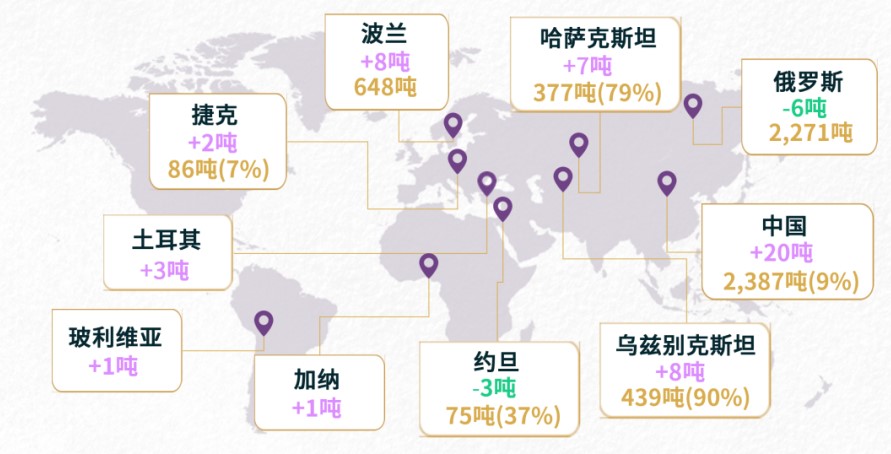
The Central Bank of Russia further reduced its holdings and sold 6 tons of gold net in August. In the first eight months, Russia had sold a total of 56 tons of gold.
The Central Bank of Jordan also sold gold in August, reducing its holdings by 3 tons. As of August at the beginning of the year, Jordan had purchased 2 tons of gold.
From the beginning of 2026 to the end of August, the central bank's gold purchase activities
Net purchases and sales volume of each central bank (tons)

Central banks manage gold in a new way
The World Gold Council said that central banks are taking a more active approach to managing gold reserves. On September 2, the Dutch central bank announced that it had transferred 86 tons of gold from New York and Ottawa to London with the aim of improving the liquidity and tradability of its gold reserves. In the past few years, there have also been reports that many central banks have shipped gold back to the country or readjusted storage locations. In 2025, the Bank of France also carried out a similar operation to improve the tradability of its gold reserves.