
Following United And WestJet Deals, Is FTAI Aviation (FTAI) Still Undervalued?
FTAI Aviation (FTAI) just linked two big moves. A multi year engine Maintenance, Repair and Exchange deal with United Airlines now sits alongside a 27 aircraft purchase from WestJet.
Despite these two announcements, FTAI Aviation’s recent share price performance has cooled, with the stock down 13% over the past month and 25% over the last quarter. However, long term total shareholder return remains very large over five years, suggesting strong underlying compounding so far.
Scan beyond FTAI Aviation and see which peers are quietly building similar engine leasing and MRO scale with the hand picked list of solid balance sheet and fundamentals (25 results).
So after a sharp pullback and two sizeable commitments in engines and aircraft, does FTAI Aviation still offer an attractive balance of risk and potential reward at US$171, or has the easy upside already been captured?
Most Popular Narrative: 24% Undervalued
FTAI Aviation’s most followed narrative pegs fair value at $225.05 a share against the last close of $171.06, which frames today’s pullback as a gap between valuation work and where the market is currently pricing the business.
FTAI Aviation Ltd. is a specialized aviation platform focused on commercial jet engine ownership, maintenance, and leasing, with a growing emphasis on aftermarket aerospace products (MRE – Maintenance, Repair & Exchange). The company is undergoing a strategic pivot from capital-intensive leasing toward higher-margin, asset light aftermarket services, leveraging its expertise in mid-life narrowbody engines (CFM56, V2500).
See why 6 investors see FTAI Aviation as 24% undervalued.
According to kapirey, the narrative hinges on a few key pieces of evidence. Earnings are forecast to grow 37.8% per year, while revenue is projected to rise 27.9% annually, both ahead of the wider US market. At the same time, the stock is trading 66.3% below an estimate of future cash flow value of $506.99 per share, and below a user-assessed fair value of $225.05, which together paint a picture of a business priced well under the cash flow and narrative estimates that have been built out.
Those growth forecasts are paired with a very high forecast Return on Equity of 73.4% in three years and a history of very large earnings expansion over the past five years, where profit has risen 66.3% a year. The memo also highlights that FTAI Aviation has already moved from losses to profitability over that period, while shifting its focus toward higher margin aerospace products and asset light capital partnerships, rather than purely balance sheet heavy leasing.
There are clear caveats in the same storyline. Profit margins have compressed from 19.4% to 15.3%, earnings growth over the most recent year of 14.7% is well below that five year pace, and that latest result did not keep up with the 28.9% growth seen across the Aerospace & Defense industry. Reported Return on Equity of 122.84% is described as outstanding but skewed by high leverage, debt is not well covered by operating cash flow, and all liabilities currently come from higher risk funding sources rather than customer deposits.
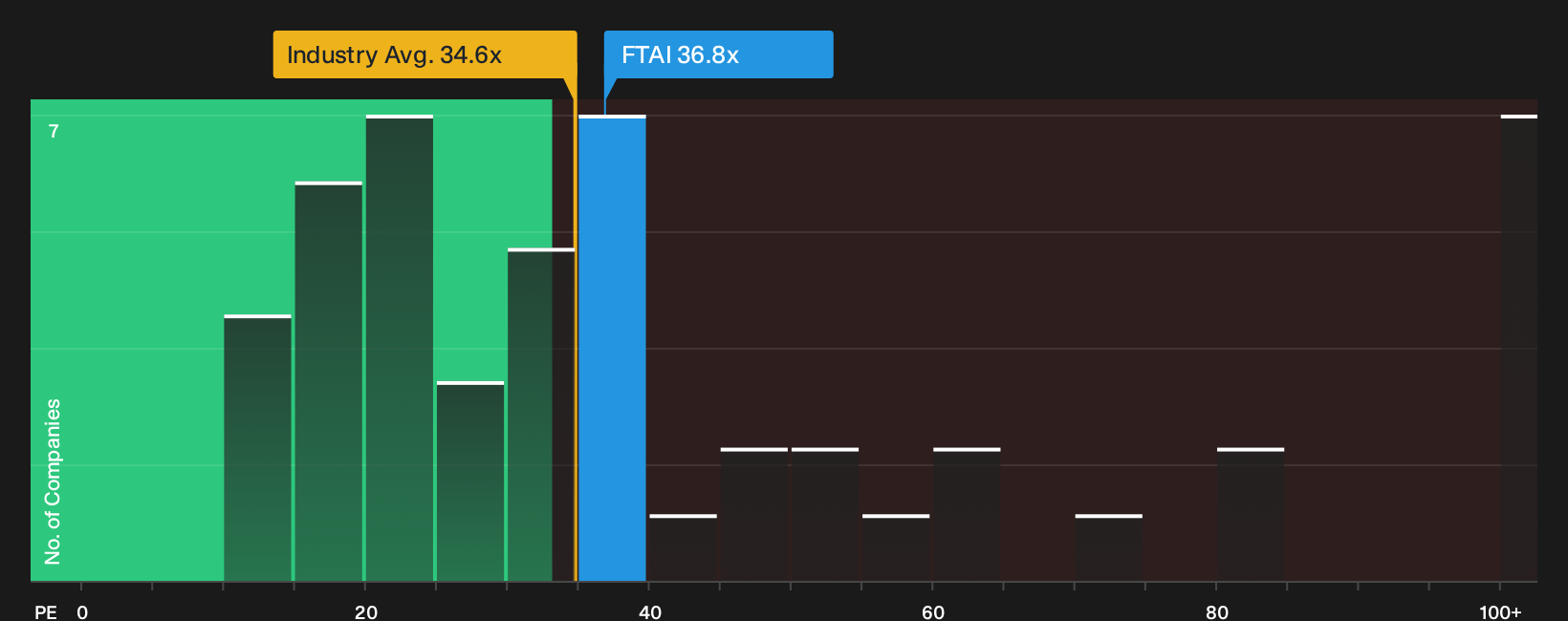
On price, the memo accepts that the market is applying a rich P/E of 36.8x, which is higher than both the peer average of 21x and the broader US Aerospace & Defense sector on 34.6x. The narrative counters this by pointing out that the fair P/E derived from the SWS model is 55.3x, so the present earnings multiple sits well below the level that regression analysis suggests could be justified for this earnings and growth profile. In that framing, the premium to peers is treated as the market partially, but not fully, pricing in the growth and profitability assumptions embedded in the narrative work.
Result: Fair Value of $225.05 (UNDERVALUED)
Still, the whole FTAI Aviation story leans heavily on aging CFM56 and V2500 fleets and on managing a sizeable debt load without a stumble in funding conditions.
Find out about the key risks to this FTAI Aviation narrative.
Another View On FTAI Aviation’s Valuation
The memo focuses on value relative to cash flows, yet the current P/E of 36.8x tells a different story. That figure sits well above peers on 21x and the wider US Aerospace & Defense group on 34.6x. It also remains below a fair ratio of 55.3x that regression work suggests the market could move toward. For an investor, that mix points to potential upside if the market moves toward the fair ratio, but also downside risk if sentiment instead moves back toward sector and peer averages. Which side of that spread do you think will be more influential over the next few years?
See what the numbers indicate about this price in our valuation breakdown See what the numbers say about this price — find out in our valuation breakdown.
Next Steps
Curious whether this mix of optimism and concern lines up with your own instincts on FTAI Aviation? Act quickly, review the key issues for yourself, and ground your view in the 3 key rewards and 2 important warning signs.
Looking for more investment ideas beyond FTAI Aviation?
If FTAI Aviation has sharpened your interest in focused, thesis driven investing, do not stop here. Put that momentum to work by scanning fresh opportunities that match your risk, return, and income goals.
- Chase potential mispricings by scanning companies that screen as quality yet priced as bargains through the 27 high quality undervalued stocks.
- Build a sturdier core by focusing on resilient businesses with healthier finances using the 31 resilient stocks with low risk scores.
- Hunt for lesser known opportunities with solid fundamentals using the 20 high quality undiscovered gems.
This article by Simply Wall St is general in nature. We provide commentary based on historical data and analyst forecasts only using an unbiased methodology and our articles are not intended to be financial advice. It does not constitute a recommendation to buy or sell any stock, and does not take account of your objectives, or your financial situation. We aim to bring you long-term focused analysis driven by fundamental data. Note that our analysis may not factor in the latest price-sensitive company announcements or qualitative material. Simply Wall St has no position in any stocks mentioned.
Have feedback on this article? Concerned about the content? Get in touch with us directly. Alternatively, email editorial-team@simplywallst.com