
Union Pacific Stock And Other US Companies Facing New Union Pressure
Union-linked stocks suddenly sit right in the crosshairs of US politics, with Ohio’s tight races putting tariffs, factory jobs, and labor rules back on the front page. That mix of policy risk and worker power can punish some businesses and create pricing power or protection for others. This piece explains what that shift could mean and walks through three stocks exposed to these headlines that investors are watching closely.
The stocks covered below are only a sample, and the full screen pulled out 10 more US union linked and labor advantaged companies with similarly rich storylines that are not covered in this article. If you want to identify potential opportunities that fit your own thesis, head straight to the US Union-Linked and Labor-Advantaged Companies screener to filter, analyze, and focus on the ideas that match your highest conviction plays.
Columbus McKinnon (CMCO)
Columbus McKinnon plugs directly into the union-linked theme because its hoists, conveyors, and motion systems sit on factory floors where skilled trades and collective bargaining often shape costs, productivity, and job security in the US industrial heartland.
Columbus McKinnon generates about US$1.5b in Machinery & Industrial Equipment revenue and has a market value of roughly US$461 million, so investors are looking at a mid cap industrial that turns union-relevant manufacturing and material-handling projects into sales.
Columbus McKinnon gives this union-focused screen real industrial heft, since its equipment is installed in plants where wage agreements, shifts, and safety rules all influence how often cranes lift and conveyors run.
"If management cross sells Crosby consumables through Columbus McKinnon's EMEA and Latin America channels, and pushes Columbus McKinnon hoists and automation through Kito's strong Asia Pacific footprint, that revenue synergy is the single largest swing factor on the upside. Synergy capture is the main one; management guides to $70 million net by year three, but integration of a company this size, with overlapping facilities and different operating cultures, frequently runs over time and under target."
What happens to margins if one quiet pressure on costs and capacity inside those union-heavy plants shifts even slightly in either direction?
That quiet shift in bargaining power and integration risk is exactly what the full narrative for Columbus McKinnon unpacks, including where union leverage could be masking upside or capping returns.

Centuri Holdings (CTRI)
Centuri Holdings plugs directly into the union-linked utility theme because its crews build and maintain regulated gas and electric networks where wage agreements, safety rules, and long-term labor commitments often set the economic terms for essential infrastructure work.
Centuri Holdings runs gas and electric utility infrastructure services across North America, with about US$1.6b from U.S. Gas, US$878 million from Union Electric, US$654 million from Non-Union Electric, and US$293 million from Canadian Operations, and a market value near US$2.1b.
"Growing utility infrastructure investment tied to regulatory-driven gas pipeline replacement, such as PHMSA Gas Mega Rule projects, is expanding high-visibility, multi-year workloads that may support steady revenue expansion and structurally higher base earnings."
What really moves the needle for Centuri Holdings now is how one unresolved pressure on margins and contract quality interacts with that backlog-heavy workload.
That pressure point is where full narrative for Centuri Holdings outlines how Centuri Holdings’ union exposure, contract mix, and capital plans could be quietly reshaping its risk reward profile.

Union Pacific (UNP)
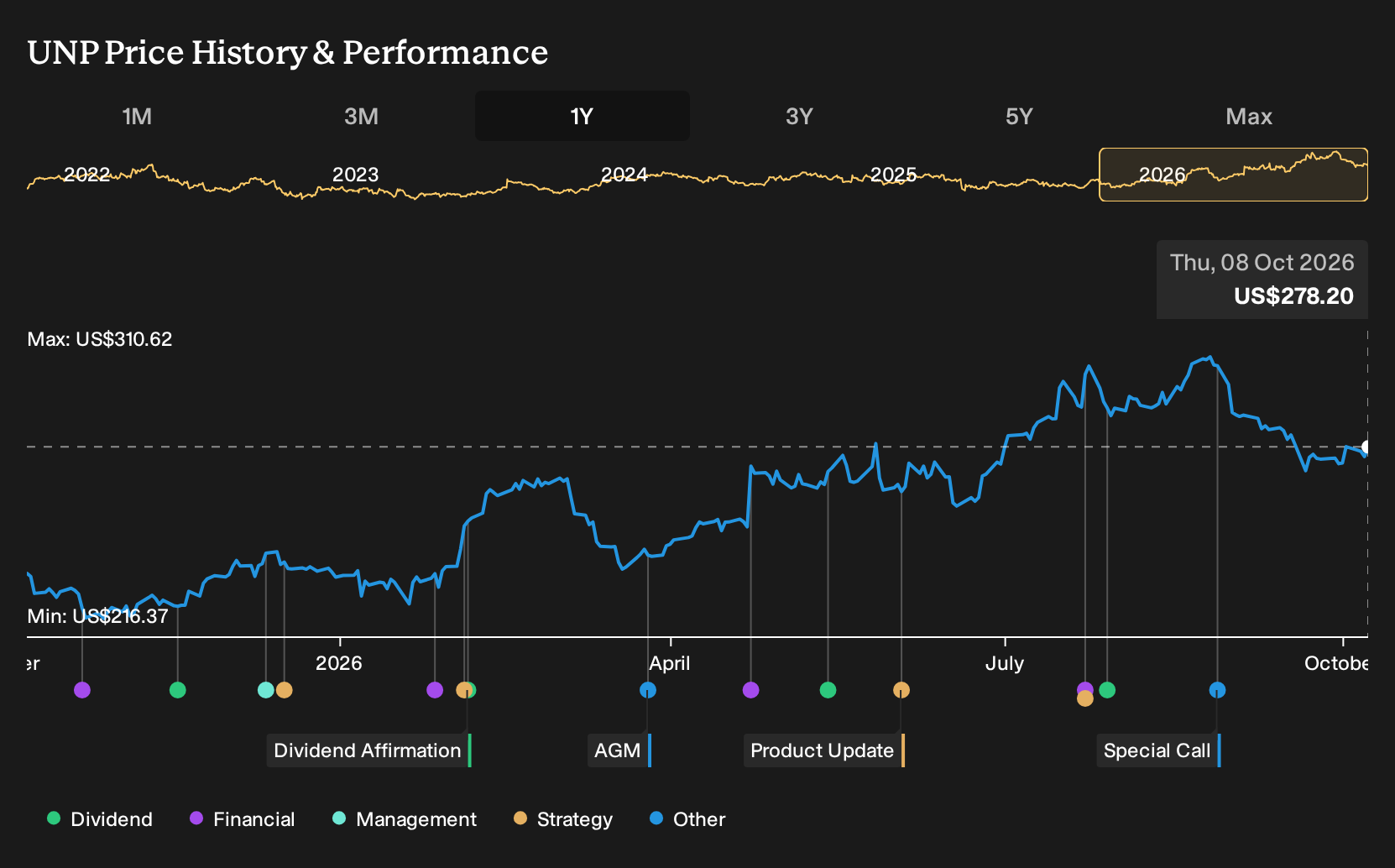
Union Pacific is a freight heavyweight in a heavily union-influenced sector, moving everything from grain and autos to chemicals across its rail network, with all US$25.4b in revenue tied to the railroad segment and a market value around US$163.2b.
For investors watching how union power interacts with essential infrastructure, Union Pacific turns that theme into something very concrete, because every wage deal, work rule, and network decision flows through a single, sprawling freight railroad that touches core parts of the US economy.
"Domestic intermodal remains a key focus, with four consecutive record quarters in both volume and revenue and expectations for a fifth, and continued truck to rail conversion campaigns that could extend volume growth and support freight revenue and earnings."
The real swing factor now is how one largely unseen labor and merger related pressure shapes the balance between higher pay, service quality, and long term margins.
That labor and merger pressure is exactly where the full narrative for Union Pacific shows how Union Pacific’s union deals, service quality, and capital plans could be quietly decoupling near term risk from long term opportunity.
Seeking Alternatives Before The Crowd?
Fresh themes keep breaking out while older ideas lose momentum and get caught by the crowd. Scan what is still under the radar for now and act now.
- Target high-yield income plays that can keep cash flowing while prices swing by reviewing the curated 8 dividend fortresses before yields start dropping.
- Race toward faster growth potential by checking the hand picked 37 AI small caps that could be building real earnings power behind today’s AI momentum.
- Strengthen your downside protection by filtering through the carefully selected 31 resilient stocks with low risk scores before those resilient balance sheets get fully priced in.
This article by Simply Wall St is general in nature. We provide commentary based on historical data and analyst forecasts only using an unbiased methodology and our articles are not intended to be financial advice. It does not constitute a recommendation to buy or sell any stock, and does not take account of your objectives, or your financial situation. We aim to bring you long-term focused analysis driven by fundamental data. Note that our analysis may not factor in the latest price-sensitive company announcements or qualitative material. Simply Wall St has no position in any stocks mentioned.
Have feedback on this article? Concerned about the content? Get in touch with us directly. Alternatively, email editorial-team@simplywallst.com