
How Revenue Decline Fears At United Therapeutics Stock Have Changed Its Investment Story
- United Therapeutics is facing analyst expectations for a 3.2% revenue decline over the next 12 months, along with weaker adjusted operating and free cash flow margins compared with five years ago.
- The combination of softer top line expectations and shrinking profitability metrics points to mounting pressure on United Therapeutics's cost base and operational efficiency, rather than a single product issue.
- We will explore how United Therapeutics's investment narrative is challenged by the expected 3.2% revenue decline and weaker profitability benchmarks.
Broaden your watchlist beyond United Therapeutics by scanning a curated set of resilient companies in our 31 resilient stocks with low risk scores, which may better align with your preferred risk profile.
United Therapeutics Investment Narrative Recap
To own United Therapeutics, you need to be comfortable with a story built on pulmonary drugs and a long runway of high science projects in organ manufacturing and advanced delivery platforms. The current expectation for a 3.2% revenue decline plus softer profitability means the near term hinge is execution on costs while keeping core therapies competitive against rival PAH treatments.
The biggest near term catalyst remains progress on late stage studies such as TETON for Tyvaso in idiopathic pulmonary fibrosis, because those data shape how credible the broader growth pipeline feels. The main risk is that rising competition and heavier R&D needs keep pressuring margins just as top line momentum cools, limiting flexibility.
Given this backdrop, the most relevant piece of the story tied to these margin and revenue concerns is the broader Tyvaso program and its TETON Phase III trials in idiopathic pulmonary fibrosis. These studies directly relate to how effectively United Therapeutics can extend the life of its pulmonary franchise and justify ongoing investment intensity in that area.
Strong TETON results that support a new indication could help offset pressure from a 3.2% revenue decline and weaker cash generation, because the same core platform would reach more patients. If outcomes or timing disappoint, the strain from lower adjusted operating and free cash flow margins becomes harder to absorb while the firm continues to fund organ manufacturing and xenotransplant projects.
United Therapeutics' narrative projects US$4.3b revenue and US$1.8b earnings by 2029. This implies 11.0% yearly revenue growth and an earnings increase of about US$500m from US$1.3b today.
Discover why United Therapeutics' fair value suggests a potential 20% upside from its current price before the market closes the gap.
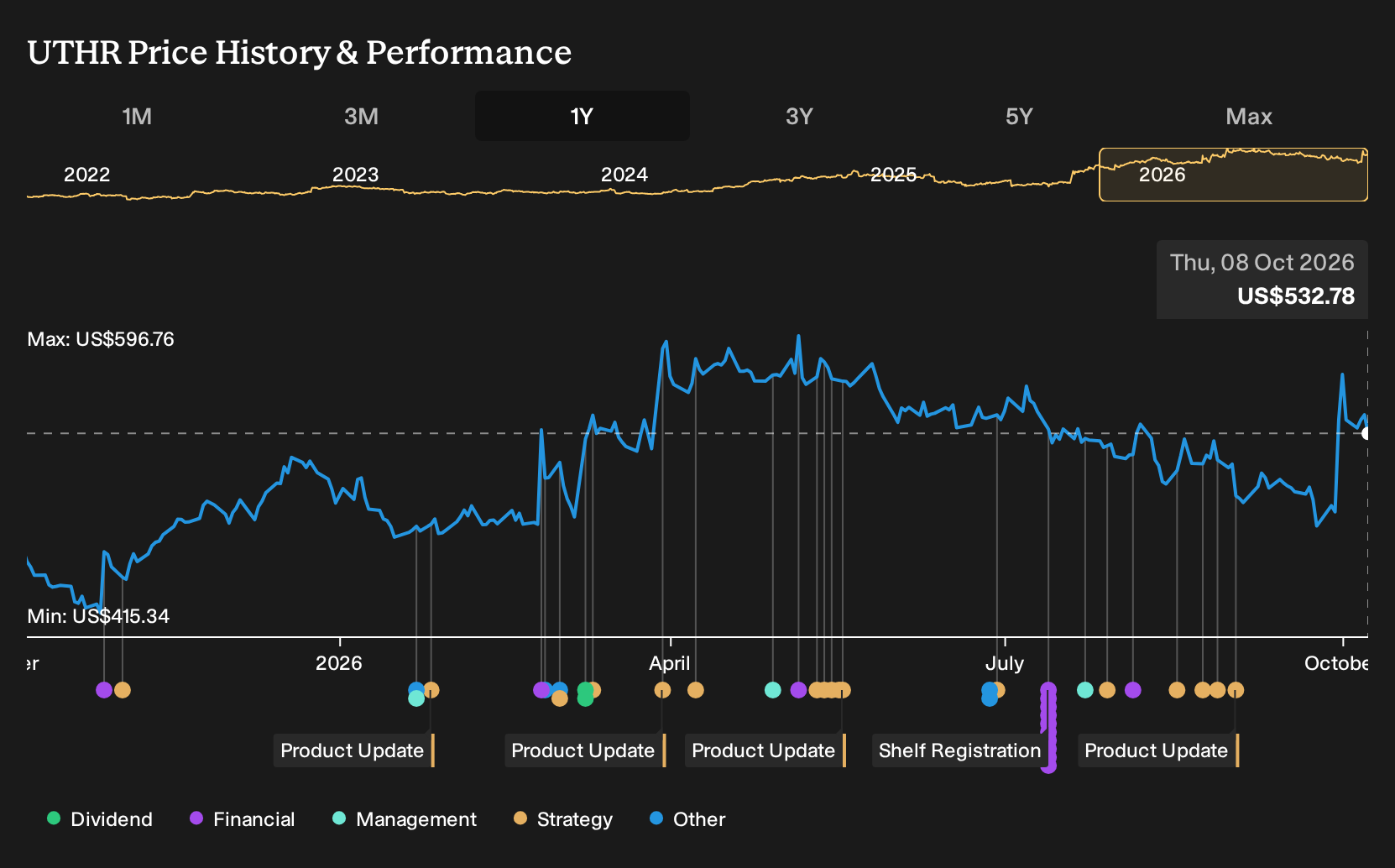
Exploring Other Perspectives
For a very different angle on United Therapeutics, bullish analysts focus on the fibrosis and organ programs as the real story. Before this revenue slowdown, the most optimistic group was penciling in US$5.1b of 2029 revenue and US$2.4b of earnings. That is far above consensus, and these views may shift as the new data sink in.
Explore 2 other United Therapeutics fair value estimates, including one that suggests up to 270% upside from the current price!
The Verdict Is Yours
Disagree with existing narratives? Extraordinary investment returns rarely come from following the herd, so trust your own research and judgment.
- A great starting point for your United Therapeutics research is our analysis highlighting 3 key rewards that could impact your investment decision.
- See our latest analysis for United Therapeutics. The report includes a comprehensive fundamental analysis summarized in a single visual, the Snowflake, making it easy to evaluate United Therapeutics' overall financial health at a glance.
Looking For More Investment Ideas Beyond United Therapeutics?
United Therapeutics may be the focal point today, but your portfolio is rarely about a single ticker. To broaden your opportunity set, use the Simply Wall St Screener to filter for other businesses that better fit your goals on quality, income, or risk.
- If you want potential mispricing combined with business strength, start with a focused group of 27 high quality undervalued stocks that may warrant a closer look on fundamentals.
- For investors who care most about durability and balance sheet strength, consider companies from our list of solid balance sheet and fundamentals (25 results) as possible anchors for a more resilient portfolio.
- If you are hunting for under-followed opportunities, widen your horizon with a curated pool of 20 high quality undiscovered gems that many investors may not be watching yet.
This article by Simply Wall St is general in nature. We provide commentary based on historical data and analyst forecasts only using an unbiased methodology and our articles are not intended to be financial advice. It does not constitute a recommendation to buy or sell any stock, and does not take account of your objectives, or your financial situation. We aim to bring you long-term focused analysis driven by fundamental data. Note that our analysis may not factor in the latest price-sensitive company announcements or qualitative material. Simply Wall St has no position in any stocks mentioned.
Have feedback on this article? Concerned about the content? Get in touch with us directly. Alternatively, email editorial-team@simplywallst.com