
Meridian Energy (NZSE:MEL) Waitaki Upgrade Puts Its Valuation Back In Focus
Meridian Energy (NZSE:MEL) is committing between NZ$440 million and NZ$510 million over the next decade to comprehensively upgrade its 92 year old Waitaki hydro power station in New Zealand.
At a share price of NZ$5.44, Meridian Energy has seen short term share price gains with a 1 month return of 2.26%. Over the same period, the 90 day share price return has declined 4.06% and the 1 year total shareholder return has fallen 5.23%, while the 3 and 5 year total shareholder returns of 19.01% and 36.57% indicate steadier longer term momentum.
Scan how Meridian Energy’s hydro upgrade fits into the wider clean power theme by comparing it with a hand picked group of 43 power grid technology and infrastructure stocks that could benefit from similar investment tailwinds.
Short term gains and softer 12 month returns leave Meridian Energy at an interesting crossroads. Are investors reacting to the Waitaki upgrade story, or simply rotating sentiment around the stock? And how does the current price compare with the company’s fundamentals?
Preferred P/E of 110.8x for Meridian Energy: Is it justified?
Meridian Energy’s latest close of NZ$5.44 lines up with a very high P/E of 110.8x, which points to a rich valuation compared with peers and the wider renewable energy space. For anyone watching the Waitaki upgrade story, that P/E is the market’s shorthand for how much future earnings strength is already baked into the share price.
The P/E ratio compares what investors pay for each NZ$1 of earnings. For a generator retailer like Meridian Energy, that matters because earnings can swing with hydrology, power prices, and investment cycles, so a high P/E implies investors are comfortable paying up relative to today’s profit base.
That comfort shows up in the contrasts. MEL is described as expensive on a 110.8x P/E versus the global renewable energy industry average of 14.8x, and also when stacked against a peer average of 27.5x. The estimated fair P/E of 34.4x is far lower than where the shares trade, which signals a steep premium the market could eventually reassess if expectations do not match outcomes.
Explore the SWS fair ratio for Meridian Energy.
Result: Price-to-Earnings of 110.8x (OVERVALUED)
Still, the Waitaki upgrade story relies on smooth project delivery and stable hydrology, while any earnings disappointment could test market patience with Meridian Energy’s premium P/E.
Find out about the key risks to this Meridian Energy narrative.
Another View On Meridian Energy’s Value
The rich 110.8x P/E paints Meridian Energy as expensive, yet the SWS DCF model points a different way. At NZ$5.44, the stock sits below an estimated future cash flow value of NZ$9.42, which implies a wide gap between earnings based pricing and cash flow expectations. Which signal should carry more weight for you?
Look into how the SWS DCF model arrives at its fair value.
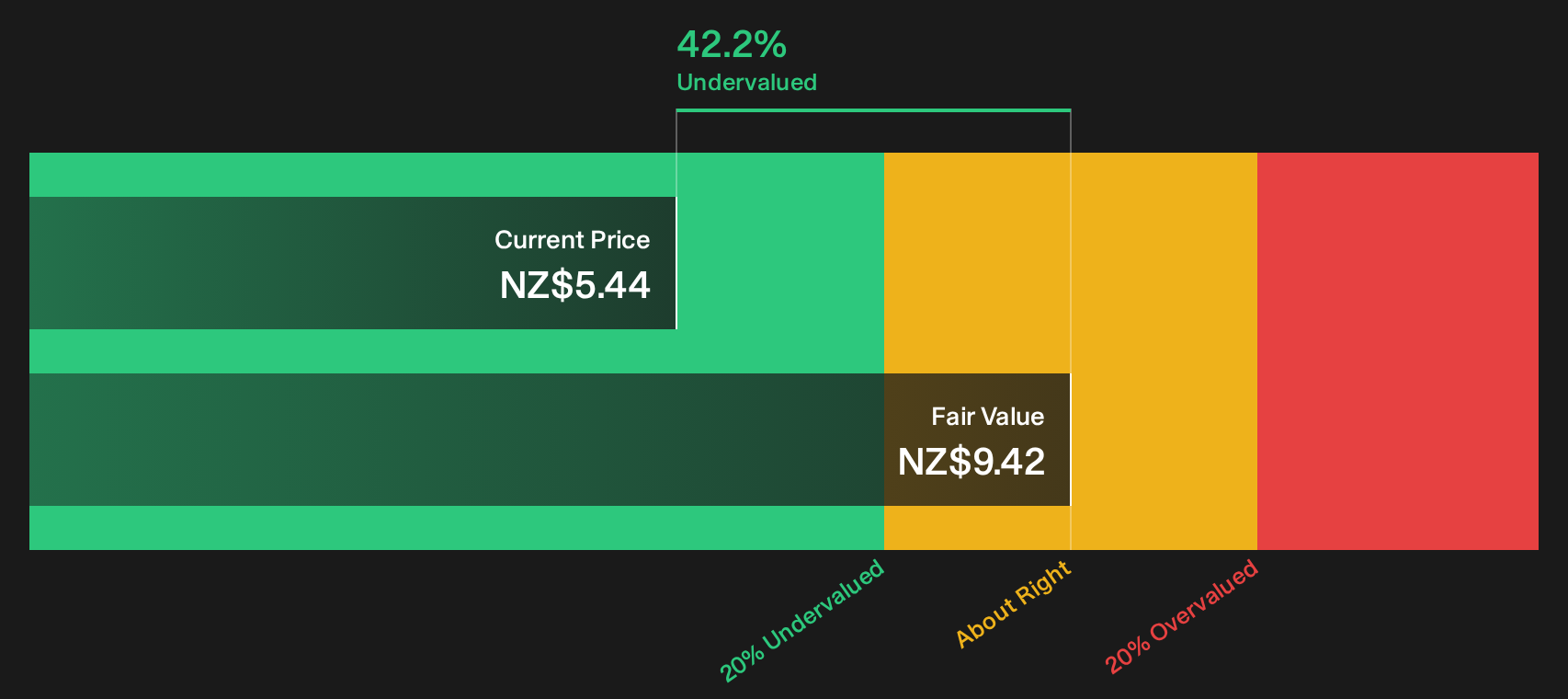
Simply Wall St performs a discounted cash flow (DCF) on every stock in the world every day (check out Meridian Energy for example). We show the entire calculation in full. You can track the result in your watchlist or portfolio and be alerted when this changes, or use our stock screener to discover 180 high quality undervalued stocks. If you save a screener we even alert you when new companies match - so you never miss a potential opportunity.
Next Steps
Mixed signals around Meridian Energy’s valuation and outlook do not have to leave you on the fence, especially when both risks and rewards are in play. Take a few minutes to review the data, pressure test your own thesis, and see how your conclusion lines up with the 3 key rewards and 1 important warning sign
Looking for more Meridian Energy sized investment ideas?
If Meridian Energy has sharpened your focus on pricing and quality, do not stop here. Broaden your watchlist with a few targeted shortlists that surface very different types of opportunities.
- Target resilience first and give yourself a calmer ride by scanning companies in the 225 resilient stocks with low risk scores.
- Hunt for strong businesses that the market might be overlooking by pulling up the 619 high quality undiscovered gems.
- Prioritise financial strength and reduce nasty surprises by filtering contenders through the list of solid balance sheet and fundamentals (206 results).
This article by Simply Wall St is general in nature. We provide commentary based on historical data and analyst forecasts only using an unbiased methodology and our articles are not intended to be financial advice. It does not constitute a recommendation to buy or sell any stock, and does not take account of your objectives, or your financial situation. We aim to bring you long-term focused analysis driven by fundamental data. Note that our analysis may not factor in the latest price-sensitive company announcements or qualitative material. Simply Wall St has no position in any stocks mentioned.
Have feedback on this article? Concerned about the content? Get in touch with us directly. Alternatively, email editorial-team@simplywallst.com