
Cerebras Stock Has Been a Bust Since Its IPO. That Could Be About to Change.
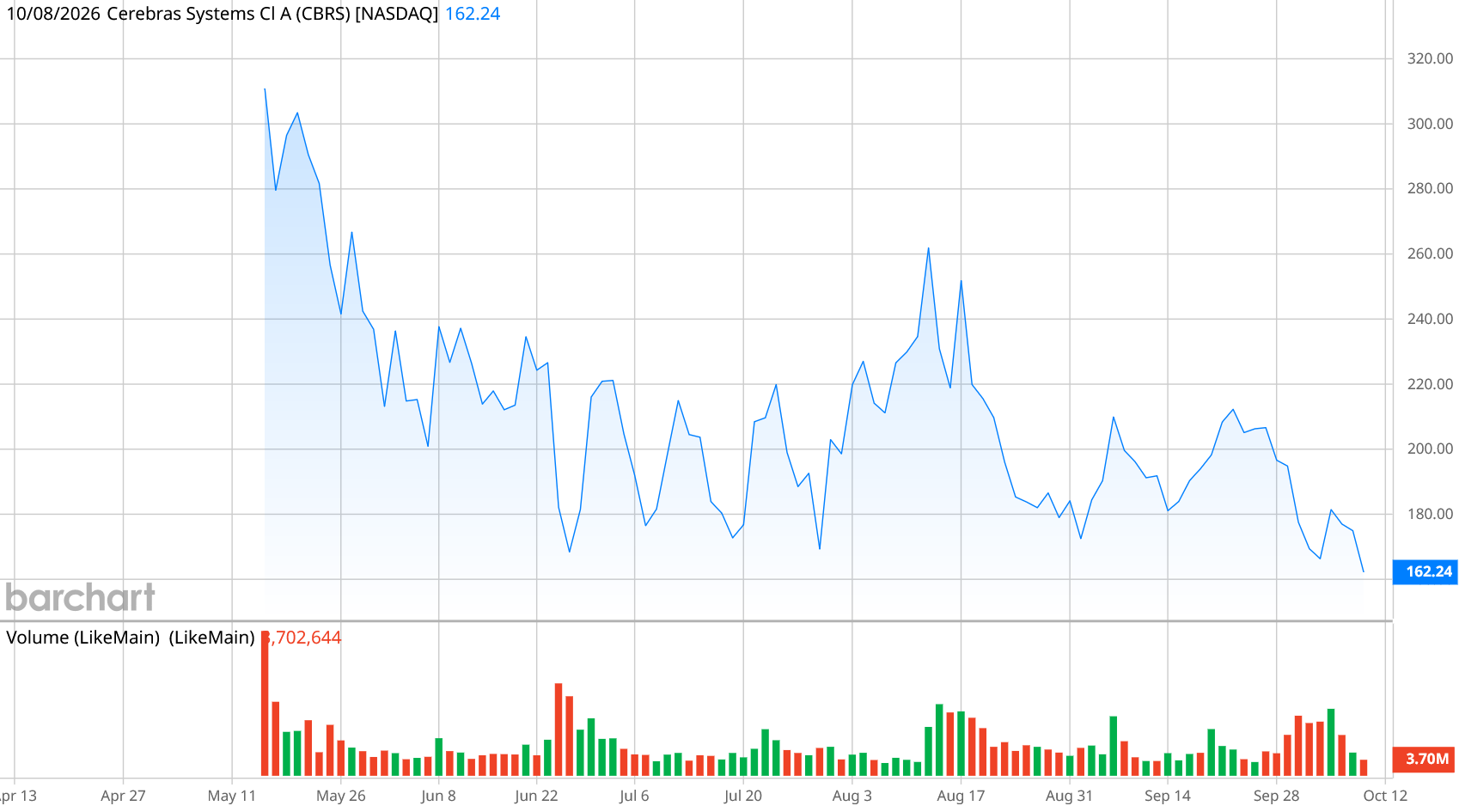
Few artificial intelligence stocks needed a jolt of good news this week as badly as Cerebras Systems (CBRS). The chipmaker, which competes with Nvidia (NVDA) and other chip stocks, is down a whopping 58% from its all-time high set shortly after its initial public offering in May. Trading at $162 at this writing, Cerebras stock is lower than the company’s IPO price of $185, and its first few months as a publicly traded entity have been a bitter disappointment for shareholders.
But the stock got a boost on Monday after OpenAI CEO Sam Altman pushed back against concerns about the relationship between the two companies.
In a post on X, Altman attempted to put to rest speculation about the relationship between Cerebras and his company, the operator of ChatGPT. Altman called Cerebras a “close partner” and said the companies are deeply engaged in efforts to increase AI processing speeds.
CBRS stock jumped 8% following the Oct. 5 post, and while it’s given some of those gains back, Altman’s comments carry a lot of weight. Shares have been sinking on fears that Nvidia could take business away from Cerebras as OpenAI continues to expand relationships with semiconductor companies. OpenAI launched its first AI model using Cerebras chips earlier this year and is projected to spend up to $20 billion through 2028 to rent computing capacity from Cerebras.
Let’s look at the challenges facing Cerebras and its unique solution to providing processors to power AI.
About Cerebras Stock
Cerebras is headquartered in Sunnyvale, California. The company, which operated for a decade before going public in May, has developed an unusual approach to AI computing. Instead of relying on clusters of conventional graphics processing units (GPUs), Cerebras builds massive wafer-scale processors designed to keep computing, memory, and bandwidth closely integrated.
The goal is to eliminate bottlenecks and dramatically increase inference speeds—how quickly an AI model can respond after receiving a prompt. But the chips are distinctive – for example, Cerebras uses an entire 12-inch silicon wafer that is 30 times the size of Nvidia’s Blackwell B200 package, and it has 19 times as many transistors as Blackwell.
Cerebras has a partnership with Amazon (AMZN) to pair AWS Trainium chips and Cerebras’ CS-3 accelerator, and in July announced a partnership with Advanced Micro Devices (AMD) to pair AMD’s Helios racks with the Cerebras Wafer-Scale Engine to run AI processes.
More recently, Cerebras launched its CS-4 rack-scale solution, which it says is the industry’s fastest AI accelerator and is built from three new wafer-scale engines, providing a 30x advantage in tokens-per-second-per-user over GPUs.
But the market has not been impressed; CRBS stock has fallen 27% since that mid-August announcement, while Nvidia recently hit an all-time high.
Beats on Earnings
Cerebras has a short history as a publicly traded company, but it’s doing better than analysts expected. In the second quarter, it posted revenue of $180.11 million, up from $103.32 million a year before. Cerebras also reported core revenue of $210 million, which strips out pass-through revenue and the amortization of customer warrant assets.
The company posted a net loss of $450.5 million a year after quarterly profits of $309.5 million. Management attributed the loss to stock-based compensation costs, which equaled $386.6 million. Bottom-line results had Cerebras losing $0.05 per share versus analysts’ expectations of a loss of $0.17 per share.
“Speed changes what AI can do. It makes AI more useful, more productive, and opens entirely new markets,” CEO Andrew Feldman said. “As a result, the demand for fast inference is enormous and Cerebras is scaling to meet it, securing more data center capacity, expanding manufacturing, and growing with customers and partners including OpenAI, AWS, AMD, and CrowdStrike.”
Cerebras projects full-year core revenue to be between $880 million and $890 million, up from a range of $855 million to $865 million. Core revenue is expected to be between $214 million and $216 million in the third quarter.
What Do Analysts Expect for CRBS Stock?
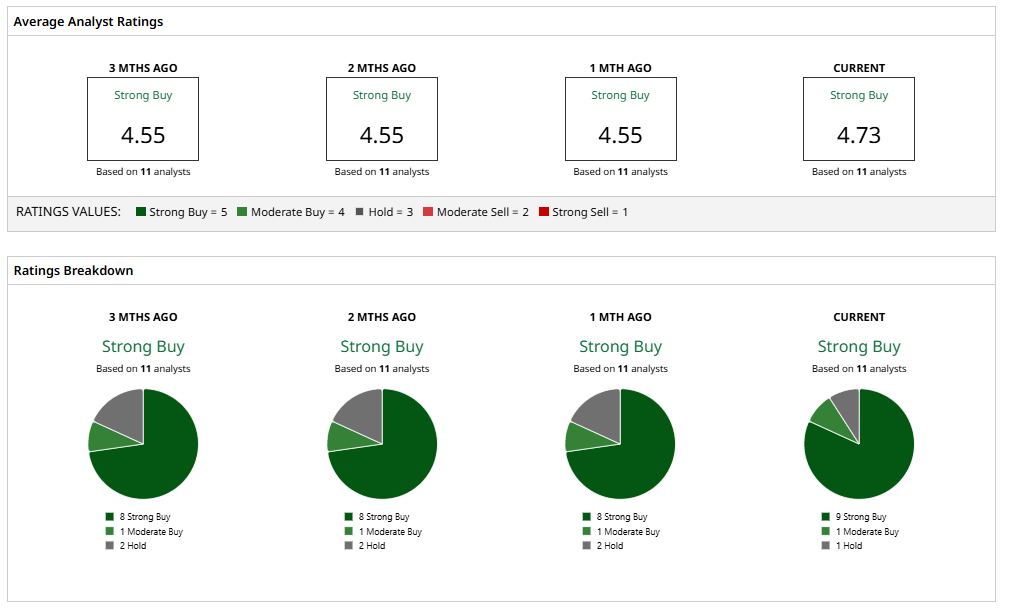
The decline in the company’s stock price isn’t shaking analysts’ confidence in Cerebras. Eleven analysts surveyed by Barchart have a consensus “Strong Buy” recommendation for CRBS stock, with only one of those suggesting that investors hold. The mean price target of $280.09 represents a potential upside of 72% in CBRS stock.
While Altman’s social media post could help ease investors’ concerns, it doesn’t eliminate risk; OpenAI is purposefully building a diversified computing infrastructure and will continue to work with multiple chip providers. It would be foolhardy to think it would put all of its eggs in Cerebras’ basket, just as it would be unwise for Cerebras not to expand its customer base.
But Altman’s public endorsement provides an important signal for Cerebras investors: OpenAI still sees the company as a meaningful part of its AI infrastructure strategy.
For a newly public chipmaker competing in a market dominated by Nvidia, keeping that relationship strong could be critical.
On the date of publication, Patrick Sanders had a position in: NVDA . All information and data in this article is solely for informational purposes. For more information please view the Barchart Disclosure Policy here.