
Why Ceconomy Stock And Eurozone Consumer Shares Could Benefit From ECB Rate Pressure
Eurozone consumers are still spending, services are humming, and the ECB is talking tougher on interest rates. That mix can reward some domestic-facing stocks while putting others under pressure as borrowing costs bite and inflation clouds real spending power. If you care about where everyday wallets meet central bank policy, this is your moment. This article unpacks three Eurozone consumer and services stocks exposed to these ECB headlines.
The three stocks in this article are just a sample set from the Eurozone domestic consumer and services theme. The full screen surfaced 9 more listed companies with equally compelling stories that are not covered below. To see the wider field and start identifying your own highest conviction ideas, head straight to the Eurozone Domestic Consumer & Services Stocks screener.
Ceconomy (XTRA:CEC)
Ceconomy plugs straight into the Eurozone consumer theme, with its MediaMarkt and Saturn stores and related services giving direct exposure to how households across the currency bloc are spending on electronics and in-home support.
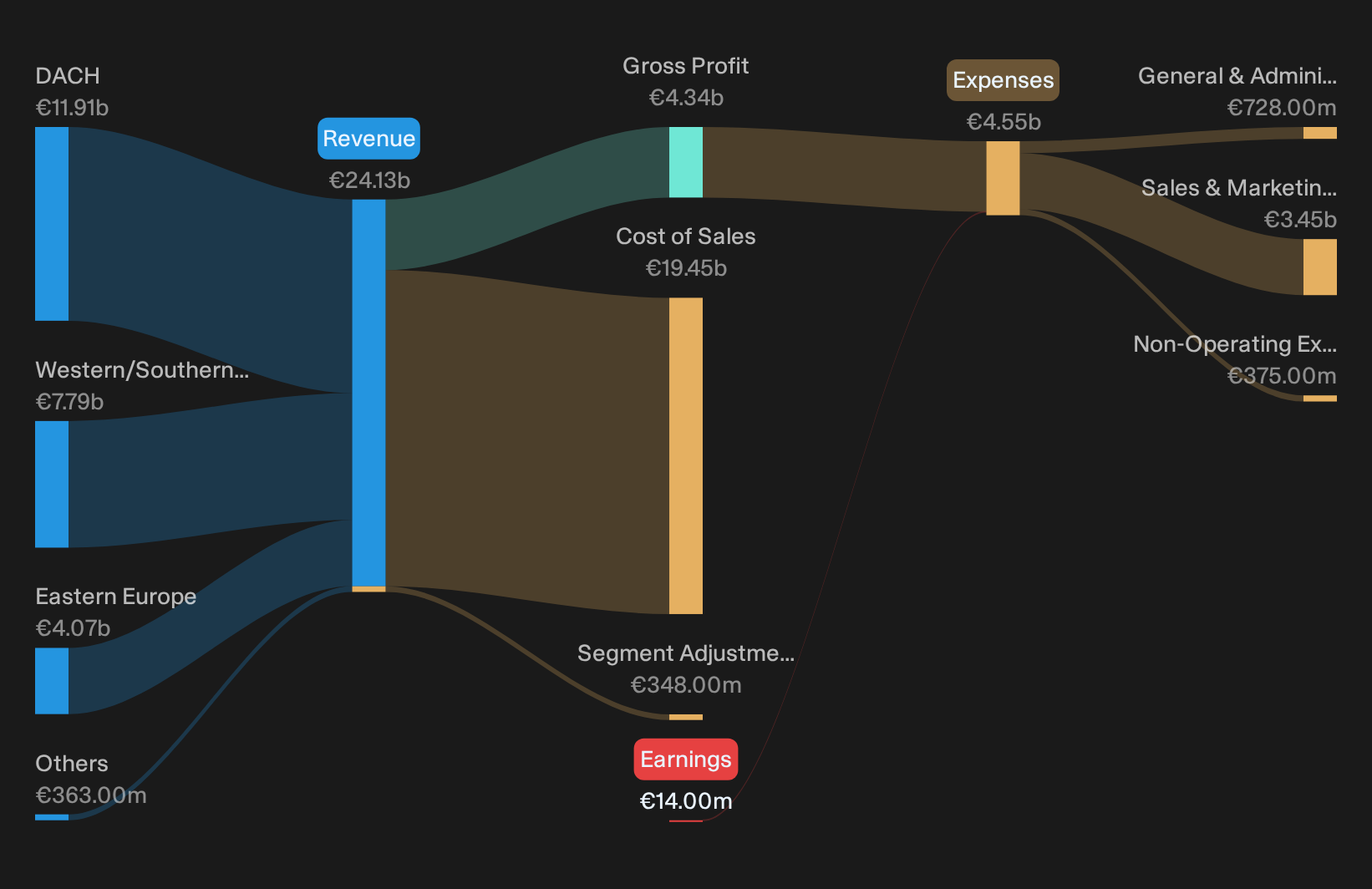
Ceconomy AG runs the MediaMarkt and Saturn chains plus in home tech services under Deutsche Technikberatung, generating about €23.8b in consumer electronics revenue and carrying a market value of roughly €2.1b.
"The ongoing expansion and optimization of Ceconomy's omnichannel platform, including strong double-digit online sales growth, increased omnichannel initiatives (such as 19-minute and same-day delivery in multiple countries), and a rapidly growing customer loyalty base (50 million+ members, well ahead of plan), is driving higher topline revenue and supporting structurally better gross margins as digital penetration increases."
What really matters now is how one still unresolved pressure shapes the balance between that stronger margin potential and everyday demand.
That unresolved pressure is exactly what the full narrative for Ceconomy unpacks in detail, separating margin gains from demand risks and highlighting where Ceconomy could be mispriced.
D'Ieteren Group (ENXTBR:DIE)
D'Ieteren Group plugs into the Eurozone domestic consumer theme through car distribution, glass repair and other vehicle services. Most of its €6.9b Belron and €4.7b D'Ieteren Automotive activity is tied to everyday drivers, complemented by €3.1b PHE, €1.7b TVH and €119m Moleskine, and backed by a €8.5b market cap.
For this screener, D'Ieteren Group matters because it is a large, consumer-facing mobility platform whose fortunes are closely linked to how often people in the euro area drive, repair and replace their cars.
"Belron delivered another record year, with sales up 7.1% at constant exchange rates and adjusted operating profit up 15.7% in 2025."
What investors will watch closely now is how one quiet shift inside that mobility portfolio reshapes the balance between resilience and sensitivity to higher rates.
That portfolio shift is exactly where the real story for D'Ieteren Group starts to accelerate, and the full narrative for D'Ieteren Group digs into how resilience and rate sensitivity could be quietly decoupling.

AUTO1 Group (XTRA:AG1)
AUTO1 Group runs one of the Eurozone’s largest online used car marketplaces, plugging directly into domestic consumer demand for mobility. The business generated about €7.0b from its Merchant segment and €2.1b from Retail, and the stock has a roughly €3.6b market value.
Used cars are a very local, service-heavy purchase, which puts AUTO1 Group squarely in the middle of euro-area consumer spending that still leans on services and everyday mobility. Investors watching this theme may see appeal in that exposure to ongoing car replacement decisions, depending on how one unseen pressure on its economics resolves itself.
That unseen pressure is exactly where things get interesting, and the analysis report for AUTO1 Group shows whether AUTO1 Group’s current economics are masking upside or future strain.

Seeking Alternatives Before The Crowd?
Fresh ideas move first. Breakout stories gain momentum while they are still under the radar for now. Spot them before the crowd reacts and consider your options.
- Look for cash rich outliers by scanning a curated list of solid balance sheet and fundamentals (207 results) that keeps you focused on durability rather than hype.
- Track earnings momentum with a filtered pool of 35 profitable AI stocks that aren't just burning cash so you are following AI stories supported by profits, not just promises.
- Explore potential income streams through a curated group of 227 dividend fortresses before yield-focused investors narrow the available opportunities.
This article by Simply Wall St is general in nature. We provide commentary based on historical data and analyst forecasts only using an unbiased methodology and our articles are not intended to be financial advice. It does not constitute a recommendation to buy or sell any stock, and does not take account of your objectives, or your financial situation. We aim to bring you long-term focused analysis driven by fundamental data. Note that our analysis may not factor in the latest price-sensitive company announcements or qualitative material. Simply Wall St has no position in any stocks mentioned.
Have feedback on this article? Concerned about the content? Get in touch with us directly. Alternatively, email editorial-team@simplywallst.com