
They all went to the Middle East to make quick money! The “Great Migration” of supertankers exacerbates global capacity shortages, and the number of empty ships on the Atlantic Ocean route is halved
The Zhitong Finance App noticed that supertankers are competing to sail to the Middle East in order to get a share of the soaring oil transportation costs in the Strait of Hormuz. This has exacerbated the shortage of ships around the world and driven up freight rates sharply.
Although attacks on ships continue, crude oil transportation through this waterway connecting the Persian Gulf to international markets has returned to close to pre-war levels in recent weeks. However, the risk of this route has caused tanker freight costs to skyrocket: the cost of transporting oil from the Persian Gulf to East Asia has reached more than six times what it was before the conflict.
According to statistics from shipping data provider Signal Ocean, more than 40% of the world's approximately 850 very large tankers (VLCCs) are currently either in the Persian Gulf or are only a few days away from it.
The so-called “ferry trade” has further increased the concentration of ships in the region: crude oil is transferred to other ships at emerging transit points such as the Gulf of Oman or off the west coast of India because these vessels are unwilling to risk crossing the Strait of Hormuz.
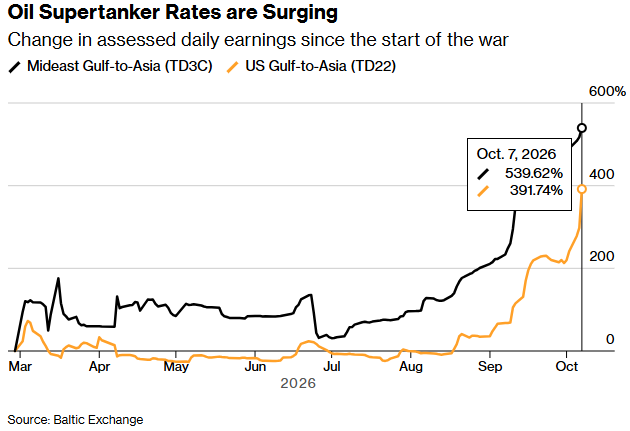
Supertanker freight rates soar
Signal Ocean freight analyst Georgios Sakellariou said, “The last few months have been the best period in the history of crude oil tankers.” “The main problem is the inefficiency of the ship-to-ship transit system outside the Strait of Hormuz, which has greatly stretched the supply of ships in the region and beyond.”
According to Signal Ocean data, the number of unloaded VLCCs going to Atlantic ports has been cut in half compared to a month ago. The scarcity of supertankers is also changing the structure of tanker fleets in other regions, driving the use of more small ships that do not have the economic advantage of large ships.
At the same time, crude oil producers outside the Middle East, especially the American oil producers, have maintained high production levels even as crude oil exports from the Persian Gulf have rebounded. All of this is being transmitted to the global oil freight market, adding fuel to already high freight rates.
At least one VLCC was reported this week that the freight rate from the US Gulf of Mexico to Japan may be as high as 82 million US dollars, a record high, which is equivalent to more than 40 US dollars per barrel. Freight charges for this route have increased by more than 50% compared to three weeks ago.
The journey from the Persian Gulf to East Asia took about three weeks, and the supertanker freight rate assessed on Wednesday reached a record high of nearly $1.4 million per day. This figure is almost 540% higher than before the war, while Brent crude oil rose by only about 40% during the same period.
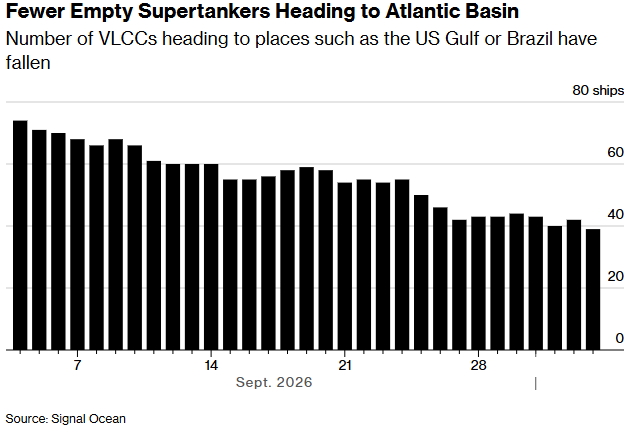
Fewer number of unloaded supertankers heading to the Atlantic basin
The scarcity of supertankers and sky-high freight rates have prompted African and Middle Eastern routes to switch to smaller Suezmax (Suezmax) and Aframax (Aframax) tankers. Up to now, most of the US crude oil transportation transactions shipped to Asia in November used such ships, which in turn boosted their freight rates.
Shipping brokerage company Fearnleys wrote in a report on Monday, “VLCC's little sister ships, Suez and Afula tankers, also show no sign of slowing down, so there really is no place to hide now.”