
Shortage of memory chips has overshadowed the prospects for hybrid bonding technology adoption! Dutch semiconductor equipment supplier Besi's stock price almost fell short of its peak
The Zhitong Finance App learned that the stock price of Dutch semiconductor equipment supplier BE Semiconductor Industries NV (Besi) has been rising due to the market's optimistic expectations for its next-generation chip technology. But now, the global shortage of memory chips has caused the market to question the speed of adoption of this technology, and investors' patience is running out. Since this week, the stock has fallen 14%, down 45% from its peak in June.
Just a day ago, Bank of America downgraded Besi's rating to “neutral.” After UBS Group downgraded its rating from “buy” to “sell” due to lower profit expectations, the decline in Besi's stock price widened further. This further intensified the sell-off of the stock, making Besi the worst performer in the European Stoxx 600 index between June and September.
As it becomes more difficult to further shrink a single chip, the entire industry is looking for other ways to improve performance. One way is to connect multiple chips together or stack them on top of each other. To achieve this goal, specialized tools such as hybrid bonding equipment (hybrid bonding) from Besi are needed.
As the world's leading manufacturer of hybrid bonding equipment, Besi's flagship technology can directly connect semiconductor components to improve computational performance in a smaller space. Investors previously bet that chipmakers will quickly adopt this technology, but the shortage of memory chips and concerns about cost may further delay this transformation process. Barclays analyst Simon Coles said, “There are many other factors, and these factors are driven together by a large number of variables. Unfortunately, none of these things are within Besi's control.” He rated the stock as “hold and see.”
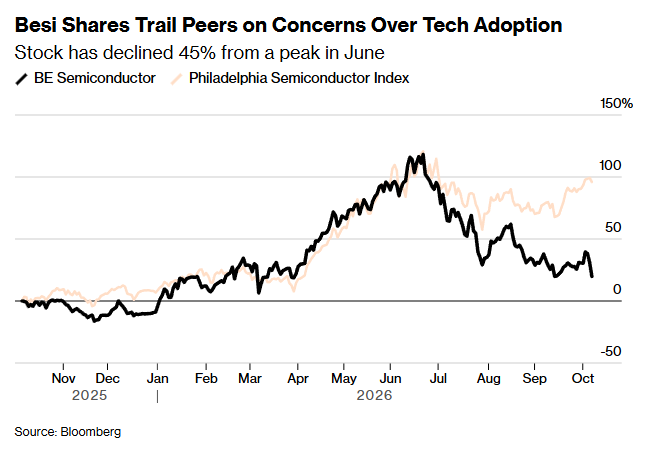
Besi's stock price outperformed its peers due to market concerns about the speed of technology penetration. The stock price fell 45% from the June peak
A worrying question for investors is: if the architecture of memory chips is actually becoming simpler rather than more complex, is Besi's technology still relevant?
According to independent research institute SemiAnalysis, the AI accelerator Rubin Ultra that NVDA.US (NVDA.US) plans to launch next year will use fewer storage layers than current generation products. This is an expedient measure to enable more AI chips to be shipped when the supply of memory chips is limited.
Besi previously anticipated that every storage component used by Nvidia's AI accelerator would become more and more complex, and eventually chip makers would switch to using the Dutch company's technology to stack multiple layers of memory chips in a package thinner than a credit card.
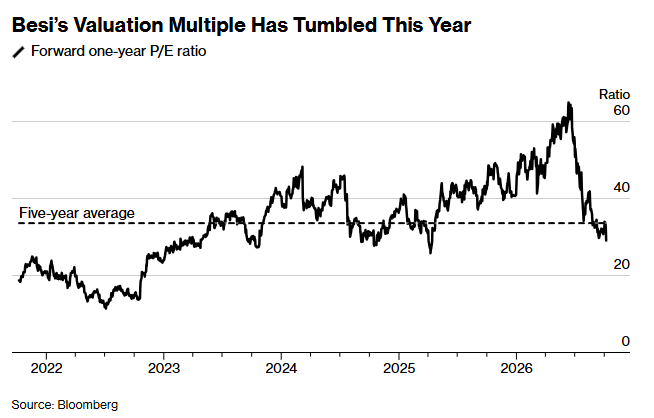
Besi's valuation multiples fell sharply this year
Currently, the price-earnings ratio of Besi's stock price corresponding to next year's profit is about 29 times, less than half of the peak valuation of about four months ago. However, Barclays's Simon Coles said this is probably not the biggest concern for Besi investors. He said, “Over the past three or four years, Besi's core investment logic has mainly revolved around hybrid bonding. If the adoption of hybrid bonding gains momentum, then the stock price will perform well. And if the market is uncertain about the future of hybrid bonding, then stock prices will be under pressure, as has happened since this summer.”
AMD (AMD.US) was one of the early adopters of Besi technology, and the company already used hybrid bonding technology in Ryzen 7 processors as early as 2022. However, the technology has been much slower to spread among memory chip makers.
Myron Xie, an analyst at SemiAnalysis, said that's because hybrid bonding really works, and it's not just as simple as using Besi's equipment. This process also involves expensive preparation steps to ensure that the surfaces of the two chips are almost perfectly flat. Myron Xie said that for high-bandwidth memory (HBM), the cost of using hybrid bonding “may not be worth the incremental benefits” it brings.
There is a trade-off: if you abandon hybrid bonding and reduce the number of silicon-layer stacks, the workload that a single storage unit can handle will be more limited. Myron Xie said that although this is not ideal for AI computing, there are still some workarounds. Workloads can be distributed across multiple storage units, while next-generation AI models are being designed to use less memory.
Analysts who are bullish on Besi look at this issue from a different perspective. Ideally, if there is an adequate supply of memory chips, the AI model should run on a larger memory module rather than a smaller one. Therefore, if the supply of memory chips finally catches up with demand — Bernstein analyst David Dai believes this may happen in 2028 — Besi's hybrid bonding equipment should be put back into use. “This investment logic still holds true,” David Dai said. He added that hybrid bonding technology is still necessary in the long run.
David Dai also cites South Korean semiconductor giant SK Hynix as an example. The company has yet to adopt this technology on a large scale, but at a conference closely watched by the market in August, SK Hynix emphasized the advantages of hybrid bonding technology.