
What SEI Investments (SEIC)'s Singapore Expansion Means For Shareholders
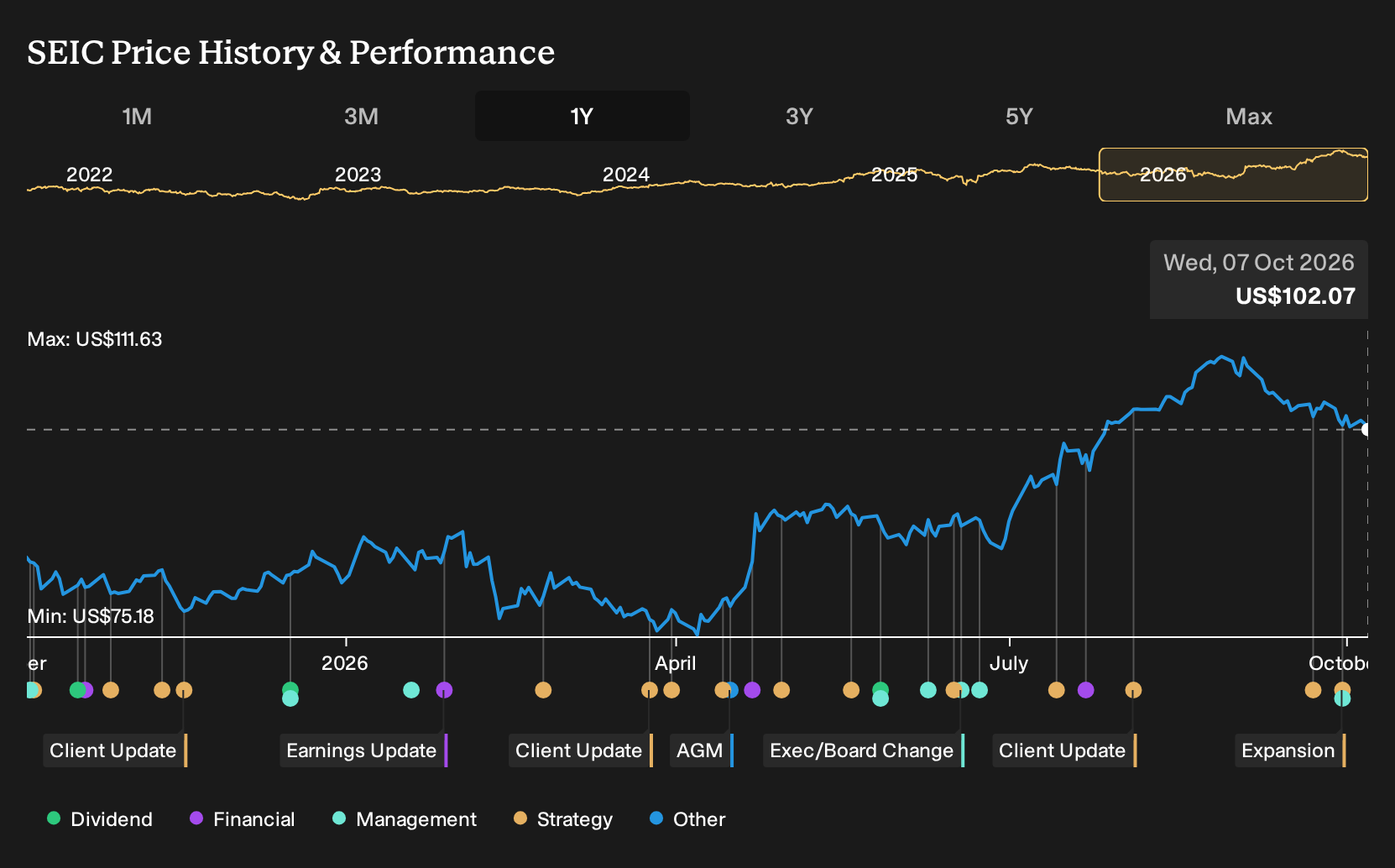
- SEI Investments expanded in Asia in late September 2026, opening a Singapore office and appointing Connall McGuckian as Managing Director to focus on asset servicing, professional services, and UCITS fund distribution in a major asset management hub.
- The integration of ICE ETF Hub into SEI’s ETF order management points to a push for more automated, scalable workflows that can support growing exchange traded product activity across its global client base.
- We will now look at how SEI Investments' broader investment narrative could shift as it embeds ICE ETF Hub into its ETF platform.
Scan how SEI Investments' Singapore push and ETF buildout compare with other asset managers pursuing global expansion by reviewing list of solid balance sheet and fundamentals (25 results)
SEI Investments Investment Narrative Recap
To own SEI Investments, you need to believe the mix shift toward outsourced fund administration, data platforms and ETFs can offset fee pressure from newer, lower priced products. The near term story still leans on steady demand for complex asset servicing and higher margin professional services, even as net profit margins sit below last year.
The Singapore buildout and ICE ETF Hub integration look directionally supportive rather than transformational for the next few quarters. They help execution on existing catalysts around ETFs and automation but do not remove key risks such as insider selling, potential buyback constraints if cash generation softens and lower fee yields as product mix evolves.
The ICE ETF Hub agreement is the clearest operational tie in to this news. Integrating ETF primary market workflows into SEI Investments platforms speaks directly to the ETF and ETP catalyst that analysts already flagged. A smoother create redeem process can make the ETF range more competitive and help SEI support larger mandates without proportional cost increases.
For you as a shareholder, the question is whether this infrastructure work shows up in higher ETF assets and more resilient fee revenue, or simply accelerates the shift toward lower margin products. Execution risk is real. If ETF growth does not keep pace with mix pressure in older mutual funds, the margin and buyback narrative flagged in the risk section could matter more than the new plumbing.
SEI Investments Forecasts Behind The Story
SEI Investments' narrative projects US$3.0b revenue and US$864.8m earnings by 2029. This rests on analysts assuming 7.2% yearly revenue growth and an earnings increase of about US$158m from US$706.9m today.
Uncover why SEI Investments' fair value points to a 14% potential upside to its current price, which could narrow quickly if sentiment shifts.
Exploring Other Perspectives
Some of the most optimistic analysts frame the Singapore move and ICE ETF Hub work as proof that SEI Investments could support faster outsourcing wins. Before this news, the bullish group was already pencilling in about US$3.2b revenue and US$964.7m earnings by 2029. You now get to ask whether this expansion justifies that optimism or pushes forecasts even higher, keeping in mind that others were closer to US$3.0b and US$864.8m. Views can differ a lot, so it can help to compare several narratives before deciding how you see SEI’s next chapter.
Explore 3 other SEI Investments fair value estimates, including one that suggests potential upside of as much as 228589% from the current price!
Reach Your Own Conclusion
Disagree with existing narratives? Extraordinary investment outcomes rarely come from following the herd, so consider your own analysis.
- A great starting point for your SEI Investments research is our analysis highlighting 3 key rewards and 1 important warning sign that could impact your investment decision.
- See our latest analysis for SEI Investments. The report includes a comprehensive fundamental analysis summarized in a single visual, the Snowflake, making it easier to evaluate SEI Investments' overall financial health at a glance.
Looking For More SEI Investments Style Ideas?
If SEI Investments has sharpened your thinking about fees, balance sheets and long term earnings power, it can help to compare it with other companies that share some of the qualities you care about most.
- For investors who want potential upside without ignoring quality, scan a curated 29 high quality undervalued stocks that pair solid fundamentals with discounted prices.
- If resilience matters more than excitement, review a focused 31 resilient stocks with low risk scores that screens for businesses with steadier risk profiles.
- When you want to widen the opportunity set beyond well known tickers, cast the net over a 20 high quality undiscovered gems that might not yet be on most radars.
This article by Simply Wall St is general in nature. We provide commentary based on historical data and analyst forecasts only using an unbiased methodology and our articles are not intended to be financial advice. It does not constitute a recommendation to buy or sell any stock, and does not take account of your objectives, or your financial situation. We aim to bring you long-term focused analysis driven by fundamental data. Note that our analysis may not factor in the latest price-sensitive company announcements or qualitative material. Simply Wall St has no position in any stocks mentioned.
Have feedback on this article? Concerned about the content? Get in touch with us directly. Alternatively, email editorial-team@simplywallst.com