
First Busey (BUSE) Pulls Back After A Strong Run, Is The Valuation Still Compelling?
First Busey (BUSE) is back on investor radars after a recent pullback, with the share price down about 5% over the past month.
Short term momentum for First Busey has cooled, with the share price down 5.5% over the past month and edging lower again in the last week. Yet the year to date share price return of 21.2% and 1 year total shareholder return of 29% point to a still constructive longer term trend as investors continually reassess growth prospects and perceived risk around a regional bank with a US$2.4b market value.
Scan how First Busey compares with other regional financials by reviewing a curated set of list of solid balance sheet and fundamentals (25 results).
After that kind of run, then a quick 5% slip, the question around First Busey is simple: Does the recent reset still leave room for upside, or has most of the easy progress already been made on valuation?
Preferred P/E Multiple of 11.3x for First Busey: Is it justified?
On simple earnings terms, First Busey’s latest close at $28.97 sits in territory where the stock looks mixed, trading at a P/E of 11.3x that screens as inexpensive against some checks and slightly stretched against others.
The P/E ratio compares what investors pay for each dollar of earnings, which matters a lot for a regional bank like First Busey where profit levels and balance sheet strength are key focus areas. A P/E of 11.3x means the market is paying $11.30 for every $1 of the company’s net income.
Against the broader US Banks industry, that 11.3x P/E is described as good value compared with the 11.5x sector average and also sits below a peer average of 12.8x. At the same time, the SWS fair P/E ratio estimate is 10.6x, which implies the current market multiple is higher than a level the market could move toward if sentiment cooled, especially with forecast earnings and revenue growth of 2.4% per year and a Return on Equity currently assessed at 9.7% and still expected to remain below 20% in three years.
Explore the SWS fair ratio for First Busey.
Result: Price-to-earnings of 11.3x (ABOUT RIGHT)
Still, the case for First Busey can weaken quickly if loan losses rise, or if funding costs squeeze profitability more than the current P/E implies.
Find out about the key risks to this First Busey narrative.
Another View on First Busey’s Value
The P/E story only gives you part of the picture. On a different yardstick, our DCF model values First Busey at $50.84 per share, compared with the current $28.97 price. This comparison suggests the stock may be trading at a sizable discount. The question is which valuation approach deserves more weight in your process.
Look into how the SWS DCF model arrives at its fair value.
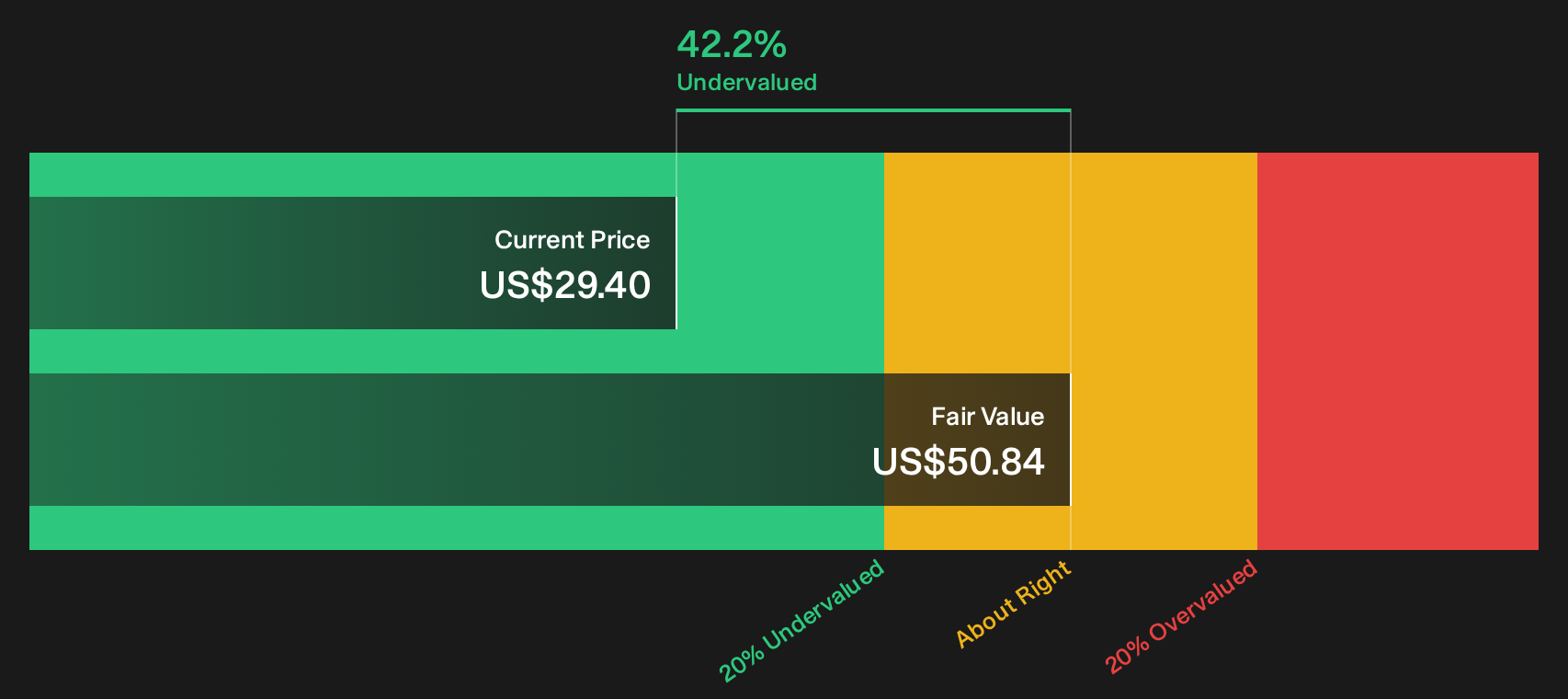
Simply Wall St performs a discounted cash flow (DCF) on every stock in the world every day (check out First Busey for example). We show the entire calculation in full. You can track the result in your watchlist or portfolio and be alerted when this changes, or use our stock screener to discover 29 high quality undervalued stocks. If you save a screener we even alert you when new companies match - so you never miss a potential opportunity.
Next Steps
Sentiment around First Busey is mixed, so the key question is what you make of the numbers and the valuation trade off in front of you. Move quickly, review the upside drivers, and pressure test whether they justify the current pricing by digging into the 3 key rewards
Looking for more First Busey style investment ideas?
If First Busey has you rethinking what good value looks like, broaden the opportunity set and use curated screeners to spot other potential candidates before they move.
- Target strong cash generation and pricing power by scanning a curated set of 29 high quality undervalued stocks that pair quality fundamentals with compressed valuations.
- Prioritise resilience and sleep-better-at-night holdings by reviewing 31 resilient stocks with low risk scores that focus on sturdier balance sheets and cleaner risk profiles.
- Hunt for future leaders before the crowd by checking 20 high quality undiscovered gems with solid numbers that are not yet widely followed.
This article by Simply Wall St is general in nature. We provide commentary based on historical data and analyst forecasts only using an unbiased methodology and our articles are not intended to be financial advice. It does not constitute a recommendation to buy or sell any stock, and does not take account of your objectives, or your financial situation. We aim to bring you long-term focused analysis driven by fundamental data. Note that our analysis may not factor in the latest price-sensitive company announcements or qualitative material. Simply Wall St has no position in any stocks mentioned.
Have feedback on this article? Concerned about the content? Get in touch with us directly. Alternatively, email editorial-team@simplywallst.com