
Did Falling Freight Demand Just Shift Saia (SAIA) Investment Narrative?
- Saia is contending with softer freight demand, with tons shipped declining over the past two years, while earnings per share have fallen about 16.3% annually and returns on capital appear to be losing steam.
- The combination of weaker volumes, shrinking profitability and waning capital efficiency points to pressure on Saia’s ability to sustain prior profit engines without meaningful business adjustments.
- The focus now is on how Saia’s investment narrative holds up when weaker freight demand and declining earnings per share stay front and center.
Balance Saia's freight softness by scanning a curated group of resilient operators with stronger volume and earnings trends through the 31 resilient stocks with low risk scores.
Saia Investment Narrative Recap
To stay on board with Saia, you need to believe the LTL platform can convert its expanded terminal network and technology investments into better density and more efficient runs over time. Softer tons shipped and a 16.3% annual decline in EPS keep the near term focus on whether pricing, mix and cost control can firm up margins.
The key short term swing factor is how quickly newer terminals and Saia REV tools translate into steadier shipment trends and operating ratio progress. The biggest risk is that ongoing wage, benefit, fuel and insurance pressures outpace any efficiency gains, which would keep returns on capital under strain if freight demand remains muted.
With no fresh company announcements tied directly to this softer freight patch, the most relevant reference point is still Saia’s ongoing terminal expansion since 2022. Management has added or upgraded more than 218 facilities, which are starting to show operating ratio improvement as they move along the maturity curve.
For you, that network build out is central to the catalyst story. If those sites reach mature productivity, they can support higher density, more reliable service and firmer pricing, which matter when tons shipped are under pressure. The operational risk is that wage inflation, fuel costs and insurance expenses dilute those gains before newer terminals fully ramp.
Saia's current analyst narrative points to forecast revenues of US$4.3b and earnings of US$512.1m by 2029, based on projected revenue growth of 8.5% a year and an earnings increase of about US$234.1m from US$278.0m today.
Uncover why Saia's fair value indicates a 30% potential upside to its current price that could narrow quickly.
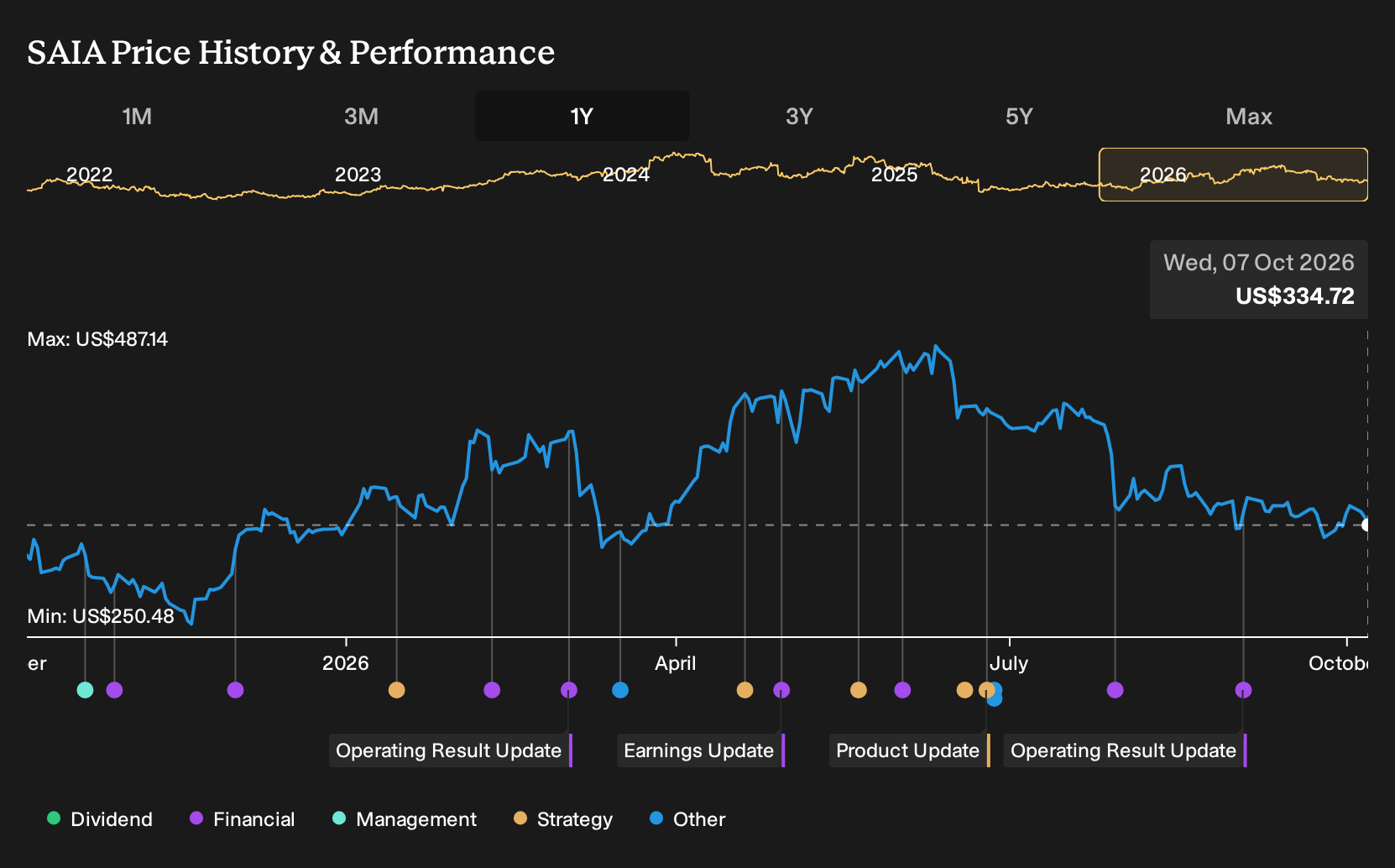
Exploring Other Perspectives
One alternate view leans hard into Saia’s pricing power as a counterweight to today’s freight softness. The most optimistic analysts were penciling in revenue of about US$4.6b and earnings near US$634.2m by 2029 before this news. That is a much stronger story. Use this update as a cue to compare how those assumptions might shift.
Explore 4 other Saia fair value estimates, including one that suggests as much as 52% potential upside from the current price.
Form Your Own Verdict
Disagree with existing narratives? Extraordinary investment returns rarely come from following the herd, so rely on your own analysis.
- A great starting point for your Saia research is our analysis highlighting 2 key rewards that could impact your investment decision.
- See our latest analysis for Saia. The report includes a comprehensive fundamental analysis summarized in a single visual, the Snowflake, making it easy to evaluate Saia's overall financial health at a glance.
Looking For More Investment Ideas Beyond Saia?
If Saia has you rethinking your exposure to freight and you want a broader set of possibilities, use this as a moment to refresh your watchlist with companies that have different risk and earnings profiles.
- For investors prioritizing capital preservation and steadier balance sheets, start with a list of solid balance sheet and fundamentals (25 results) that can anchor a more resilient portfolio core.
- If the goal is to find mispriced opportunities backed by solid fundamentals, scan a 27 high quality undervalued stocks that might not be fully reflected in current prices.
- Those hunting for stronger income streams can review a 8 dividend fortresses that aim to pair higher yields with more durable cash flows.
This article by Simply Wall St is general in nature. We provide commentary based on historical data and analyst forecasts only using an unbiased methodology and our articles are not intended to be financial advice. It does not constitute a recommendation to buy or sell any stock, and does not take account of your objectives, or your financial situation. We aim to bring you long-term focused analysis driven by fundamental data. Note that our analysis may not factor in the latest price-sensitive company announcements or qualitative material. Simply Wall St has no position in any stocks mentioned.
Have feedback on this article? Concerned about the content? Get in touch with us directly. Alternatively, email editorial-team@simplywallst.com