
Learn Why The Bull Case For UOB (SGX:U11) Could Change Following Baiduri Debt Programme Mandate
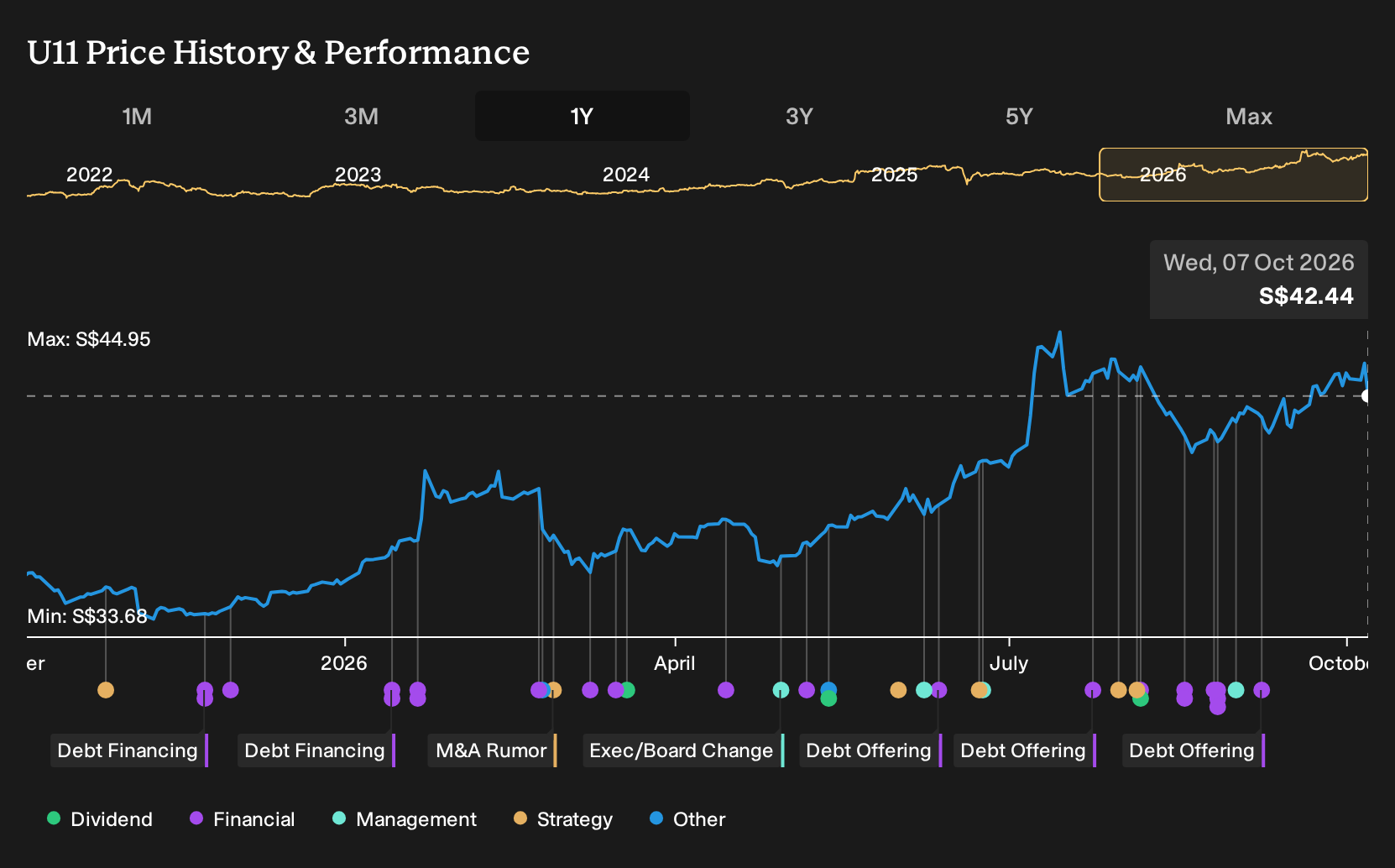
- United Overseas Bank recently acted as sole arranger and dealer for Baiduri Bank's inaugural US$2b Euro Medium Term Note Programme, giving the Brunei lender a framework to access international debt markets.
- This mandate underscores UOB's role as a regional capital markets partner for other financial institutions, and it ties directly into its push toward fee-driven, asset light income streams.
- We will now look at how United Overseas Bank's sole arranger role for Baiduri's EMTN programme could influence its broader investment narrative.
Scan other bank and financial stocks that lean on fee-based, capital markets income with our curated list of list of solid balance sheet and fundamentals (206 results) for ideas beyond United Overseas Bank.
United Overseas Bank Investment Narrative Recap
Owning United Overseas Bank means backing a regional lender that leans heavily on deposit funding, fee income and disciplined risk management rather than pure loan growth. The broader thesis is that digital investment, ASEAN connectivity and asset light businesses can help offset pressure from lower net interest margins and higher costs. The Baiduri EMTN role fits this by reinforcing UOB’s capital markets and treasury franchise.
In the short term, the main swing factor is how net interest margins and credit costs shape earnings, given earlier guidance cuts and ongoing economic uncertainty across ASEAN. The key risk is that margin compression and rising expenses prove more significant than the offset from fee income and digital initiatives. The Baiduri transaction supports the fee income story but is unlikely to be a major earnings catalyst on its own.
Recent commentary around United Overseas Bank has centred on consistent themes. Management is investing in digital banking, integrating the Citi consumer portfolio and building asset light fee streams such as cash management and supply chain finance. The Baiduri EMTN arranger role aligns closely with that last element. It illustrates UOB using its wholesale banking and markets platform to originate client driven treasury business.
For investors, the link is straightforward. A larger volume of regional capital markets mandates can support fee income and contribute to diversification away from spread based revenue. This can be important if margins come under pressure and credit costs remain elevated. On the other hand, capital markets activity can be cyclical, so the central questions around operating expenses, allowance levels and the stability of UOB’s earnings profile remain in focus.
United Overseas Bank's current narrative points to revenues of SGD 16.0b and earnings of SGD 6.5b by 2029, based on analyst consensus. This implies forecast revenue growth of 10.5% per year and an earnings increase of about SGD 1.8b from current earnings of SGD 4.7b.
Uncover why United Overseas Bank's fair value is viewed as broadly in line with its current price.
Exploring Other Perspectives
Three fair value estimates from the Simply Wall St Community span roughly US$43.36 to US$67.47 per share for United Overseas Bank, which shows how far apart private investors can be. These views sit alongside risks around loan growth guidance cuts and margin pressure, so you should weigh several contrasting opinions before forming your own stance.
Explore 2 other United Overseas Bank fair value estimates, including one that suggests it could be worth just SGD43.36.
The Verdict Is Yours
Disagree with existing narratives? Extraordinary investment returns rarely come from following the herd, so trust your own analysis.
- A great starting point for your United Overseas Bank research is our analysis highlighting 2 key rewards and 2 important warning signs that could impact your investment decision.
- See our latest analysis for United Overseas Bank. The report includes a comprehensive fundamental analysis summarized in a single visual, the Snowflake, making it easy to evaluate United Overseas Bank's overall financial health at a glance.
Looking for more investment ideas beyond United Overseas Bank?
If the United Overseas Bank story has sharpened your thinking about risk, income and balance sheet strength, it can be useful to line it up against other opportunities that share some of those qualities. The Simply Wall St screener lets you scan wider across the market while still filtering for the traits that matter most to you.
- For investors who want potential upside without ignoring fundamentals, consider a curated set of value focused opportunities via the 179 high quality undervalued stocks.
- If capital preservation ranks high on your list, you can narrow your hunt to companies that score well on financial resilience through the 228 resilient stocks with low risk scores.
- Those looking for income ideas can target stronger yield candidates with robust profiles by reviewing the 169 dividend fortresses.
This article by Simply Wall St is general in nature. We provide commentary based on historical data and analyst forecasts only using an unbiased methodology and our articles are not intended to be financial advice. It does not constitute a recommendation to buy or sell any stock, and does not take account of your objectives, or your financial situation. We aim to bring you long-term focused analysis driven by fundamental data. Note that our analysis may not factor in the latest price-sensitive company announcements or qualitative material. Simply Wall St has no position in any stocks mentioned.
Have feedback on this article? Concerned about the content? Get in touch with us directly. Alternatively, email editorial-team@simplywallst.com