
Should Private Market ID Deal Require Action From MSCI (MSCI) Investors?
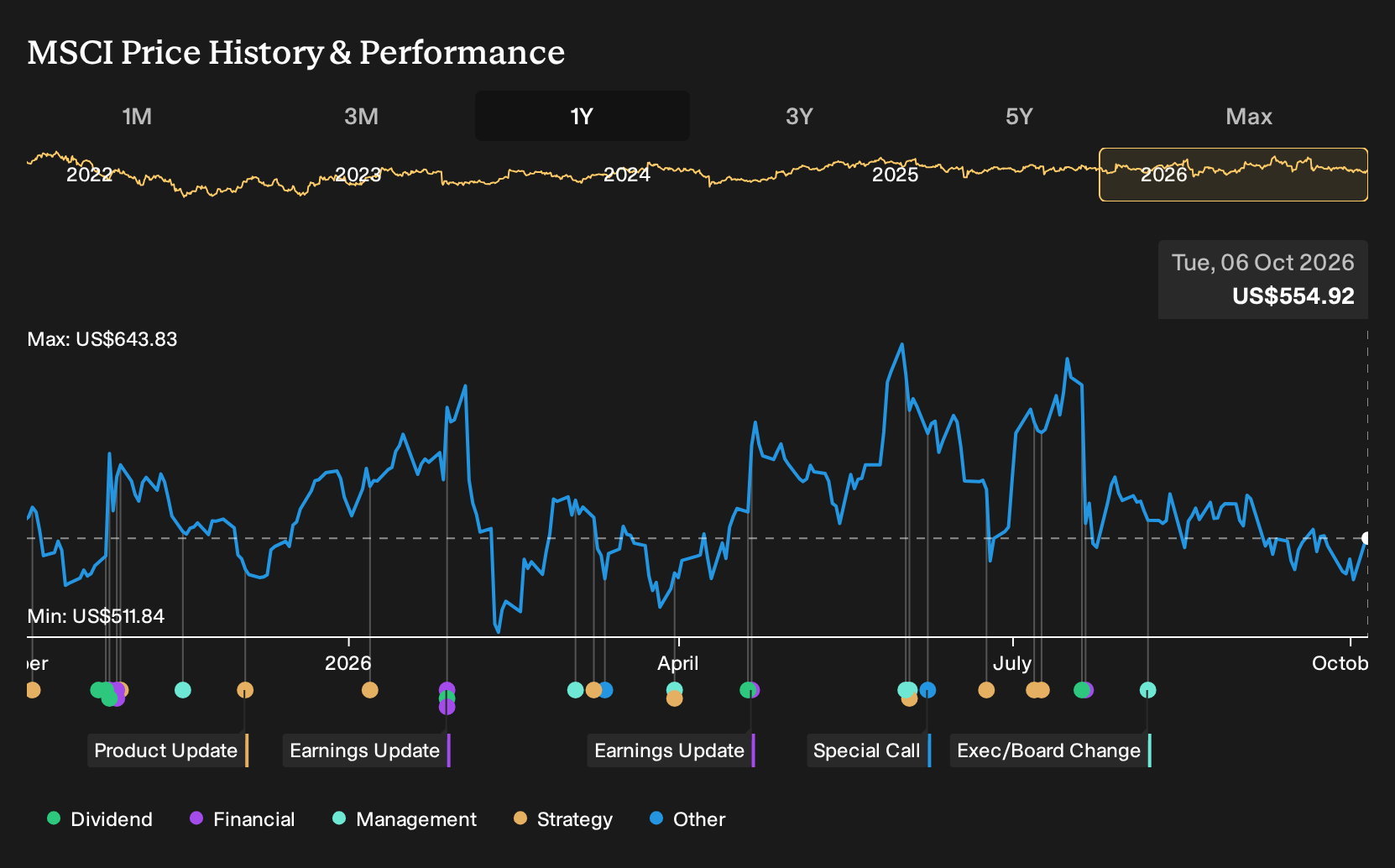
- CUSIP Global Services recently announced a collaboration with MSCI to extend CUSIP identifiers to late stage, venture backed U.S. private companies using MSCI’s Private Company Insights database.
- The arrangement pushes MSCI’s private markets data deeper into workflows that support secondary trading of private shares. This is relevant for investors watching how MSCI monetizes information across both listed and unlisted assets.
- We will look at how MSCI's investment narrative is shaped by supplying private company data that could standardize late stage VC markets.
Scan how MSCI fits within the broader shift toward standardized private markets by reviewing a hand picked set of 19 high quality undiscovered gems that could benefit as transparency in late stage deals improves.
MSCI Investment Narrative Recap
To own MSCI you need to be comfortable with a data and index powerhouse that leans heavily on recurring fees from ETFs, subscriptions and private markets tools. The big near term swing factor is how well management turns product launches into net new sales while keeping expense growth, including AUM linked compensation and acquisition costs, under control.
The sharpest risk right now sits in two pockets. Weak near term Sustainability and Climate net new sales, where management already guides to roughly flat or slightly negative, and pressure on asset based fee rates from mix shift into very large, lower fee ETFs. The CUSIP deal is helpful for the story but not a material near term catalyst on its own.
The CUSIP Global Services collaboration is the announcement that ties closest to this theme. MSCI is feeding its Private Company Insights database into a standard identifier system for late stage venture backed companies. That moves private company data closer to how public equities are tracked, which matters for index providers, brokers and fund administrators.
For you as a shareholder, the link back to catalysts is about execution in private capital solutions. Private markets subscriptions already carry a strong run rate and over 80 new products landed in recent quarters. If identifiers from the MSCI and CUSIP effort help secondary trading workflows in private shares, that could support adoption of MSCI private markets data while still competing with ESG softness and fee rate pressure in ETFs.
MSCI's narrative points to forecast revenues of US$4.3b and earnings of US$1.8b by 2029, built on an 8.8% yearly revenue growth rate. That path implies earnings today of about US$1.4b would need to rise by roughly US$400m to meet the consensus view for 2029.
Uncover why MSCI's fair value indicates a 25% potential upside to its current price, which could narrow quickly.
Exploring Other Perspectives
Six fair value estimates from the Simply Wall St Community span roughly US$423 to US$763 for MSCI, with views spread across the entire range. That kind of dispersion shows how strongly opinions can diverge, especially when some investors focus on ETF flows and private markets platforms, while others worry about expense pressure and weaker sustainability demand. Use that spread as a prompt to test your own assumptions and explore several contrasting viewpoints before deciding how MSCI fits your portfolio.
Explore 5 other MSCI fair value estimates, including one that estimates up to 37% potential upside from the current price.
The Verdict Is Yours
Disagree with existing narratives? Extraordinary investment returns rarely come from following the herd, so go with your instincts.
- A great starting point for your MSCI research is our analysis highlighting 5 key rewards and 1 important warning sign that could impact your investment decision.
- See our latest analysis for MSCI. The report includes a comprehensive fundamental analysis summarized in a single visual, the Snowflake, making it easy to evaluate MSCI's overall financial health at a glance.
Looking For More Investment Ideas Beyond MSCI?
If the MSCI story has sharpened how you think about data rich businesses, it can help to widen the lens and look for other stocks that match your preferred balance of quality, risk and income. The Simply Wall St Screener lets you filter the market around those themes instead of chasing headlines one by one.
- For investors who want quality at a reasonable entry point, start with a focused group of 27 high quality undervalued stocks that combine fundamentals with a potentially attractive gap between price and estimated worth.
- If capital preservation comes first for you, narrow the field to a 31 resilient stocks with low risk scores that scores well on financial strength and business stability.
- Income focused readers can scan a 8 dividend fortresses that emphasises higher yielding stocks where the payout is backed by underlying cash generation.
This article by Simply Wall St is general in nature. We provide commentary based on historical data and analyst forecasts only using an unbiased methodology and our articles are not intended to be financial advice. It does not constitute a recommendation to buy or sell any stock, and does not take account of your objectives, or your financial situation. We aim to bring you long-term focused analysis driven by fundamental data. Note that our analysis may not factor in the latest price-sensitive company announcements or qualitative material. Simply Wall St has no position in any stocks mentioned.
Have feedback on this article? Concerned about the content? Get in touch with us directly. Alternatively, email editorial-team@simplywallst.com