
Does Bread Recall Change The Bull Case For Flowers Foods (FLO)?
- Flowers Foods recalled certain Nature's Own Hawaiian Bread 20 oz and 40 oz packages after discovering milk was not disclosed as an ingredient, a concern for consumers with allergies. No related illnesses have been reported, and the action was taken in coordination with the Food and Drug Administration.
- The undeclared milk issue points to a quality control and labeling gap inside Flowers Foods’ production process. This can influence recall-related costs, working capital tied to withdrawn inventory, and management’s focus at a time when the business is already working to rebalance its portfolio.
- We will now look at how Flowers Foods' investment narrative could be affected by this Hawaiian Bread recall and labeling issue.
Scan how Flowers Foods handles this recall risk, then benchmark it against other consumer names with resilient balance sheets using our hand picked list of solid balance sheet and fundamentals (25 results)
Flowers Foods Investment Narrative Recap
For you to own Flowers Foods, you need to believe the shift toward Better For You bread and snacks, along with a bigger push into premium cakes and cookies, can offset pressure in traditional loaves and soft margins. The recent Hawaiian Bread recall looks contained and, on current information, does not materially change that near term story.
The key near term catalyst is execution on portfolio mix and cost removal while defending volumes in core bread. The biggest risk is that unit volumes and fresh bread demand stay weak, which would keep revenue under strain and limit the benefit from US$200 million of past cost cuts and the planned US$20 million tailwind into 2027.
The Hawaiian Bread recall sits closest to that thesis because it touches a flagship brand, Nature’s Own. The issue is operational, tied to labeling and quality control rather than demand. For most investors, the main questions are about recall execution, direct costs, and the potential distraction for management while it is already working on portfolio reset.
So far, Flowers Foods has reported no related illnesses and is working with the FDA. This helps frame the situation as a process and compliance risk rather than a product demand shock. The way the business tightens controls from here feeds directly into the broader risk set you are already watching, including high debt levels, tight dividend coverage, and the need to protect margins that currently sit at 1.1% versus 4.3% last year.
Flowers Foods' current analyst narrative points to revenues of US$5.1b and earnings of US$148.0 million by 2029, based on forecasts that assume fairly flat top line performance, an increase in profit margins from 1.1% today to 2.9%, and an earnings move of about US$92.8 million from current earnings of US$55.2 million.
Discover how Flowers Foods' fair value indicates a 38% potential upside to its current price, which could narrow quickly if sentiment improves.
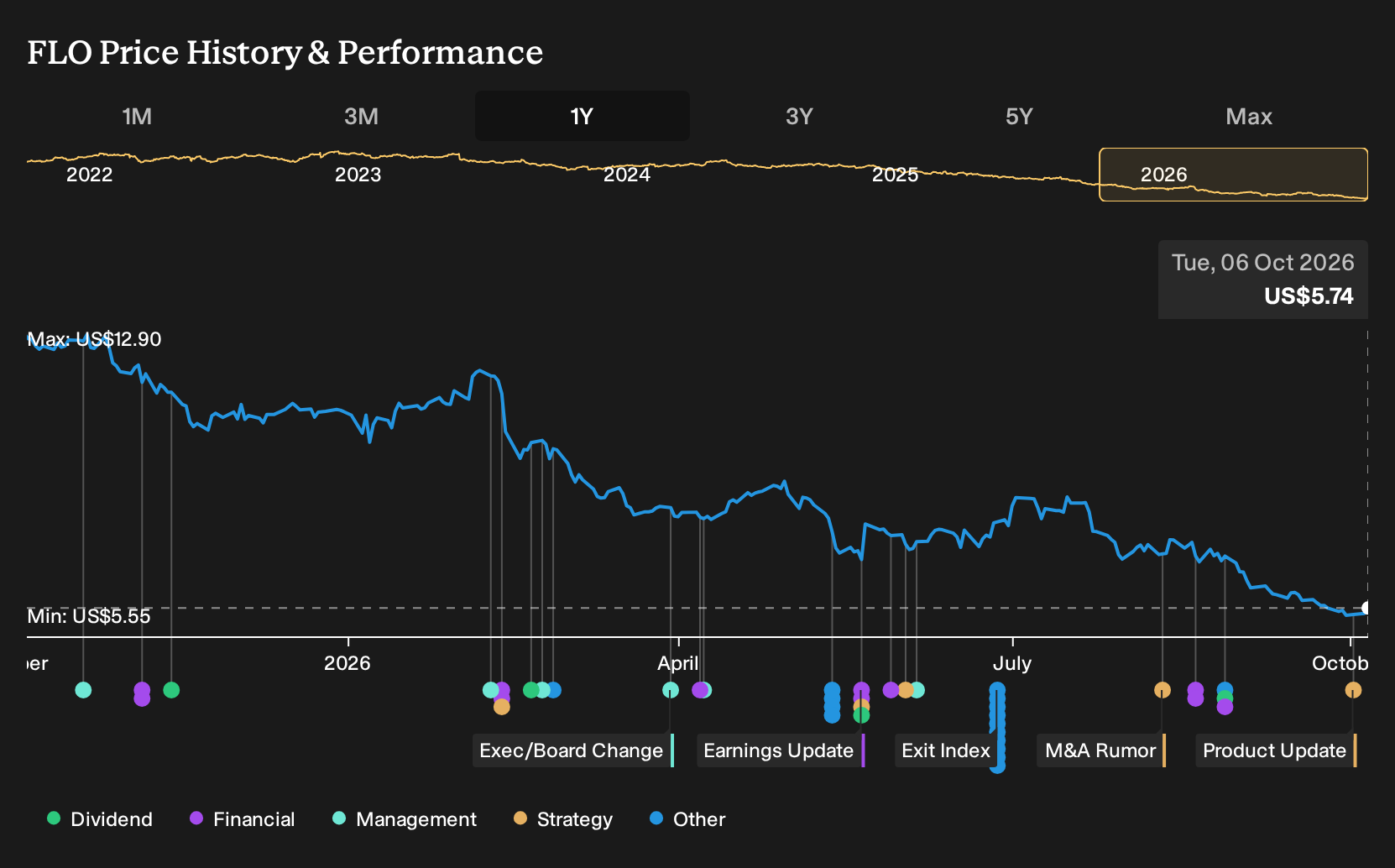
Exploring Other Perspectives
Some of the lowest ranked analysts focus less on product mix and more on labor and packaging cost risk. Before the recall, they were pencilling in roughly flat revenues around US$5.0b and earnings of US$128.8 million by 2029. You can read those pessimistic views as a reminder that opinions on Flowers Foods can swing widely as new events land.
Explore 8 other Flowers Foods fair value estimates, including one that suggests it could be worth just $6.00.
Reach Your Own Conclusion
Don't just follow the ticker. Dig into the data and build a conviction that's truly your own.
- A great starting point for your Flowers Foods research is our analysis highlighting 2 key rewards and 4 important warning signs that could impact your investment decision.
- See our latest analysis for Flowers Foods. The report includes a comprehensive fundamental analysis summarized in a single visual, the Snowflake, making it easy to evaluate Flowers Foods' overall financial health at a glance.
Looking For More Investment Ideas Beyond Flowers Foods?
If the Flowers Foods story has sharpened your thinking on risk, balance sheets, and future earnings potential, it can help to line it up against a broader watchlist built from objective filters.
- For investors hunting for potential mispricing, start with a focused set of candidates using our screener of 27 high quality undervalued stocks that already clear basic quality and balance sheet checks.
- If income is a priority, stress test your dividend watchlist by screening for companies with resilient cash flows using our collection of 8 dividend fortresses that aim to pair higher yields with staying power.
- When capital protection matters most, narrow your research pipeline to businesses with sturdier finances through our carefully curated 31 resilient stocks with low risk scores that score well on debt and earnings stability.
This article by Simply Wall St is general in nature. We provide commentary based on historical data and analyst forecasts only using an unbiased methodology and our articles are not intended to be financial advice. It does not constitute a recommendation to buy or sell any stock, and does not take account of your objectives, or your financial situation. We aim to bring you long-term focused analysis driven by fundamental data. Note that our analysis may not factor in the latest price-sensitive company announcements or qualitative material. Simply Wall St has no position in any stocks mentioned.
Have feedback on this article? Concerned about the content? Get in touch with us directly. Alternatively, email editorial-team@simplywallst.com