
Sabine Royalty Trust (SBR) Lifts Distribution As New Production Data Tests Whether Units Look Pricey
Dividend announcement and fresh production data set the tone
Sabine Royalty Trust (SBR) has paired a new monthly cash distribution of $0.355450 per unit with fresh oil and gas production figures released on October 5, 2026.
Sabine Royalty Trust units trade at $72.35, with the 1-day and 7-day share price returns of 1.36% and 3.19% suggesting short-term momentum building, while a 3.06% year-to-date share price gain and 5-year total shareholder return of 162.37% highlight a much stronger longer-term record.
Scan Sabine Royalty Trust’s latest move against other income-focused opportunities by reviewing our hand-picked 8 dividend fortresses featuring resilient cash flows and higher-yield potential.
After a fresh distribution announcement and mixed monthly production trends, the live question for Sabine Royalty Trust is whether most of the upside is already reflected in the US$72.35 price or if valuation still leaves room ahead.
Price-to-earnings of 14.8x: Is it justified for Sabine Royalty Trust?
On valuation, Sabine Royalty Trust trades on a P/E of 14.8x, which looks rich against both its own peer group and the broader US oil and gas space, even as the latest cash distribution and production data keep income-focused investors engaged.
The P/E ratio compares what the market is paying today for each dollar of Sabine Royalty Trust’s earnings. For a royalty trust built on mature producing assets, that figure often reflects how confident investors feel about the durability of distributions and the stability of the underlying production stream rather than aggressive future expansion.
Sabine Royalty Trust sits on a P/E of 14.8x, while the peer group average is 9.8x and the wider US oil and gas industry sits at 12.4x. That is a clear premium, which suggests the market is willing to pay more for each dollar of earnings than it does for comparable producers and royalty vehicles.
Stripping out the multiples, the SWS DCF model sends a very different signal. The units change hands at $72.35, while the model’s estimate of future cash flow value sits at $138.05 per unit, implying the current price is trading at 47.6% below that calculated fair value.
For Sabine Royalty Trust, that DCF framework projects the trust’s expected future cash distributions, then discounts them back using a required rate of return. It effectively asks what today’s unit price would need to be so that those future payments compensate investors for the time value of money and risk, given SBR’s asset base across states like Texas, Oklahoma and New Mexico.
The trust’s structure, high quality earnings profile, and very high reported return on equity together help explain why a simple earnings multiple can signal “expensive” while a cash-flow based model indicates room between price and estimated value. Income investors weighing the latest monthly distribution against long term cash flow potential may find the DCF lens a more direct way to think about what they are paying for those royalties.
Look into how the SWS DCF model arrives at its fair value.
Result: Price-to-earnings of 14.8x (OVERVALUED).
Still, Sabine Royalty Trust remains exposed to weaker commodity pricing and any sustained step down in production volumes, which could pressure future distributions and compress that valuation gap.
Find out about the key risks to this Sabine Royalty Trust narrative.
Another view on Sabine Royalty Trust’s value
The P/E screen presents Sabine Royalty Trust as expensive, yet the SWS DCF model suggests a different perspective. On that cash flow view, the $72.35 unit price is about 47.6% below an estimated $138.05 fair value, which indicates an apparent discount rather than a premium.
Look into how the SWS DCF model arrives at its fair value.
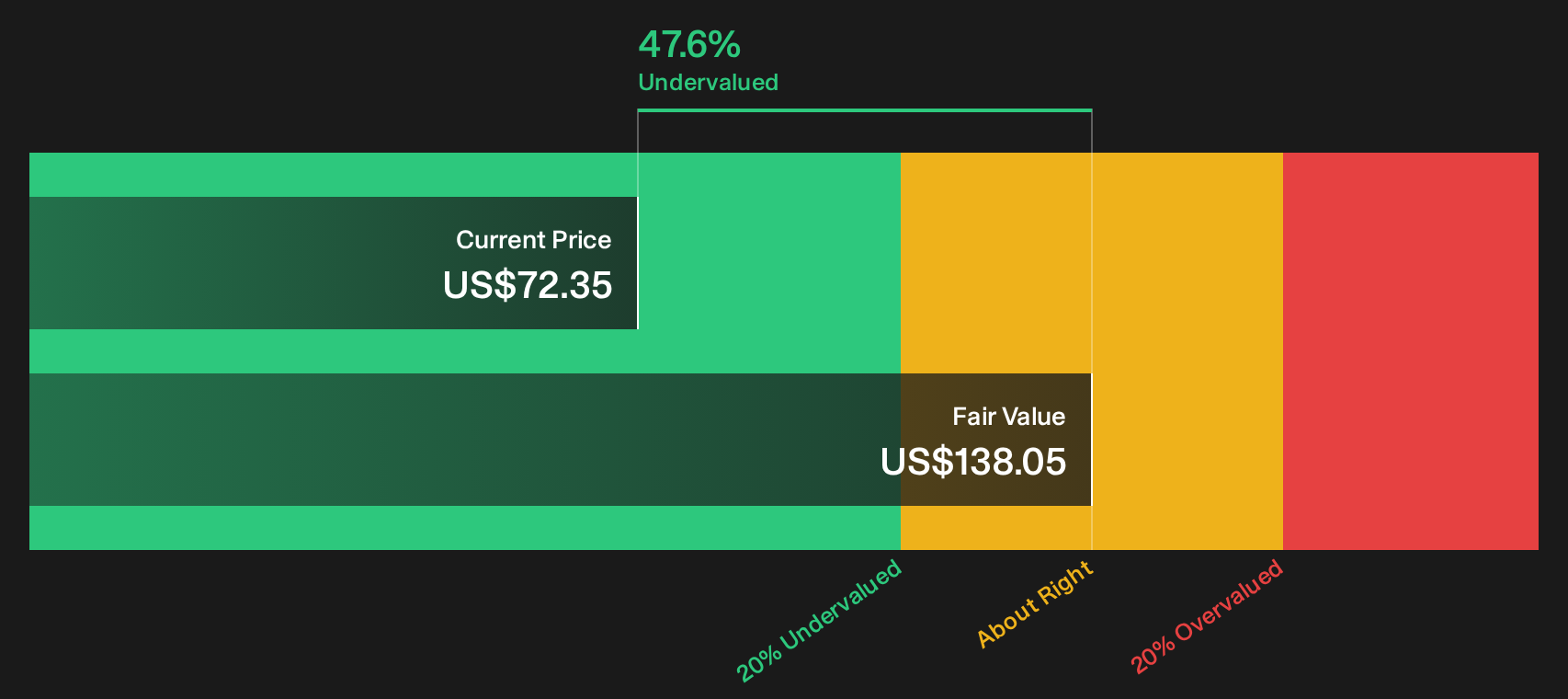
Simply Wall St performs a discounted cash flow (DCF) on every stock in the world every day (check out Sabine Royalty Trust for example). We show the entire calculation in full. You can track the result in your watchlist or portfolio and be alerted when this changes, or use our stock screener to discover 27 high quality undervalued stocks. If you save a screener we even alert you when new companies match - so you never miss a potential opportunity.
Next Steps
Sentiment around Sabine Royalty Trust is clearly mixed, so take a moment to test the numbers yourself and stress test both the income story and the valuation setup before you act, then weigh the 1 key reward and 1 important warning sign
Looking for more investment ideas beyond Sabine Royalty Trust?
If you only stop at Sabine Royalty Trust, you might miss other opportunities that fit your income goals and risk comfort just as well.
- Target higher potential value gaps by scanning the 27 high quality undervalued stocks, which filters for companies combining cash flow strength with attractive pricing.
- Strengthen your focus on financial resilience by checking the list of solid balance sheet and fundamentals (25 results) to see businesses backed by sturdier balance sheets and fundamentals.
- Spot less crowded opportunities early by reviewing the 19 high quality undiscovered gems, which highlights quality companies flying under most investors’ radar.
This article by Simply Wall St is general in nature. We provide commentary based on historical data and analyst forecasts only using an unbiased methodology and our articles are not intended to be financial advice. It does not constitute a recommendation to buy or sell any stock, and does not take account of your objectives, or your financial situation. We aim to bring you long-term focused analysis driven by fundamental data. Note that our analysis may not factor in the latest price-sensitive company announcements or qualitative material. Simply Wall St has no position in any stocks mentioned.
Have feedback on this article? Concerned about the content? Get in touch with us directly. Alternatively, email editorial-team@simplywallst.com