
Will New Smartwatch Launches Change Garmin (GRMN) Narrative
- Garmin recently launched two high end wearables: the Enduro 4 endurance GPS smartwatch with up to 320 hours of solar assisted activity tracking, and the Approach S72 golf watch with AMOLED display, advanced swing metrics and on device health features.
- The dual release deepens Garmin’s focus on premium, sport specific devices that can feed into its software and services ecosystem across fitness and golf.
- We will now look at how Garmin’s extended battery Enduro 4 could reshape the existing investment narrative around premium wearables.
Garmin Investment Narrative Recap
For an investor to stay with Garmin, the core belief is that Fitness, services and high end wearables can offset pressure in Outdoor and Auto OEM. The Enduro 4 and Approach S72 show the product pipeline is active, but they do not obviously change the near term focus on execution in higher margin Fitness and subscription services.
The clearest short term swing factor remains whether Garmin can grow device and services revenue fast enough to absorb expected higher memory costs and weakness in Outdoor and Auto OEM. The key risk is that Outdoor softness persists and Auto OEM margins retreat as anticipated, which could cap earnings even if flagship wearables sell well.
The Enduro 4 launch looks most relevant for investors watching Outdoor. It directly targets endurance users, an area where management has been working to stabilize performance after Outdoor revenue declines of 5% in Q1 2026 and 2% in Q2 2026. If the new watch only shifts mix within Outdoor without lifting volumes, the financial effect could be limited.
Viewed against catalysts like Garmin Connect+, the CIRQA Smart Band and the acquisitions of TrainingPeaks and TrainHeroic, Enduro 4 fits a broader push to keep serious athletes inside the Garmin ecosystem for longer. The potential benefit is that longer battery life and deeper metrics support services adoption. The execution risk is that higher component costs and pricing pressure narrow the economic payoff.
What The Current Garmin Forecasts Assume
Garmin's current analyst playbook leans heavily on growth in higher end wearables and services, and that flows through directly into the long term numbers investors are using as a reference point today.
Analysts are building their models around revenue that is expected to rise by 9.1% a year over the next three years, with profit margins easing from 24.5% today to 23.6% over the same span.
On earnings, the consensus view points to profit of US$2.3b by 2029, compared with US$1.9b today, with the more optimistic forecasts stretching to US$3.0b.
That shift from US$1.9b to the US$2.3b baseline implies an earnings increase of about US$0.4b, before even considering the more upbeat scenarios some analysts are publishing.
Garmin's narrative projects US$10.0b revenue and US$2.3b earnings by 2029. This requires 9.1% yearly revenue growth and an earnings increase of about US$0.4b from US$1.9b today.
The structure behind those estimates is clear. Analysts are effectively asking investors to accept a future P/E of 31.5x on the 2029 consensus earnings, compared with 28.9x today and a US Consumer Durables industry multiple of 13.1x.
That kind of premium usually only holds if the market believes Garmin can keep users locked into its devices and services for longer. Launches like the Enduro 4 and the broader training ecosystem around it become part of the justification for those future earnings assumptions.
Uncover why Garmin's fair value indicates an 8% potential upside to its current price that could narrow quickly.
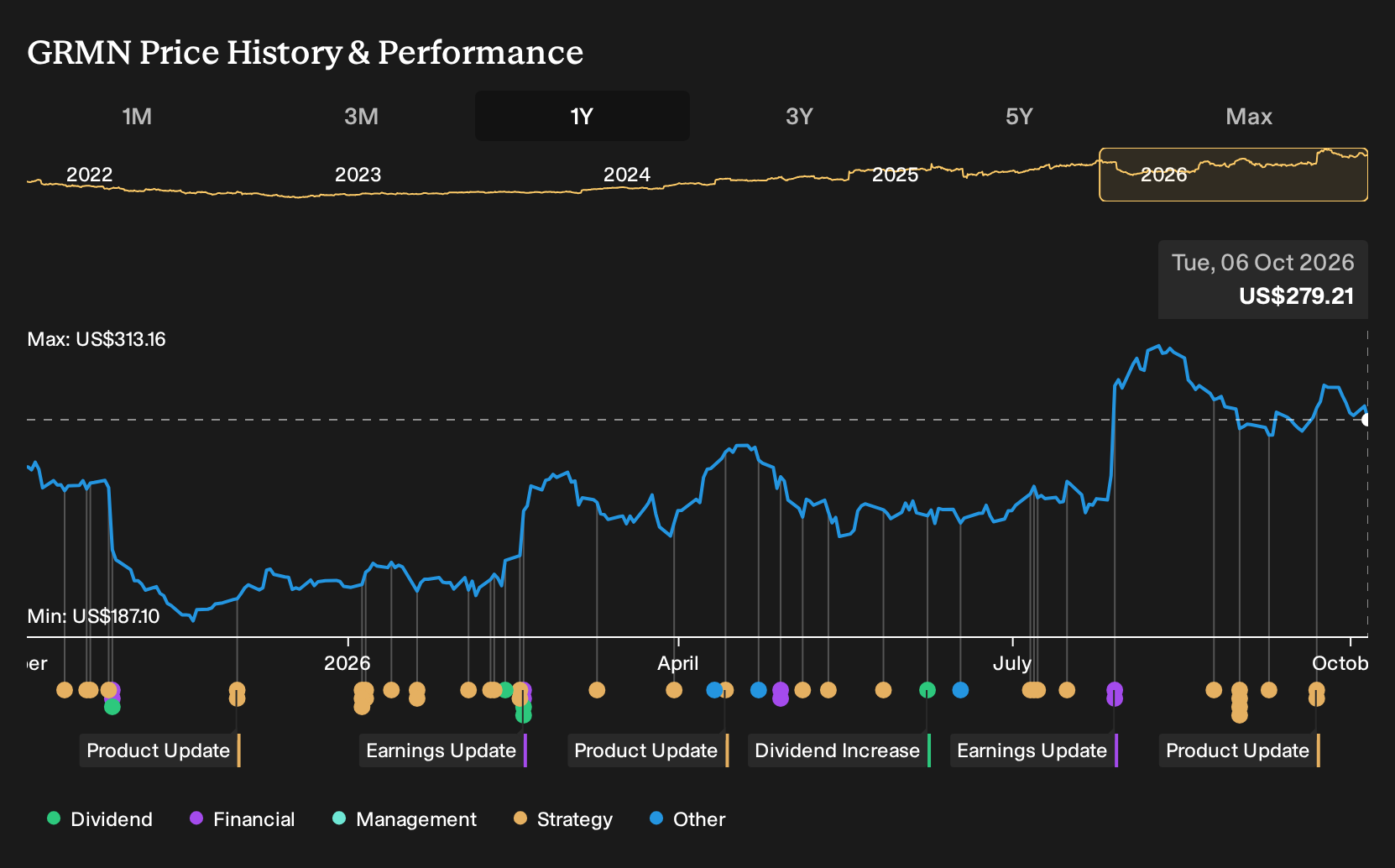
Exploring Other Perspectives
One alternate view puts less faith in Garmin’s subscription story and sees a risk that services tied to devices like Enduro 4 remain smaller than hoped. The most cautious analysts were working off revenue of about US$9.9b and earnings near US$2.2b by 2029. That is a tighter outlook than the US$10.0b and US$2.3b consensus scenario, and it shows how sharply opinions can differ. Both sets of forecasts were made before these new product launches, so you may want to compare them and decide which version of Garmin’s future you find more convincing.
Explore 4 other Garmin fair value estimates, including one that suggests there could be as much as 17% downside from the current price.
The Verdict Is Yours
Disagree with existing narratives? Extraordinary investment returns rarely come from following the herd, so consider trusting your own analysis.
- A great starting point for your Garmin research is our analysis highlighting 3 key rewards and 1 important warning sign that could impact your investment decision.
- See our latest analysis for Garmin. The report includes a comprehensive fundamental analysis summarized in a single visual, the Snowflake, making it easy to evaluate Garmin's overall financial health at a glance.
Looking For More Garmin Style Investment Ideas?
If the Garmin story has you thinking about other businesses pairing strong products with durable economics, the Simply Wall St screener can help you widen the net without losing focus on quality.
- For investors who care most about balance sheet strength and fundamentals, start with this list of solid balance sheet and fundamentals (25 results) that may handle stress better than highly leveraged peers.
- If capital preservation and smoother returns matter more to you than chasing every swing, take a look at 31 resilient stocks with low risk scores that currently screen well on Simply Wall St's risk model.
- Those hunting for potential mispricing opportunities might prefer 27 high quality undervalued stocks that combine quality indicators with valuations that our methodology flags as attractive.
This article by Simply Wall St is general in nature. We provide commentary based on historical data and analyst forecasts only using an unbiased methodology and our articles are not intended to be financial advice. It does not constitute a recommendation to buy or sell any stock, and does not take account of your objectives, or your financial situation. We aim to bring you long-term focused analysis driven by fundamental data. Note that our analysis may not factor in the latest price-sensitive company announcements or qualitative material. Simply Wall St has no position in any stocks mentioned.
Have feedback on this article? Concerned about the content? Get in touch with us directly. Alternatively, email editorial-team@simplywallst.com