
3 Australian Dividend Stocks To Watch With Up To 6% Yield
Asian shares have just rallied after weaker United States jobs data pulled back expectations for another Federal Reserve rate hike, and that softer rates tone suddenly makes reliable income streams more attractive. When cash returns may not keep rising, Australian dividend stocks throwing off yields above 3% can look appealing for investors wanting regular cashflow. This article walks through three higher yielding candidates from our income screen.
The three dividend stocks below are just a starting sample from this income theme, and the full screen surfaced 37 more companies with similarly compelling income stories that are not covered here.
To go deeper into the idea, head straight into the Dividend Powerhouses (3%+ Yield) screener to identify, filter and analyze the highest conviction dividend plays for your watchlist.
Objective (ASX:OCL)
Overview: Objective is an enterprise software group that helps governments and regulated industries manage records, automate workflows, and govern sensitive information through its Objective Nexus and Objective 3Sixty platforms.
Operations: Objective generates about A$134.7 million of software and programming revenue, largely from Australia, New Zealand, and the United Kingdom public sectors.
Market Cap: A$555 million
Objective matters for this dividend screen because its governance software is built into critical public-sector workflows, creating recurring licence and service income that can support a stable, covered payout.
"When two-thirds of the shares are held by the person who built the thing, you don't spend much time worrying about incentive alignment."
The real test for Objective’s income story now hinges on how one unresolved contract shock ultimately shapes margins and recurring cash generation.
That contract shock is only part of the story, and the full narrative for Objective shows how Objective’s recurring income and founder alignment could be decoupling risk from long term dividend potential.

Nick Scali (ASX:NCK)
Overview: Nick Scali runs a furniture retail business, selling sofas, dining, bedroom pieces and accessories through showrooms and online. It uses this cash-generating model to support regular dividends.
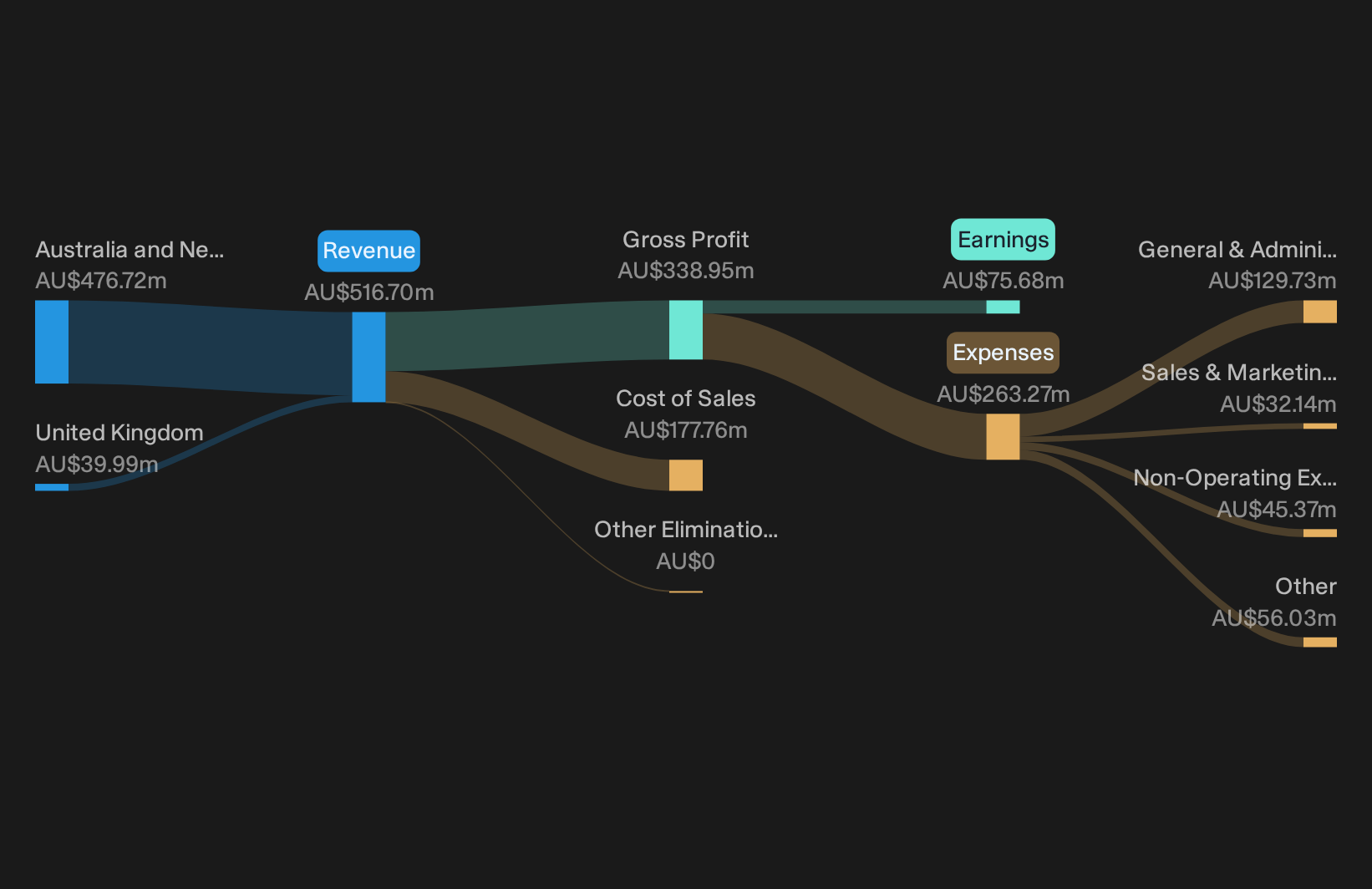
Operations: Nick Scali derives A$516.7 million in revenue from furniture retailing, with A$476.7 million from Australia and New Zealand and A$40.0 million from the United Kingdom.
Market Cap: A$1.2b
For the Dividend Powerhouses theme, Nick Scali matters because its furniture sales generate steady cashflow that underpins a 5.61% headline yield. This draws income investors to a single, easy to understand source of dividend funding.
"Solid ongoing sales growth in Australia and New Zealand, underpinned by increased store traffic, continued store expansion, and favourable demographic tailwinds such as population growth and urbanisation, positions Nick Scali for sustainable revenue and earnings expansion."
The key swing factor for Nick Scali’s dividend strength now is how one evolving cost pressure ultimately affects future profit margins.
That margin question is exactly what the full narrative for Nick Scali unpacks, showing how Nick Scali’s cost pressures, cash generation and dividend profile could be shifting under the surface.
Vita Life Sciences (ASX:VLS)
Overview: Vita Life Sciences sells branded vitamins and supplements across Asia-Pacific, turning repeat pharmacy and health-store purchases into cash flow that supports dividends.
Operations: Vita Life Sciences generates about A$43 million from Australian VMS operations, A$46 million from Malaysia and Singapore, and A$6 million from China and Vietnam.
Market Cap: A$146 million
Vita Life Sciences brings a 5.19% yield backed by recurring consumer health sales and earnings described as high quality. Investors should monitor how one less visible pressure ultimately affects the durability of that income stream.
That quieter pressure on Vita Life Sciences makes the 3 key rewards and 1 important warning sign a sharp shortcut to see what might be strengthening or eroding that dividend story next.

Seeking Alternatives Before Everyone Else?
Fresh ideas move first. Capital chases momentum and late entries often get caught chasing flying prices or dropping quality. Scan these under the radar themes while it matters and act now.
- Spot resilient compounders early by running the 7 resilient stocks with low risk scores and focus your attention on businesses where balance sheets and risk scores already do much of the heavy lifting.
- Explore potential infrastructure exposure by targeting enabling hardware and data picks through the 91 AI infrastructure stocks, before capital crowds into the most visible names.
- Consider ways to gain exposure to metals by filtering producers in the 36 elite gold producer stocks that pair quality assets with financial discipline while they are still under the radar for now.
This article by Simply Wall St is general in nature. We provide commentary based on historical data and analyst forecasts only using an unbiased methodology and our articles are not intended to be financial advice. It does not constitute a recommendation to buy or sell any stock, and does not take account of your objectives, or your financial situation. We aim to bring you long-term focused analysis driven by fundamental data. Note that our analysis may not factor in the latest price-sensitive company announcements or qualitative material. Simply Wall St has no position in any stocks mentioned.
Have feedback on this article? Concerned about the content? Get in touch with us directly. Alternatively, email editorial-team@simplywallst.com