
Is Manchester United (MANU) Undervalued Following Rising Debt And Weaker Earnings?
Debt pressure and fresh guidance put Manchester United stock under the microscope
Manchester United (NYSE:MANU) has been thrust back into focus after fresh attention on its rising debt burden coincided with a new quarterly earnings report and revenue guidance for fiscal 2027.
Recent coverage highlighted total borrowings of about £1.1b, including an extra £90 million taken on over the summer, at the same time that management outlined projected sales of £740 million to £760 million and reported a wider quarterly loss.
The share price has given back some ground recently, with a 1-day share price return of 2.62% lower and a 90-day share price return down 10.16%, even though the year-to-date share price return is up 27.25% and the 1-year total shareholder return is 30.05%. This suggests momentum has cooled as the new guidance and higher debt load reshape how investors view Manchester United’s risk profile.
Scan how other clubs and media businesses with stronger balance sheets are positioned by reviewing our curated list of list of solid balance sheet and fundamentals (25 results) as you weigh Manchester United’s rising debt load.
Manchester United now trades below the average analyst target, even as losses widen and debt climbs. Is that a margin of safety or a warning sign that the valuation work still needs to reflect the new reality?
Most Popular Narrative: 15.1% Undervalued
On the most followed view, Manchester United screens below an estimated fair value of $23.65, compared with a last close of $20.08. This puts the focus firmly on whether the current rebuild can justify that gap.
The planned midfield overhaul at Manchester United, including planned additions such as Carlos Baleba, Andrey Santos and Manu Kone, is intended to address structural weaknesses in the squad ahead of Champions League campaigns. This could support future matchday and broadcasting revenue if performances stabilize.
The shift toward targeting players like Sander Berge and Joaquin Seys when higher priced options are deemed too expensive signals tighter discipline on transfer spending. This can help protect net margins and earnings over future windows.
See why 4 investors see Manchester United as 15% undervalued.
Result: Fair Value of $23.65 (UNDERVALUED)
Still, high wage commitments and uneven transfer income leave Manchester United exposed if key sales stall or injuries keep matchday and broadcasting performance under strain.
Find out about the key risks to this Manchester United narrative.
Another View: Manchester United looks expensive on sales
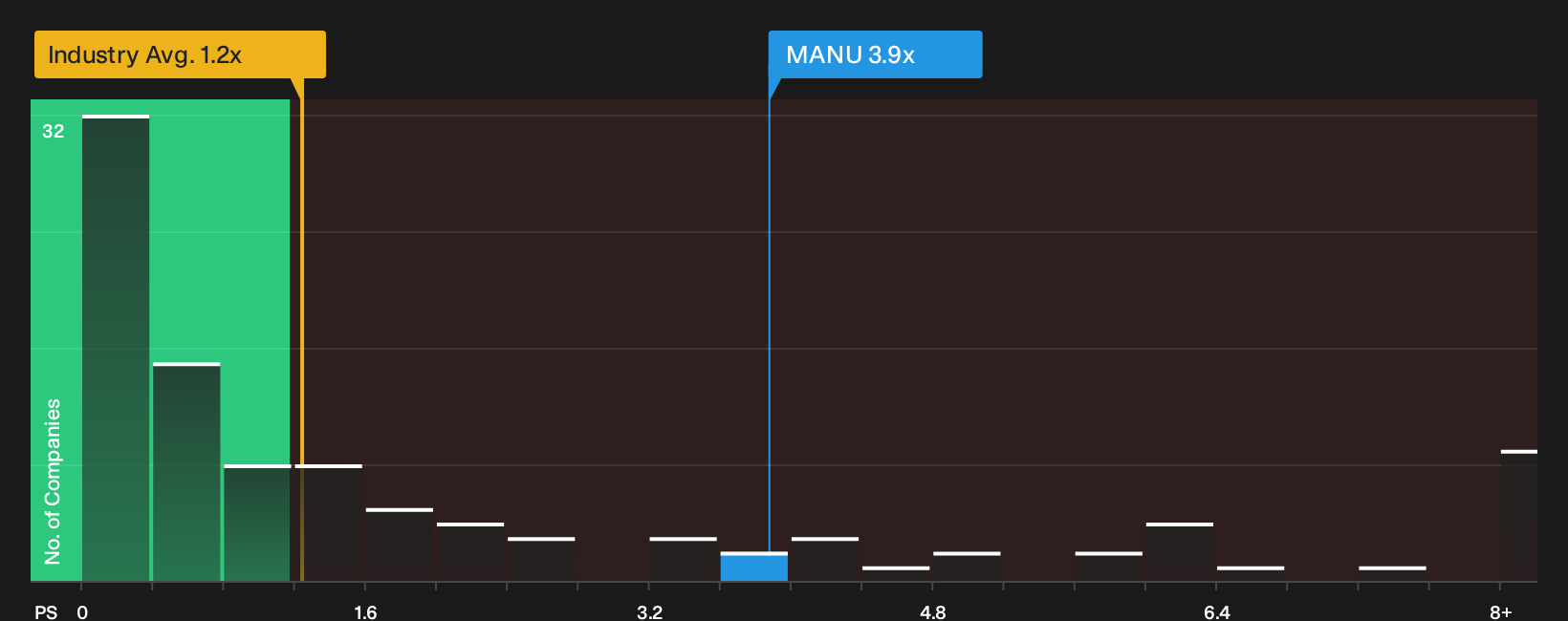
The fair value narrative leans on future earnings and rebuild execution. On current sales though, Manchester United trades on a P/S of 3.9x, compared with 1.2x for the US Entertainment sector and a 2.6x peer average, while the fair ratio sits nearer 1.9x. That gap points to meaningful valuation risk if sentiment cools.
Sense check that premium by running the numbers yourself in our valuation breakdown, starting with the See what the numbers say about this price — find out in our valuation breakdown..
Next Steps
If the mixed tone on Manchester United leaves you unsure, move quickly and review the numbers yourself so your view is not shaped for you. To pressure test that view against potential downside, start with the 1 important warning sign.
Looking for more Manchester United sized investment ideas?
You do not need to stop with Manchester United. Broaden your watchlist now so you are not relying on a single story to shape your portfolio.
- Target potential bargains early by scanning 19 high quality undiscovered gems before the crowd turns its attention to them.
- Strengthen your downside protection by focusing on 31 resilient stocks with low risk scores that prioritize resilience when conditions get tougher.
- Build a watchlist of potential value candidates by reviewing the 31 high quality undervalued stocks that combine solid fundamentals with appealing pricing.
This article by Simply Wall St is general in nature. We provide commentary based on historical data and analyst forecasts only using an unbiased methodology and our articles are not intended to be financial advice. It does not constitute a recommendation to buy or sell any stock, and does not take account of your objectives, or your financial situation. We aim to bring you long-term focused analysis driven by fundamental data. Note that our analysis may not factor in the latest price-sensitive company announcements or qualitative material. Simply Wall St has no position in any stocks mentioned.
Have feedback on this article? Concerned about the content? Get in touch with us directly. Alternatively, email editorial-team@simplywallst.com