
Will New Rewards Card Change Kroger (KR) Narrative
- Kroger launched the Kroger Rewards World Elite Mastercard, issued by First Bank & Trust and managed by Imprint Payments. The card offers up to 5X points on digital Kroger purchases, multi-category earning rates, flexible grocery and fuel redemptions, a $100 welcome bonus, and a complimentary Boost Essential membership.
- The card ties everyday non-grocery spending directly into Kroger’s rewards ecosystem. This creates another touchpoint to keep customers inside its digital and in-store network while potentially deepening engagement with its broader loyalty program.
- We will now look at how Kroger's broader investment narrative could be influenced by this new World Elite rewards credit card launch.
Scan how Kroger's new rewards push compares with other retailers tying payments to loyalty by reviewing our hand picked list of solid balance sheet and fundamentals (25 results).
Kroger Investment Narrative Recap
To own Kroger, an investor generally needs to believe that its mix of physical stores, digital grocery and private brands can convert heavy investment into steadier earnings and cash flow. The new World Elite Mastercard fits that story by pulling more everyday spend into Kroger’s ecosystem, although its near term financial impact versus large group margins and debt looks limited.
The near term swing factor still sits in execution on digital profitability and cost control, as net margins sit at 0.7% against higher levels a year ago. The biggest risk remains margin pressure from e-commerce, wages and interest on a sizable debt load, rather than this card launch itself.
The most relevant additional development for this story is Kroger’s recent fixed income activity. The company issued US$650m of 5.800% notes due 2032 and US$850m of 6.200% notes due 2036, both senior unsecured and callable, at small discounts to par. That directly ties into how management funds ongoing investments.
For a shareholder, those bond deals feed into the same catalyst and risk equation as the new credit card. The business is leaning on higher cost borrowing while e-commerce is still unprofitable and margins have compressed. Execution now is about converting these funded projects, including loyalty and digital, into steadier returns without stretching the balance sheet.
Kroger's narrative projects US$159.7b revenue and US$3.3b earnings by 2029. That path assumes 2.3% yearly revenue growth and an earnings increase of about US$2.2b from US$1.1b today.
Uncover why Kroger's fair value indicates a 16% potential upside to its current price that may not last much longer.
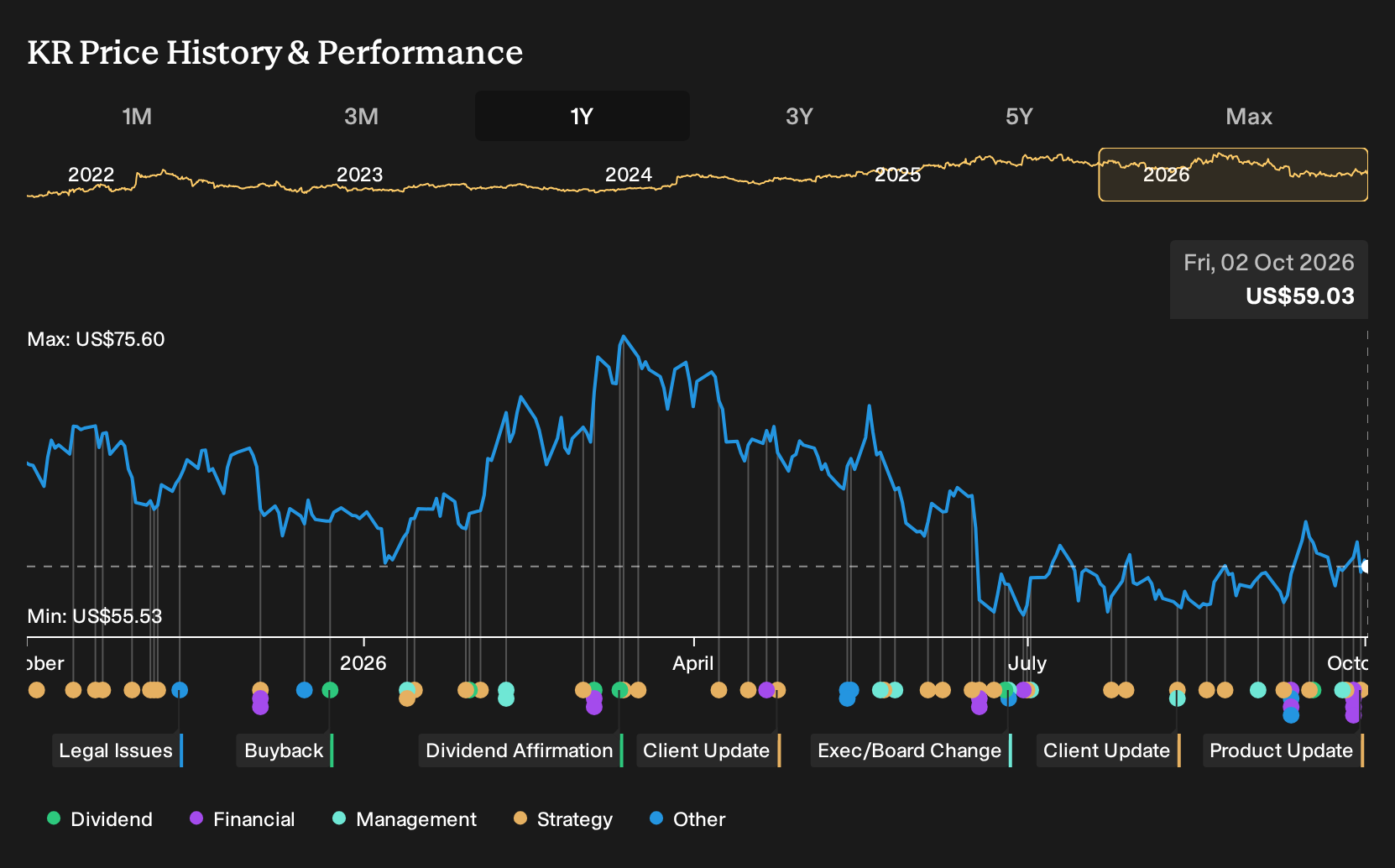
Exploring Other Perspectives
The most cautious analysts focus on Kroger’s consumer demand risk rather than its new card potential. They were penciling in only 1.7% annual revenue growth and about US$2.7b in earnings by 2029. That is far below the top end at US$3.8b. The new rewards launch could nudge those views in either direction once models update.
Explore 3 other Kroger fair value estimates, including one that suggests it could be worth just $68.48.
Decide For Yourself
Disagree with existing narratives? Extraordinary investment returns rarely come from following the herd, so go with your instincts.
- A great starting point for your Kroger research is our analysis highlighting 3 key rewards and 4 important warning signs that could impact your investment decision.
- See our latest analysis for Kroger. The report includes a comprehensive fundamental analysis summarized in a single visual, the Snowflake, making it easy to evaluate Kroger's overall financial health at a glance.
Looking For More Ideas Beyond Kroger?
If Kroger has you rethinking how steady, cash generative businesses fit in your portfolio, it can help to line it up against a few other options with different risk and income profiles. The Simply Wall St Screener lets you do that quickly by filtering for traits that match what you care about most.
- If you want potentially higher upside in smaller companies and are willing to accept more volatility, you could scan a focused group of 7 elite penny stocks with strong financials that already carry strong financials.
- If your priority is paying a fair price for quality, you might start with a curated pool of 31 high quality undervalued stocks that pair cash generation with sturdier balance sheets.
- If portfolio resilience and capital preservation matter more than chasing every swing, consider reviewing a targeted selection of 31 resilient stocks with low risk scores that score well on financial risk metrics.
This article by Simply Wall St is general in nature. We provide commentary based on historical data and analyst forecasts only using an unbiased methodology and our articles are not intended to be financial advice. It does not constitute a recommendation to buy or sell any stock, and does not take account of your objectives, or your financial situation. We aim to bring you long-term focused analysis driven by fundamental data. Note that our analysis may not factor in the latest price-sensitive company announcements or qualitative material. Simply Wall St has no position in any stocks mentioned.
Have feedback on this article? Concerned about the content? Get in touch with us directly. Alternatively, email editorial-team@simplywallst.com