
Bank of America Put a $60 Price Target on IonQ. The Quantum Bet Is Picking Up Speed.
IonQ (IONQ) has moved beyond being simply a bet on whether quantum computers eventually work. The company is now expanding its business into quantum computing, networking, sensing, security, and semiconductor manufacturing.
That shift helps explain why Bank of America has put a $60 price target on IONQ and why some analysts are expecting the stock to soar even higher.
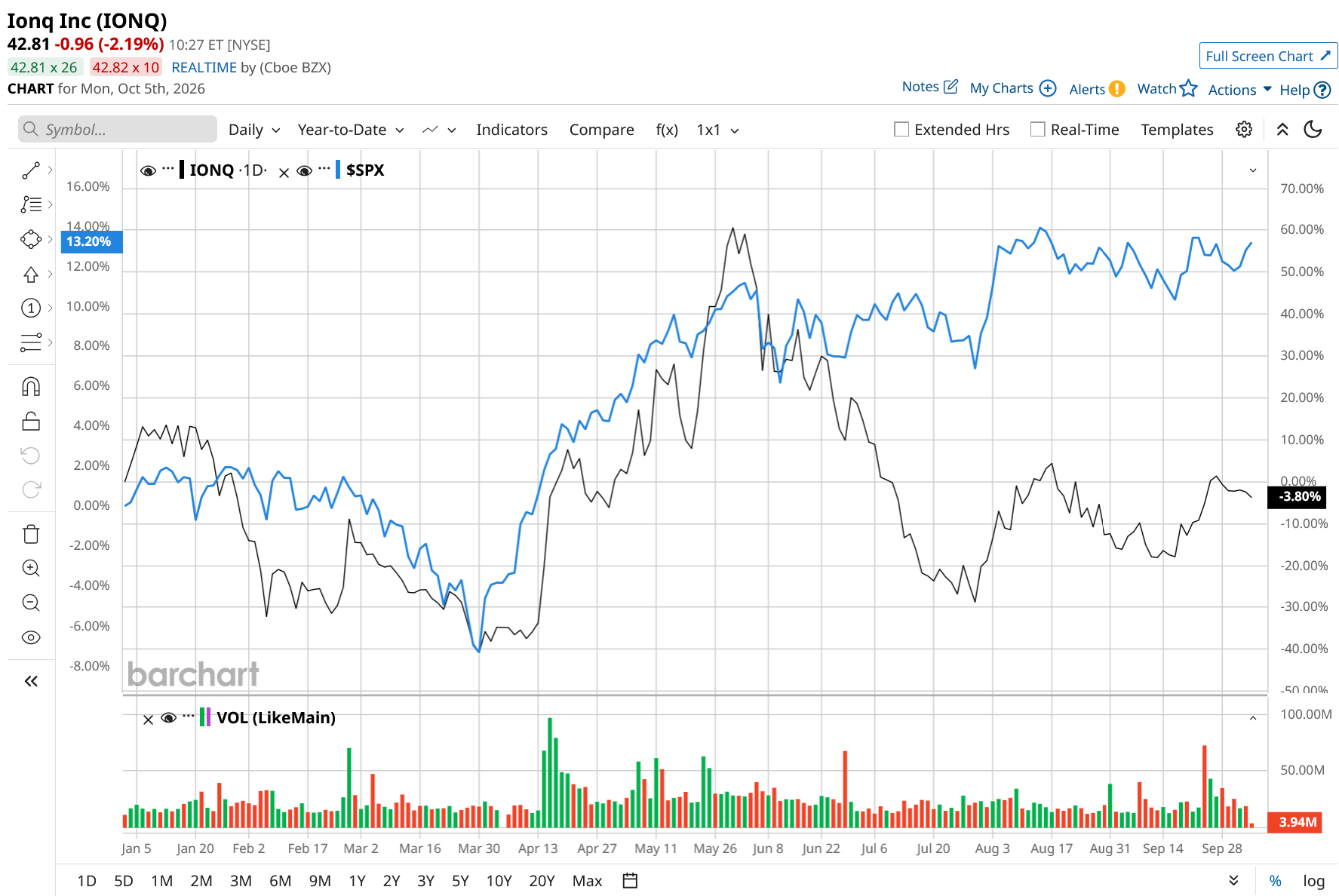
Bank of America Sees More Than Just a Quantum Computer Company
Recently, Bank of America initiated coverage of IonQ with a “Buy” rating and a target price of $60. The firm pointed to IonQ's position as the largest publicly traded pure-play quantum company by revenue, while highlighting its acquisitions and expansion into networking, security, sensing, space, and foundry services. The bank also sees IonQ's semiconductor-based strategy to increase qubit counts as an important part of its long-term opportunity.
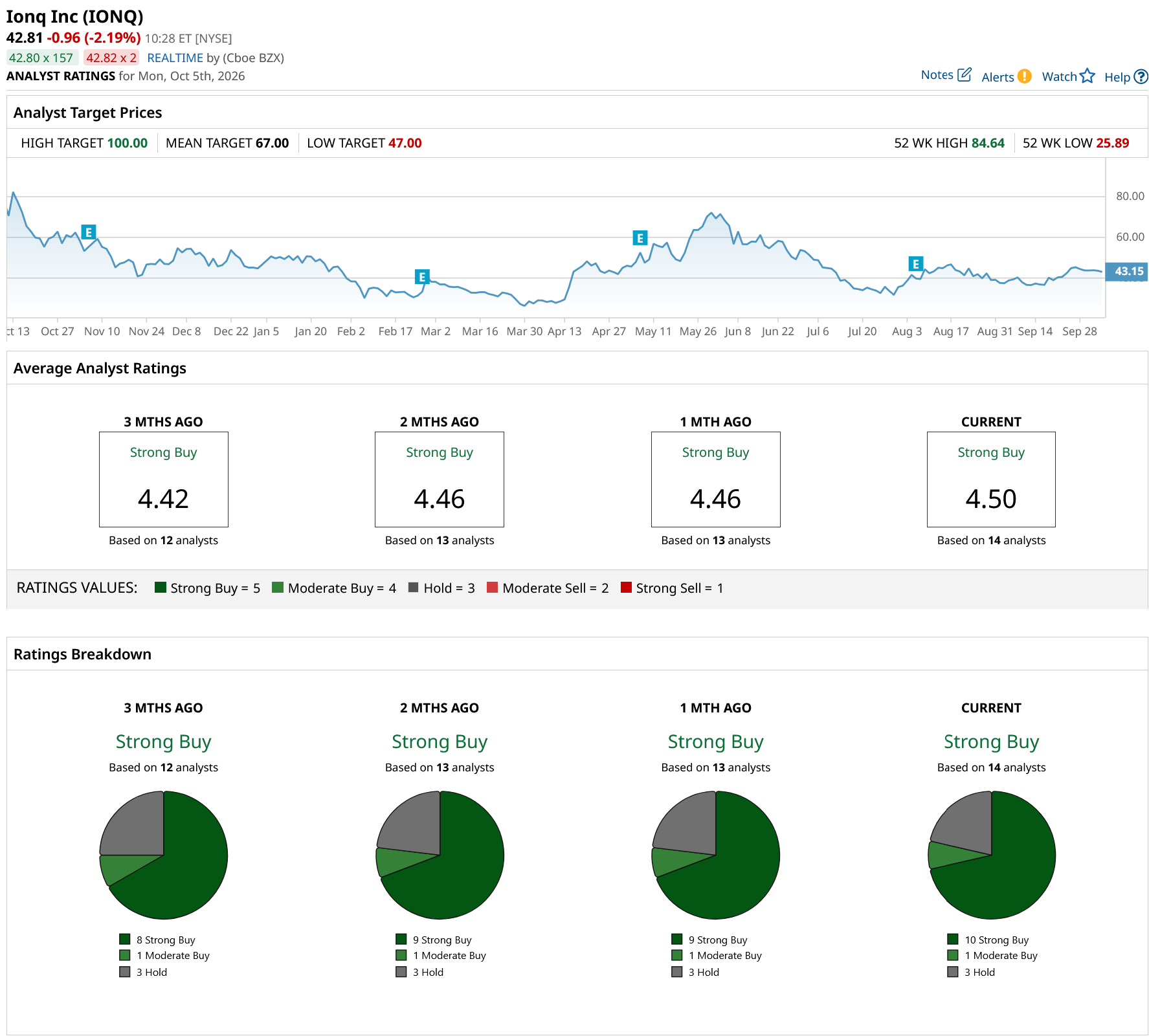
At around $43, the $60 target implies roughly 40% upside. While that looks like meaningful upside, it isn’t extreme. The mean target price for the stock sits at $67, with B. Riley Securities and Rosenblatt Securities assigning the highest price target of $100, which implies a potential upside of 133% from here.
The Opportunity Is Becoming Much Larger Than Qubits
IonQ is building computers that use quantum physics to solve certain problems much faster than today’s traditional computers. It also builds the hardware, software, networking, and security systems around them. In the second quarter, IonQ generated $80.1 million in revenue, a 287% increase from the same quarter a year ago. Organic revenue growth was 132%, suggesting the business was expanding rapidly, not just through acquisitions. The company generated 60% of total revenue from commercial customers, about 50% from international business, and around 25% from customers buying multiple products. IonQ ended the quarter with $485 million of RPO, compared with $122 million a year earlier. RPO is the amount of contracted business that the company can turn into revenue over time.
Quantum computing remains highly competitive, with pure-play companies like Rigetti Computing (RGTI) and D-Wave Quantum (QBTS) also expanding rapidly. However, IonQ has multiple commercial avenues that can contribute to revenue, along with a technical edge. IonQ's ambitions now extend well beyond building quantum computers. Its portfolio now stretches across quantum networking, sensing, cybersecurity, and manufacturing. This enables IonQ to create new opportunities to monetize while the most advanced fault-tolerant quantum computers are still being developed.
Multi-product sales climbed 40% year-over-year (YoY) in Q2. A quantum company that sells one expensive computer at a time has a very different growth profile from one that can sell computing, networking, security, and sensing products to the same customer. Its multi-product cross-selling strategy has led Bank of America to believe that the company has a lot of upside potential.
IonQ Just Raised the Bar for Its 2026 Revenue
IonQ's acquisition of SkyWater Technology is another reason BofA is bullish. The acquisition creates a vertically integrated business that combines quantum-system development with semiconductor manufacturing. The strategic advantage is that IonQ controls more of the manufacturing process, giving it more control over how quickly its quantum technology improves and how efficiently it can eventually be produced. The company is already reaping the benefits. IonQ said at its Investor Day that the integration of SkyWater capabilities decreased its 256-qubit product development cycle from nine months to two months.
Furthermore, IonQ has unveiled the Superion 256 system, is accepting orders for it, and expects customer deliveries in 2027. The company also plans to use the technology acquired through Oxford Ionics and SkyWater to push toward larger, more manufacturable quantum systems. If the integration is successful, it will show investors how IonQ will eventually move from specialized systems toward larger-scale commercial deployment.
Following the acquisition, the company raised the 2026 revenue outlook to $450 million to $460 million from the previous range of $280 million to $290 million. However, investors should also note that this is not purely organic growth, as SkyWater is now part of the consolidated company. Nonetheless, IonQ's underlying business had already been growing rapidly, with management targeting more than 100% organic revenue growth for 2026.
Can IONQ Stock Hit $60 or Above?
IONQ stock’s move to $60 would require investors to believe that the company's revenue growth can remain exceptionally high while its expanding product portfolio creates a much larger addressable market. The company has already prepared the ingredients. It has a rapidly growing revenue base, nearly half a billion dollars of RPO, a substantially larger commercial business than its pure-play peers, and a newly integrated semiconductor manufacturing operation. The next step is cooking it all together.
The path to a price target of $100, however, will need more than just revenue growth. IonQ is nowhere close to being a mature technology company. It reported an enormous GAAP loss of $1.87 billion. Management stated that the GAAP loss was heavily affected by a non-cash change in the value of warrants. However, the adjusted EBITDA loss of $120.3 million shows that IonQ is spending heavily to build the business.
The technology itself still has a long way to go. Imagine AI in its early stages. While quantum computing has made significant technical progress, commercially useful, fault-tolerant machines at scale are still being developed. IonQ has to prove that its technical roadmap translates into customers, repeat revenue, and eventually stronger profitability.
On Wall Street, IONQ stock holds a consensus rating of “Strong Buy.” Among the 14 analysts covering IONQ, ten rate it a “Strong Buy,” one calls it a “Moderate Buy,” and three suggest it is a “Hold.”
On the date of publication, Sushree Mohanty did not have (either directly or indirectly) positions in any of the securities mentioned in this article. All information and data in this article is solely for informational purposes. For more information please view the Barchart Disclosure Policy here.