
Damo: US data center power gap reaches 34%, leading chip manufacturers are temporarily under pressure from midstream and downstream links
The Zhitong Finance App learned that Morgan Stanley released a research report to update the estimated results of the power shortage in US AI data centers and the impact on the industry chain. According to the report, the total electricity demand gap for US data centers reached 57 GW in 2026-2028. After deducting “plug and play” power solutions such as post-meter power generation (BTM) and fuel cells, the net gap still reached 32 GW, accounting for 34% of the total demand during the same period. The shortage of electricity has gradually replaced the supply of chips and has become a core bottleneck in the expansion of AI computing power. However, the report emphasizes that with their global layout, higher power output per unit, and clear upstream and downstream visibility, the 2027 performance guidelines will not be impacted by power constraints for the time being, and the middle and downstream sectors such as ASICs, storage, optical modules, and analog devices will face greater risk of fluctuating demand.
Gap calculation: 34% of electricity gaps exist for a long time, and computing power resources are concentrated at the top
Morgan Stanley estimates that the cumulative electricity demand for US data centers in 2026-2028 reached 97 GW, of which the data center under construction covered 21 GW and the usable capacity of the power grid covered 19 GW. The initial power gap after deducting the two was 57 GW. After factory-weighted “plug and play” solutions such as BTM gas turbines, Bloom energy fuel cells, nuclear power plant site transformation, and cryptographic mine transformation, the net gap under the benchmark scenario was 32 GW, accounting for 34% of total demand; the gap could be narrowed to 15 GW under an optimistic scenario, and widened to 42 GW under a pessimistic scenario.
On a yearly basis, the electricity gap is expanding year by year: the net gap is about 9 GW in 2026, 15 GW in 2027, 32 GW in 2028, and further rising to 68 GW in 2029. According to the report, large-scale deployment of next-generation high-power GPU racks, such as the NVL72, is a core driver of the surge in power demand. The supply side also showed a highly concentrated pattern. In 2026-2028, hyperscale cloud vendors and emerging cloud vendors (Amazon, Google, Microsoft, Meta, etc.) contributed 60% to 95% of the new global data center production capacity. Leading players have an absolute advantage in power resource competition with stronger credit qualifications, revenue certainty, and procurement scale. Small and medium-sized cloud vendors, international vendors, and energy-inefficient chip manufacturers face the risk of being squeezed out.
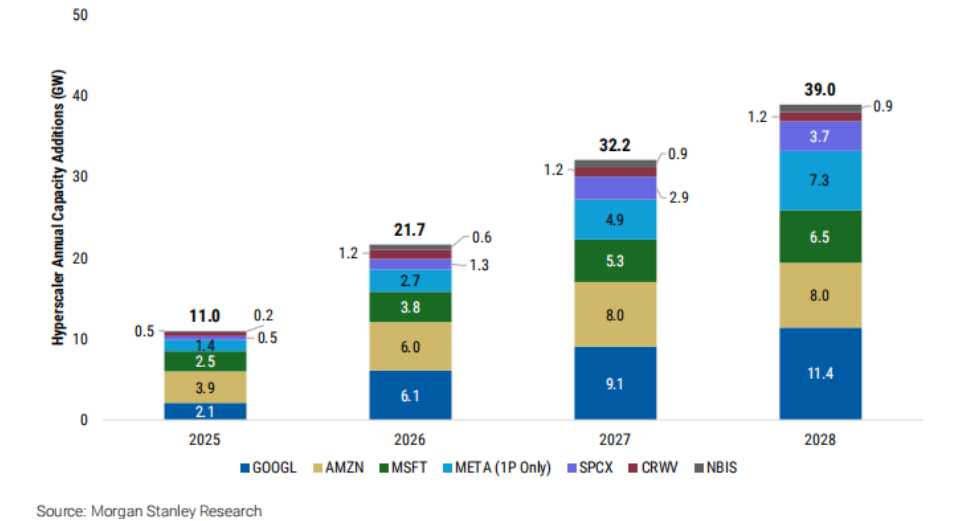
(Hyperscale cloud vendors and emerging cloud vendors will add 32 gigawatts of computing power capacity in 2027 and 39 gigawatts in 2028; among them, Google's new operating capacity ranks first)
The industrial chain affects differentiation: leading chip manufacturers are safe, and the middle and downstream end are under pressure
According to the report, the impact of electricity shortages on the semiconductor industry chain is clearly stratified. Together, Nvidia and Broadcom account for about 90% of the AI XPU market. The combined 12-month AI revenue guidance given by the two companies is about $800 billion. Currently, the guidelines are not substantially threatened by power shortages.
The core support lies in four aspects: management performance guidelines have fully taken into account the risk of shortage of site, power and infrastructure (LPS); high visibility into the full chip chain deployment sites; active layout of global computing power nodes outside the US; Nvidia's per gigawatt computing power output is significantly higher than that of its peers, and has a clear comparative advantage in a power-constrained environment.
Relatively speaking, ASIC chips produce less tokens per unit of electricity, and there is a risk that the market share will be squeezed by GPUs in an environment where power is limited. At the end of the industrial chain, low-value segments such as storage, optical modules, power management, and analog devices are the most vulnerable to the bullwhip effect — if the pace of computing power deployment slows down, customers will prioritize postponing or canceling orders for such components, and the risk of fluctuations in revenue and profits of related manufacturers is higher.
Mitigation routes are limited, making it difficult for overseas transfers to fill the local gap
In response to the gap mitigation plan that the market is concerned about, the report believes that the expansion of overseas computing power cannot fill the gap in the mainland of the United States.
Although US companies are speeding up the deployment of computing power to Australia, Asia, Europe, etc., Europe is subject to electricity restrictions and approval cycles, and there are geopolitical risks in the Middle East. Asia is expected to be able to handle only 14 GW of US supercomputing demand spillover by 2030, and the overall scale is insufficient to hedge against the domestic US gap. Based on this, the report lowered the forecast for America's share of global computing power from 60% to 55%. Back-meter power generation (BTM) is currently the most important incremental source of electricity. Under the benchmark scenario, BTM gas turbines and engines can contribute 19 GW of electricity in 2026-2028, up to 49 GW under the optimistic scenario. However, due to factors such as shortage of skilled labor, engineering complexity, and local approval processes, there is great uncertainty about the actual scale of implementation. In addition, solutions such as fuel cells and nuclear power plant site renovation can also provide some supplements, but it is difficult to fundamentally solve the long-term gap problem.
Overall, power shortages are reshaping the competitive pattern of AI computing power and the semiconductor industry chain. The trend of concentrating resources on leading manufacturers will be further strengthened, and companies with energy efficiency advantages, global layout capabilities, and the ability to obtain power resources will benefit even more. The midstream and downstream segments need to be wary of the risk of fluctuating demand.