
How Investors May Respond To Oracle (ORCL) AI And Cloud Launches
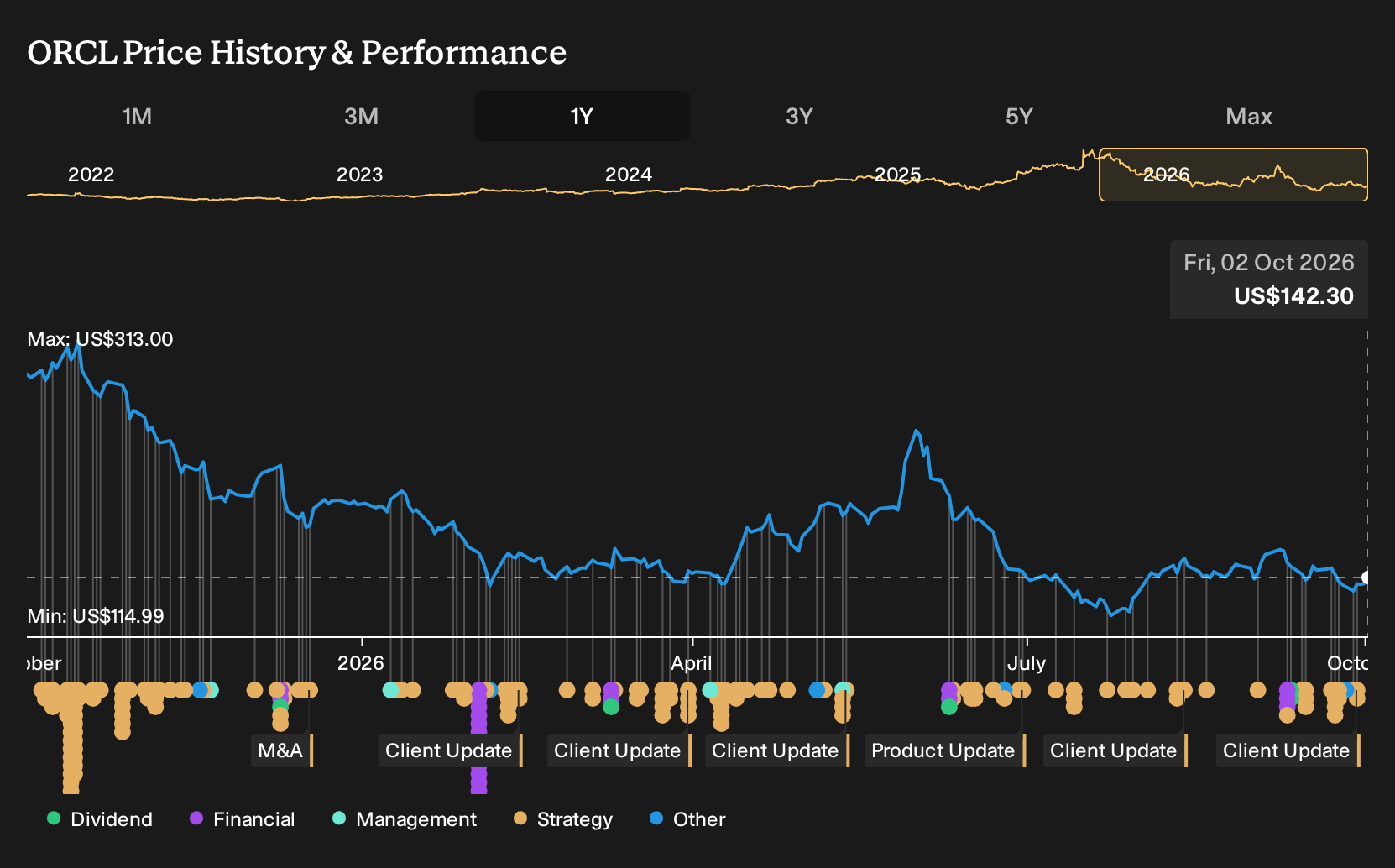
- In late September 2026, Oracle and multiple partners announced new offerings across Oracle Cloud Infrastructure, Fusion Claw agentic applications, digital assets, healthcare, and AI databases, targeting complex workloads in finance, oncology, genomics, and payments.
- These launches show Oracle pushing deeper into AI automation, regulated financial services, and healthcare workflows, expanding the practical use of its cloud and database platforms rather than just adding general purpose AI features.
- The focus now turns to how Oracle’s expanded AI agentic suite might influence the existing investment narrative around heavy AI infrastructure spending.
Scan beyond Oracle to find other enterprise AI and infrastructure stocks that could be building similar momentum with our hand picked 90 AI infrastructure stocks in this space.
Oracle Investment Narrative Recap
To own Oracle, you need to believe the huge AI and cloud buildout eventually turns a heavy investment phase into durable, cash generative usage across infrastructure, databases, and industry apps. The key short term swing factor is whether contracted AI workloads and multicloud database demand keep OCI capacity tightly used while CapEx and new debt stay digestible.
Recent AI, healthcare, and digital asset launches reinforce that Oracle is trying to fill that capacity with more specialized workloads rather than broad tools. The bigger risk does not change much. A slowdown in usage or delayed RPO conversion would still leave large data center spend, higher leverage, and thinner free cash flow working against the story.
Among the recent announcements, Oracle Fusion Claw looks most central to this AI infrastructure narrative. It ties frontier models to governed execution for complex work in finance, HR, logistics, and sales, which directly leans on OCI capacity and Oracle AI Database. If enterprises adopt these agentic apps at scale, that supports the idea that AI contracts translate into practical, high value workloads.
For you as an investor, Claw is worth watching as an execution test. Uptake and real world usage of the 25 new agentic applications can signal whether Oracle’s software layer is sticky enough to keep GPU utilization high and justify the planned US$70b of FY27 net cash CapEx, or whether the firm risks underused capacity and more pressure from debt funded expansion.
Oracle’s analyst narrative is based on projected revenues of US$193.6b and earnings of US$47.2b by 2029, assuming a 39.2% yearly revenue growth rate and an increase in earnings of about US$28.5b from US$18.7b today.
Uncover why Oracle's fair value indicates a 67% potential upside to its current price that could narrow quickly.
Exploring Other Perspectives
The lowest Oracle forecasts tell a different story. Those analysts were working off revenue expectations of about US$158.5b and earnings of US$38.0b by 2029, with a P/E of 15.5x. They worry that even new launches like Fusion Claw and OCI NetApp Storage might not fully absorb the heavy AI build, so they remain more cautious. Investors now see two very different futures based on the same numbers, so it may be useful to explore both narratives before deciding on a view.
Explore 19 other Oracle fair value estimates, including one that suggests as much as 14% downside from the current price.
The Verdict Is Yours
Disagree with existing narratives? Extraordinary investment returns rarely come from following the herd, so go with your instincts.
- A great starting point for your Oracle research is our analysis highlighting 4 key rewards and 3 important warning signs that could impact your investment decision.
- See our latest analysis for Oracle. The report includes a comprehensive fundamental analysis summarized in a single visual, the Snowflake, making it easy to evaluate Oracle's overall financial health at a glance.
Looking for more ideas beyond Oracle?
Once you have a view on Oracle, it can help to line it up against other opportunities that fit different roles in your portfolio. The Simply Wall St Screener gives you a straightforward way to search for stocks by quality, balance sheet strength, income potential, or price, so you can see where Oracle sits among peers and alternatives.
- If you want potential upside with stricter quality filters, scan a curated set of resilient opportunities through our 19 high quality undiscovered gems.
- For a focus on steadier profiles and capital protection, narrow the field to companies that pass tougher risk checks using the 31 resilient stocks with low risk scores.
- Income focused investors can zero in on stronger payers by using the 7 dividend fortresses to identify candidates offering higher yields with backing from their fundamentals.
This article by Simply Wall St is general in nature. We provide commentary based on historical data and analyst forecasts only using an unbiased methodology and our articles are not intended to be financial advice. It does not constitute a recommendation to buy or sell any stock, and does not take account of your objectives, or your financial situation. We aim to bring you long-term focused analysis driven by fundamental data. Note that our analysis may not factor in the latest price-sensitive company announcements or qualitative material. Simply Wall St has no position in any stocks mentioned.
Have feedback on this article? Concerned about the content? Get in touch with us directly. Alternatively, email editorial-team@simplywallst.com