
PG&E (PCG), Why Is The Utility Back In Focus?
Recent Share Performance And Business Profile
PG&E (PCG) has drawn investor attention after a period where the share price declined about 14% over the past month and roughly 27% over the past 3 months.
The utility operates through Pacific Gas and Electric Company, supplying electricity and natural gas across northern and central California. It serves residential, commercial, industrial, agricultural and natural gas fired power generation customers.
Electricity comes from several sources, including nuclear, hydroelectric, fossil fuel plants, fuel cells and photovoltaic facilities. The group also runs interconnected transmission lines, substations and extensive distribution networks that connect these assets to end users.
On the gas side, the enterprise manages transmission and distribution pipelines, along with storage assets that support delivery reliability. All reported revenue of US$25.8b currently comes from within the United States.
Recent trading has shifted the tone around PG&E, with the share price down 13.9% over the past 30 days and 26.8% over 3 months, while the 1-year total shareholder return has declined 21.5%. This hints that momentum has faded as investors reassess both risk and recovery expectations.
Compare PG&E's recent pullback with a curated set of utilities and infrastructure peers by scanning the 40 power grid technology and infrastructure stocks that are also exposed to grid reliability and energy transition spending.
After a 3 month slide and with PG&E still trading well below analyst price targets, the key question now is simple: is most of the upside still in front of this stock or already in the rearview mirror as valuation resets?
Most Popular Narrative: 36% Undervalued
PG&E is trading at $12.32 against a widely followed fair value estimate of $19.22. The current price sits well below what that narrative implies based on discounted future cash flows and earnings power.
Expanding opportunities for capital investment in grid modernization, wildfire mitigation, and resilience, fueled by both regulatory mandates and the need to serve new electrification and decarbonization requirements, position PG&E to grow its rate base and regulated earnings steadily over the next decade.
Ongoing and scalable reductions in non-fuel O&M expenses through technology, process improvement, and waste elimination, as seen in sustained annual savings above $200 million and a 2%+ ongoing annual reduction target, are likely to continue expanding net margins and cost competitiveness versus peers.
See why 26 investors see PG&E as 36% undervalued.
Result: Fair Value of $19.22 (UNDERVALUED)
Still, wildfire liability reform remaining unresolved and tighter affordability pressure in California could quickly challenge the PG&E undervaluation story if policy goes in an unfavorable direction.
Find out about the key risks to this PG&E narrative.
Another View: PG&E Through A Cash Flow Lens
There is a catch. While the analyst narrative tags PG&E as undervalued versus a $19.22 fair value, the SWS DCF model points the other way, with an estimate of future cash flow value around $9.60 per share, below the current $12.32 price. That raises a simple question for investors: Which story deserves more weight, earnings potential or cash generation?
Look into how the SWS DCF model arrives at its fair value.
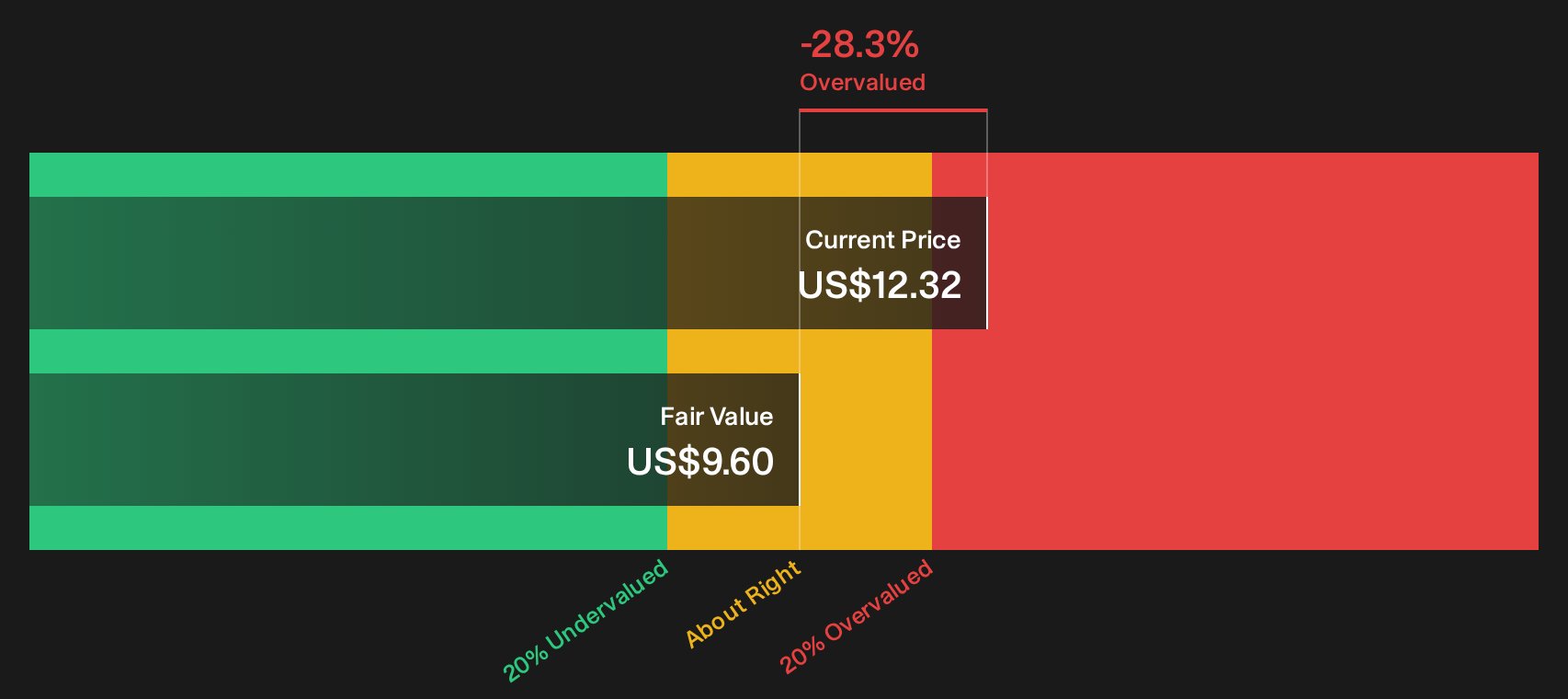
Simply Wall St performs a discounted cash flow (DCF) on every stock in the world every day (check out PG&E for example). We show the entire calculation in full. You can track the result in your watchlist or portfolio and be alerted when this changes, or use our stock screener to discover 31 high quality undervalued stocks. If you save a screener we even alert you when new companies match - so you never miss a potential opportunity.
Next Steps
Mixed signals around PG&E can feel messy, so move quickly, review the full mix of concerns and bright spots, then weigh the 4 key rewards and 3 important warning signs.
Looking For More Investment Ideas Beyond PG&E?
Do not stop at PG&E. Broaden your watchlist with fresh ideas that match different investing goals, from value and resilience to income and quality fundamentals.
- Target potential bargains by scanning companies that screen as mispriced against their fundamentals using the 31 high quality undervalued stocks.
- Prioritize staying power and balance sheet strength by reviewing a list of solid balance sheet and fundamentals (25 results) before the market fully prices in their resilience.
- Spot future leaders early by checking a 19 high quality undiscovered gems that the broader market may not be focusing on yet.
This article by Simply Wall St is general in nature. We provide commentary based on historical data and analyst forecasts only using an unbiased methodology and our articles are not intended to be financial advice. It does not constitute a recommendation to buy or sell any stock, and does not take account of your objectives, or your financial situation. We aim to bring you long-term focused analysis driven by fundamental data. Note that our analysis may not factor in the latest price-sensitive company announcements or qualitative material. Simply Wall St has no position in any stocks mentioned.
Have feedback on this article? Concerned about the content? Get in touch with us directly. Alternatively, email editorial-team@simplywallst.com