
How Investors May Respond To Halliburton (HAL) Venezuela Energy MOUs
- Halliburton announced that it signed MOUs with Eneva S.A. and WESCA to pursue oil and gas development opportunities in Venezuela, using its digital tools and subsurface expertise to support project planning and field evaluation.
- The agreements extend Halliburton's Latin American partnerships into Venezuela and could influence how its international project mix, contract risk profile and technology deployment evolve over time.
- We will now see how Halliburton's investment narrative could be influenced by the Venezuela focused MOUs with Eneva and WESCA.
Scan beyond Halliburton and this Venezuela news by reviewing a curated 40 power grid technology and infrastructure stocks that could also benefit as energy infrastructure spending and field development progress.
Halliburton Investment Narrative Recap
To own Halliburton, you need to be comfortable with a service heavyweight that is tightly linked to multi year upstream spending and uses technology to try to lift margins over time. The Venezuela MOUs fit that existing playbook. They extend Halliburton’s international and digital footprint but do not fundamentally change the near term story around utilization, pricing and capital discipline.
The biggest near term swing factor remains how effectively Halliburton converts its international backlog and digital tools into higher margin work, while holding the line on costs. The key risk stays the same. A faster shift toward renewables and tighter emissions rules could pressure long term demand for its core oilfield services and weigh on future earnings power.
The Venezuela focused agreements with Eneva and WESCA are the clearest recent development tied to this narrative. They lean directly into the catalysts analysts already highlight, such as international awards and wider deployment of digital automation, especially in Latin America. That keeps Halliburton tightly aligned with energy security driven spending rather than short cycle North American activity alone.
For investors, the central issue is execution. Can Halliburton translate these MOUs into contracted work that uses its subsurface interpretation and digital tools at scale, without overextending in a region that carries political and regulatory risk? Progress here would sit alongside existing multiyear contracts and technology deals as another proof point for its longer cycle international thesis.
What The Halliburton Consensus Is Pricing In
Halliburton's narrative projects US$25.1b revenue and US$2.7b earnings by 2029. This rests on analysts assuming 3.9% yearly revenue growth and an earnings increase of about US$1.1b from US$1.6b today.
Analysts are effectively tying the Venezuela MOUs with Eneva and WESCA into a broader Halliburton story that already assumes modest top line expansion and higher profitability. The forecast calls for revenue to grow by 3.9% a year and profit margins to rise from 7.2% today to 10.7% by 2029. That trajectory would take earnings from US$1.6b now to US$2.7b by that year. For you as an investor, the MOUs fit into that framework as potential contributors to the long run earnings bridge rather than a separate, outsized swing factor.
On the valuation side, the consensus view implies that if Halliburton reaches US$25.1b of revenue and US$2.7b of earnings in 2029, the stock could trade around 16.4x those future earnings, using a discount rate of roughly 7.9%. That multiple is in line with the P/E level analysts are using today for Halliburton and below the current P/E they cite for the broader US Energy Services industry. The Venezuela related work, if it moves from MOU to signed contracts, would simply be one contributor to hitting those revenue and profit figures rather than the sole driver.
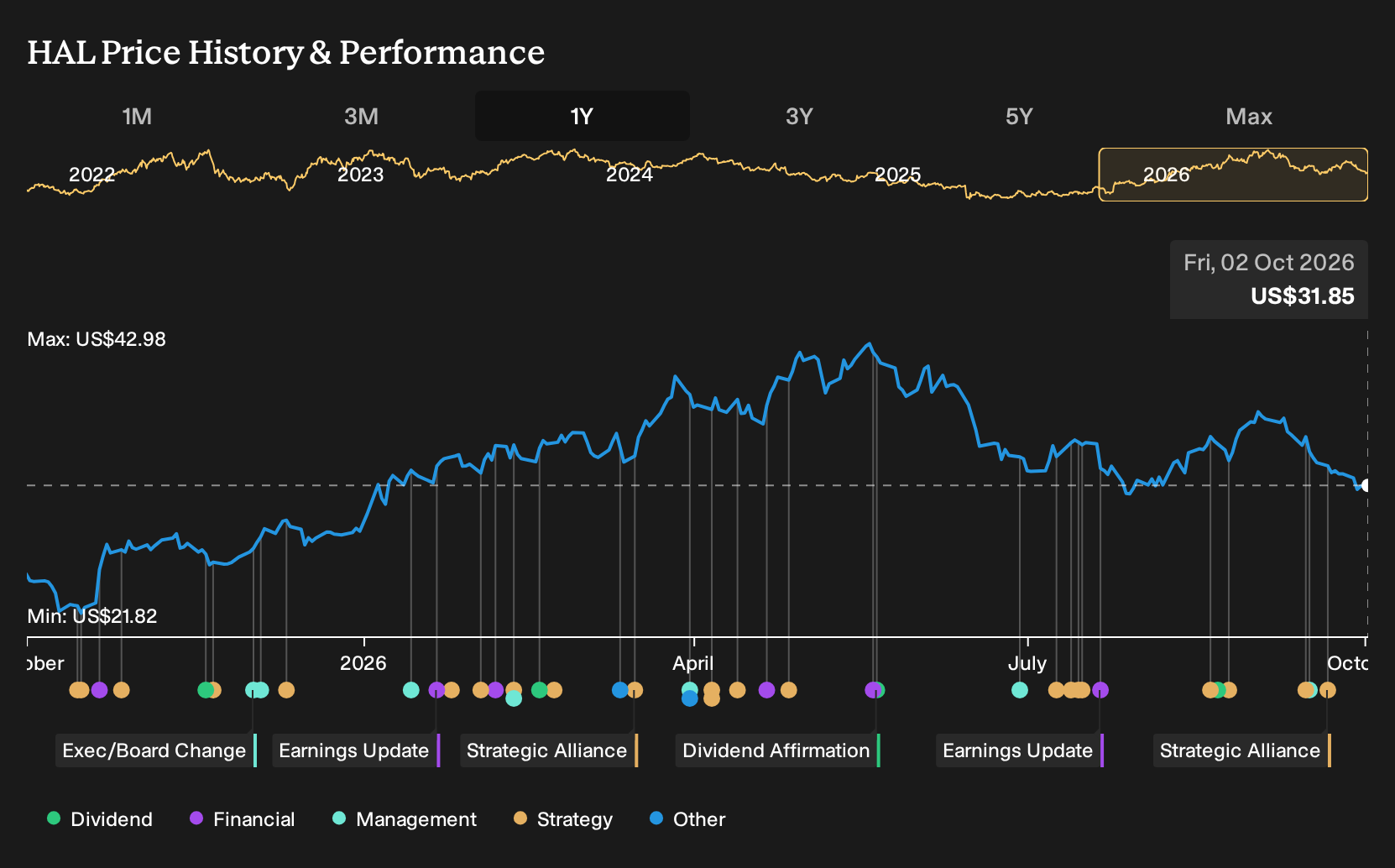
The spread in analyst targets gives a sense of how differently the market is weighing these international and digital opportunities against regional risk. The consensus price target sits at US$43.44, with the most optimistic forecast at US$53.00 and the most cautious at US$29.00. This is compared with a current share price of US$31.54 and an implied 27.4% gap to the midpoint target. That range reflects differing views on whether Halliburton can execute on its international backlog, deploy tools like ZEUS electric fracturing and OCTIV automation at scale, and manage political exposure in countries such as Venezuela without eroding returns.
For your own process, the key question is whether the path from US$1.6b of earnings today to the US$2.7b consensus for 2029 feels realistic given your view of long term upstream spending, decarbonization policy and regional risk. The Venezuela MOUs sit inside that debate. They tie Halliburton more tightly to Latin American activity and energy security spending while also adding another layer of regulatory and geopolitical complexity. Any assessment of the stock needs to weigh those trade offs against the margin uplift and cash generation analysts are currently building into their models.
Uncover why Halliburton's fair value indicates a 36% potential upside to its current price. This suggests a discount that could narrow faster than you expect.
Exploring Other Perspectives
One alternate Halliburton story puts conflict risk front and center. The most cautious analysts were previously working off revenue of about US$23.2b and earnings near US$2.8b by 2029, with a P/E closer to 12.2x. That backdrop is far more restrained. The Venezuela MOUs could eventually push those views in either direction, so treat this as a cue to compare several narratives, not just one.
Explore 4 other Halliburton fair value estimates, including one that suggests it could be worth just $34.03.
Reach Your Own Conclusion
Disagree with existing narratives? Extraordinary investment returns rarely come from following the herd, so go with your instincts.
- A great starting point for your Halliburton research is our analysis highlighting 4 key rewards and 2 important warning signs that could impact your investment decision.
- See our latest analysis for Halliburton. The report includes a comprehensive fundamental analysis summarized in a single visual, the Snowflake, making it easy to evaluate Halliburton's overall financial health at a glance.
Looking For More Investment Ideas Beyond Halliburton?
If the Halliburton story has sharpened your questions about risk, valuation and long term earnings power, it can help to line those instincts up against a wider watchlist built from different types of opportunities.
- If you are hunting for potential mispricings with solid fundamentals behind them, consider scanning a curated set of 31 high quality undervalued stocks that may warrant a closer look.
- Income focused investors who care about cash returns as much as narratives around growth can review a group of 7 dividend fortresses that provide higher yields with an emphasis on resilience.
- For a focus on financial strength and balance sheet durability, you can screen a list of solid balance sheet and fundamentals (26 results) to see which companies match your risk tolerance.
This article by Simply Wall St is general in nature. We provide commentary based on historical data and analyst forecasts only using an unbiased methodology and our articles are not intended to be financial advice. It does not constitute a recommendation to buy or sell any stock, and does not take account of your objectives, or your financial situation. We aim to bring you long-term focused analysis driven by fundamental data. Note that our analysis may not factor in the latest price-sensitive company announcements or qualitative material. Simply Wall St has no position in any stocks mentioned.
Have feedback on this article? Concerned about the content? Get in touch with us directly. Alternatively, email editorial-team@simplywallst.com