
How CVS Deal Extension At Cardinal Health (CAH) Has Changed Its Investment Story
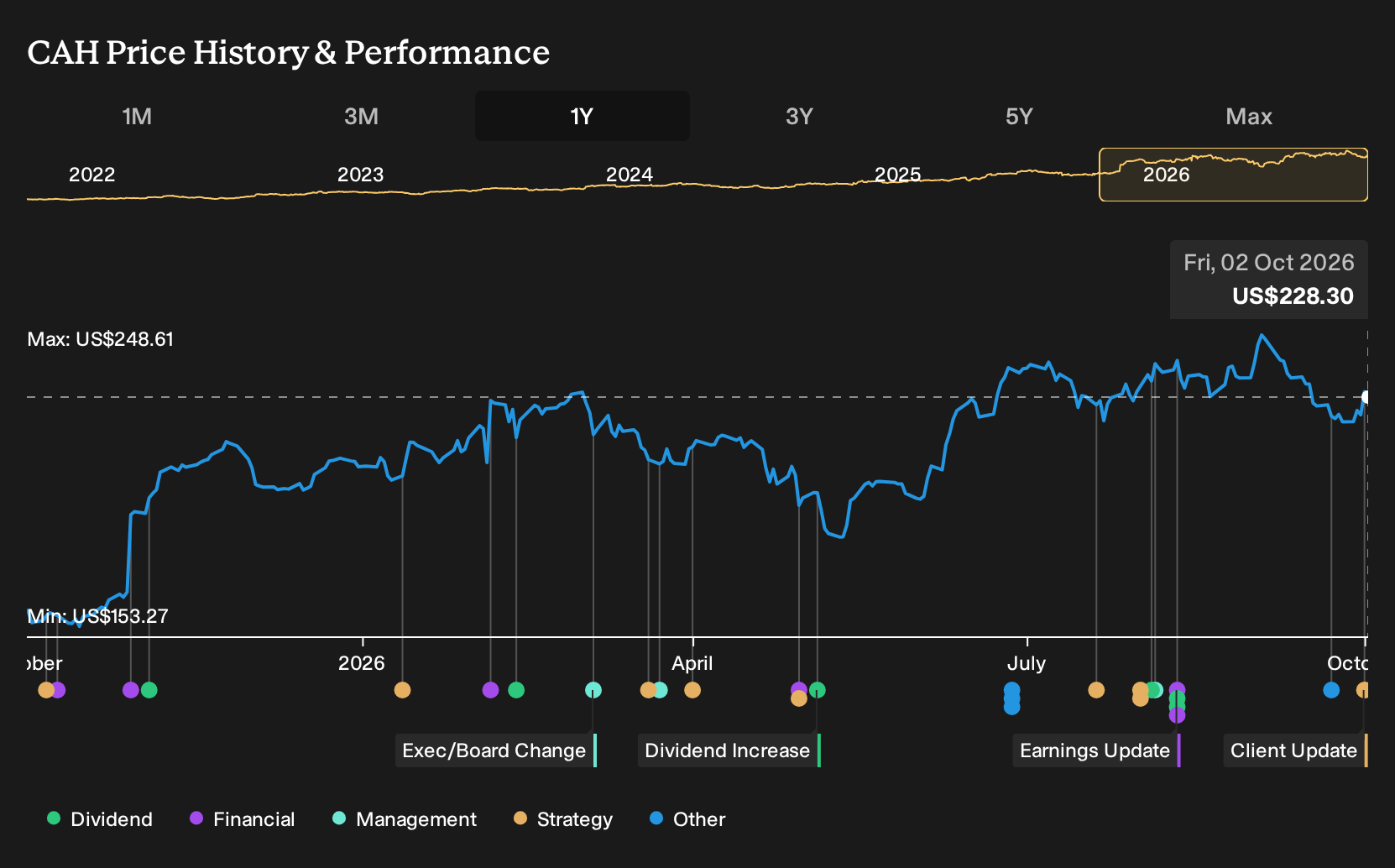
- Cardinal Health disclosed that it entered a binding Letter of Intent to extend its pharmaceutical distribution agreement with CVS Health through June 30, 2032, keeping the current service scope in place and reaffirming fiscal 2027 non-GAAP EPS growth guidance of 13% to 15%.
- The long dated CVS Health contract extension locks in a core channel partner for Cardinal Health's wholesale drug operations. This supports planning around specialty distribution expansion, cost structure decisions, and the mix shift toward higher margin service offerings outlined in its existing guidance.
- We will now look at how Cardinal Health's investment narrative could be affected by this extended CVS distribution agreement commitment.
Scan beyond Cardinal Health and this CVS extension to see how other healthcare distributors and pharmacy partners stack up in our curated list of list of solid balance sheet and fundamentals (26 results).
Cardinal Health Investment Narrative Recap
For Cardinal Health, the core belief is that a massive, fairly low margin distribution engine can gradually tilt toward higher value services in specialty pharma, at home care and logistics. The extended CVS agreement supports that idea by keeping a key volume channel intact through 2032. It looks helpful for planning, but it does not fundamentally change the short term story.
The key near term catalyst still sits in execution on mix shift, especially in specialty distribution, Biopharma Solutions and the repaired Global Medical Products and Distribution segment. Quality control and recall risk, plus input cost pressure in GMPD, remain the biggest operational overhangs. The CVS extension does not remove those issues.
The most relevant nearby event for this CVS news is Cardinal Health’s upcoming fiscal 2027 first quarter results release and webcast on November 5. Investors get two things at once: fresh numbers and management’s first detailed commentary on how the extended CVS commitment fits into guidance and capital allocation priorities.
This update should help you judge whether reaffirmed 2027 non GAAP EPS growth of 13% to 15% still looks well supported by segment trends, or whether quality, inflation or recall related issues are beginning to lean harder on profitability. Attention will likely focus on specialty, at Home Solutions and GMPD progress, given their role in mix improvement and risk management.
Cardinal Health’s current analyst framework points to revenue of US$297.6b and earnings of US$3.0b by 2029, built on assumed yearly revenue growth of 5.4% and an earnings increase of about US$1.3b from the US$1.7b reported today.
Uncover why Cardinal Health's fair value indicates a 19% potential upside to its current price, which could narrow quickly.
Exploring Other Perspectives
Two fair value views from the Simply Wall St Community span roughly US$271 to US$742 per share for Cardinal Health, which shows just how far apart private investors can be. Those estimates were set before the extended CVS agreement and recent recall headlines, so treat them as a starting point and compare several viewpoints before forming your own stance.
Explore another Cardinal Health fair value estimate, including one that suggests it could be worth just $270.94.
The Verdict Is Yours
Don't just follow the ticker; dig into the data and build a conviction that's truly your own.
- A great starting point for your Cardinal Health research is our analysis highlighting 3 key rewards and 3 important warning signs that could impact your investment decision.
- See our latest analysis for Cardinal Health. The report includes a comprehensive fundamental analysis summarized in a single visual, the Snowflake, making it easy to evaluate Cardinal Health's overall financial health at a glance.
Looking For More Investment Ideas Beyond Cardinal Health?
If this Cardinal Health update has sharpened your view on healthcare distributors, it can help to widen the lens and compare it with other businesses that have different balance sheet strength, risk profiles and income characteristics using the Simply Wall St Screener.
- For investors who care about financial resilience first, filter for companies with strong fundamentals and robust balance sheets through our curated list of solid balance sheet and fundamentals (26 results).
- If you are hunting for potential value opportunities, sort the market by quality and valuation to see a focused set of 31 high quality undervalued stocks that might merit a spot on your watchlist.
- For those who want portfolio income to feel more predictable, narrow the field to companies paying higher yields and examine a targeted group of 7 dividend fortresses.
This article by Simply Wall St is general in nature. We provide commentary based on historical data and analyst forecasts only using an unbiased methodology and our articles are not intended to be financial advice. It does not constitute a recommendation to buy or sell any stock, and does not take account of your objectives, or your financial situation. We aim to bring you long-term focused analysis driven by fundamental data. Note that our analysis may not factor in the latest price-sensitive company announcements or qualitative material. Simply Wall St has no position in any stocks mentioned.
Have feedback on this article? Concerned about the content? Get in touch with us directly. Alternatively, email editorial-team@simplywallst.com