
Wall Street is about to be sleepless! Counting down to the “23/5” trading model for US stocks, can the global capital relay strengthen the path to a long bull run?
For decades, the US stock exchange pressed the pause button every night, shutting down the market for hours. However, after December of this year, as the US stock market moves to an all-weather, 23-hour trading mode, the exchange's server trading lights will stay on longer.
The Zhitong Finance App learned that NASDAQ, NYSE Arca, 24X National Stock Exchange, and Cboe EDGX have made plans to increase the overnight trading period from 9:00 p.m. New York time to 4:00 a.m. the next day in addition to the current regular trading hours and pre- and post-market trading sessions. The expansion plan, which is scheduled to be implemented on December 6, aims to meet the growing demand from overseas investors while competing with the crypto asset market and prediction market — the latter two 24/7 uninterrupted trading models can be said to have disrupted people's traditional perception of Wall Street business hours.
Overnight trading has been around for many years, mainly through alternative trading systems, but it accounts for a small percentage of overall trading activity. According to data released at the SEC Roundtable last week, overnight trading in the second quarter accounted for about 1% of total stock trading volume. Although the scale is far smaller than day trading by any measure, overnight trading is growing rapidly, with volume surging 358% from the same period last year.
The 23/5 trading model, which is expected to be implemented soon, has sparked debate over how the extended trading hours will affect global market participants. Proponents believe this move will remove time zone barriers and make it easier for overseas traders to enter the US market. Skeptics, on the other hand, believe that lower liquidity and wider bid-ask spreads will amplify trading risks.
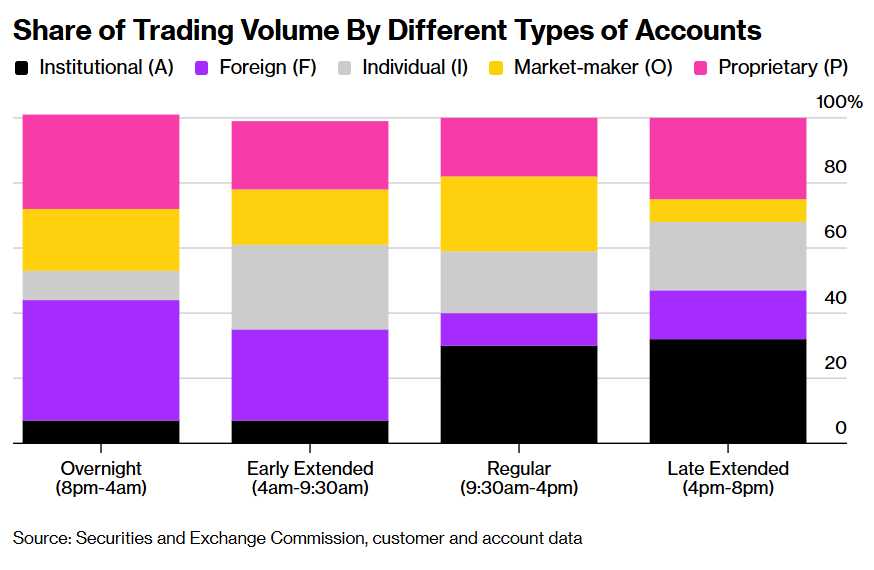
The above chart shows the trading volume ratio of different types of accounts. Source: US Securities and Exchange Commission, customer and account data.
Wall Street Sleepless: Overnight Stock Trading Is Coming
David Isthorpe, a senior stock market analyst from Crisil Coalition Greenwich, said that institutional investors are mainly concerned about “market quality during extended trading hours,” and that operational and staffing issues are not necessarily their top priorities.
Market participants aren't keen to trade stocks around the clock, according to a survey of buy-side stock traders conducted by the company last year. Due to fewer active participants outside of regular trading hours, investors may face lower volume, less liquidity, and wider bid-ask price spreads. Research shows that this may bring additional operational risks and complexity, and even affect traders' own physical and mental health.
Since the survey was conducted in the second half of 2025, the attitudes of this group have improved. Isthorpe said that now people “feel even more that this change is inevitable,” especially as regulators continue to push for relevant reforms.
The concept of overnight trading has been popular with retail investors and trading platforms for many years. Blue Ocean Technologies CEO Brian Heindman said that once the new arrangement in December comes into effect, “those market players who have always participated will be there and ready.” The company is one of the alternative trading system operators that currently provides overnight trading services.
“But I still think there are parts of the industry that have yet to participate; in fact, they are buyer agencies and investment banks.” He added, “They've been hesitant to get involved.”
Key market infrastructure providers are also preparing for this transformation. The main agency responsible for clearing US stock transactions — the American Depository Trust and Clearing Company — switched to a 24×5 model in June, operating hours from 8 p.m. on Sunday to 8 p.m. on Friday. The Securities Information Processing System (SIP), which collects and distributes quotes and transaction data, has also received regulatory approval to extend operating hours to support overnight transactions.
Joseph Salucci, partner and co-head of stock trading at Themis Trading, said that supporters of this transformation may expect that once the infrastructure is in place, institutional needs will follow.
However, he is skeptical about this shift.
“Institutional investors have no interest in trading in a market with low liquidity, wide spreads, and is likely to be highly volatile.” He added that the total volume of pre-market and after-market trading on the exchange only accounts for about 10% of the overall trading activity. “In fact, if you want to make this point, it's safe to say that the market has been trading for too long, not too short.”
Currently, institutional investors are still on the sidelines. Jeff O'Connor, head of market structure at Liquidnet, said that if the December 6 adjustments improve the nighttime price discovery, transaction costs will eventually drop, thereby helping institutional asset managers obtain excess profits during the night.
Naturally, overseas investors are particularly active during the nighttime trading hours. According to data from the US Securities and Exchange Commission, overseas investors accounted for 37% of overnight transactions in the second quarter, compared with only 7% of institutional accounts.
These trading activities are also highly concentrated. In August, an average of only 15 stocks contributed half of overnight trading volume, often including shares of companies registered in mainland China and Hong Kong with stock prices below $1. In contrast, the regular trading session required 256 stocks to account for half of the volume.
Currently, the core trading session for NASDAQ and NYSE is 9:30 a.m. to 4:00 p.m. EST, five days a week. Additionally, the two exchanges also offer pre-market and after-market trading sessions, which allow limited types of trading: pre-market trading starts as early as 4 a.m., and after-market trading lasts from 4 p.m. to 8 p.m. After extending the trading hours in December, the exchange will still be suspended for one hour from 8 p.m. to 9 p.m., for system maintenance and transaction processing.
What does the 23/5 trading model mean for the long-term US bull market trajectory and market volatility?
It can be said that the US stock market will soon move from a “New York trading day” to a near-all-weather market covering global time zones. NASDAQ, NYSE Arca, 24X, and Cboe EDGX are promoting 23/5 trading around December 6, 2026, adding night trading from 21:00 to 4:00 a.m. the next day New York time, while maintaining a maintenance window from 20:00 to 21:00.
The business driving force behind it comes from demand from overseas investors, as well as competition brought about by continued trading in crypto assets and forecasting markets: night trading volume surged 358% year on year in the second quarter, yet it still accounted for only about 1% of total US stock trading volume. Overseas investors and institutional accounts contributed 37% and 7% of night trading volume respectively, indicating that global demand is growing and institutional participation is still limited.
According to the latest official developments, this reform has entered the system preparation stage: NASDAQ announced six user acceptance test arrangements on September 28, and plans to start pre-production tests on November 1; DTCC's NSCC was extended to 24×5 clearing services in June, and the unified market processing system SIP was also approved to extend the operating time, and the plan is to launch in December.
The core of Wall Street analysts' debate over this 23/5 trading model is whether a longer transaction time can bring sufficient depth of liquidity and reliable price discovery.
23/5 means five trading days a week, 23 hours a day, and the core trading period is still preserved. Its essence is to expand the time window for capital access and information pricing across time zones. Exchanges, night trading platforms, and retail investors from overseas, especially in the Asian market, value transaction convenience, while institutional investors pay more attention to trading price differences, order depth, and execution costs of large transactions.
Night trading currently not only has clear demand across time zones, but also has the problem of highly concentrated transactions and limited institutional participation. Judging from the microstructure of the market, when the order book is thin, it is easier for transactions of the same scale to drive prices, and market makers may also compensate for inventory and hedging risks by widening the trading price difference. Therefore, between “being able to place an order at any time” and “being able to trade at a reasonable cost at any time,” there is still liquidity that needs to be replenished.
According to the microstructure of the market, if orders were scattered over a longer period of time at the beginning of the reform, and market capital did not increase at the same time, the thin order book in night trading may amplify the price shock and brief deviation of a single transaction; with institutional participation, unified market conditions, and the improvement of arbitrage mechanisms, some of the information shocks originally concentrated on the next day's opening may also be gradually digested ahead of time, so the opening gap may be reduced, but the overall fluctuation throughout the day will not necessarily decline. For the long-term bull market in US stocks, 23/5 is expected to reduce friction between overseas investors' participation, expand potential capital pools, and reduce liquidity premiums after improving liquidity; its effect is mainly reflected in market efficiency and valuation support. Long-term increases are still completely realized by corporate free cash flow, productivity changes driven by AI technology, and interest rate expectations/US bond yield curves and equity risk premiums. Extending the trading clock can broaden the channel for capital to enter US stocks. Continued profit growth will determine how long this channel can carry the bull market.
Wall Street financial giant J.P. Morgan Chase has begun to follow the bullish pace of US technology stocks from giants such as Goldman Sachs, Jefferies, and Yardeni Research. To a certain extent, this is also driving institutional and retail investors to focus more on dips layout strategies during the US stock market pullback this week. J.P. Morgan believes that the overall valuation adjustments of the seven major US tech giants (that is, Magnificent Seven, Mag 7), which have a high weight in US stocks, may have been largely completed, and profit growth is expected to once again become the main force supporting stock prices; J.P. Morgan said that the ratio of the Big Seven's expected price-earnings ratio over the next 12 months to the market has fallen to about one standard deviation below the historical median, which is at a ten-year low.
Wall Street financial giant Jefferies recently said that the S&P 500 index is expected to soar to 8,000 points by the end of 2026 and further hit 9,000 points in 2027, driven by the dual engine of AI investment frenzy and rising profits of AI-related companies exceeding expectations. Jefferies's core logic is clear and powerful: in a cycle where AI-driven profit growth exceeds the historical average by more than two times the historical average, fighting against profit trends is dangerous. Jefferies's 2026 8,000-point S&P 500 benchmark forecast is based on earnings per share (EPS) reaching $373 (up 35% year over year, well above 29% of market consensus) and a price-earnings ratio of 21.5 times.