
The global bond market sell-off storm swept through, and the US dollar took advantage of the momentum to reach a new 17-month high! The euro became the “hardest hit area”
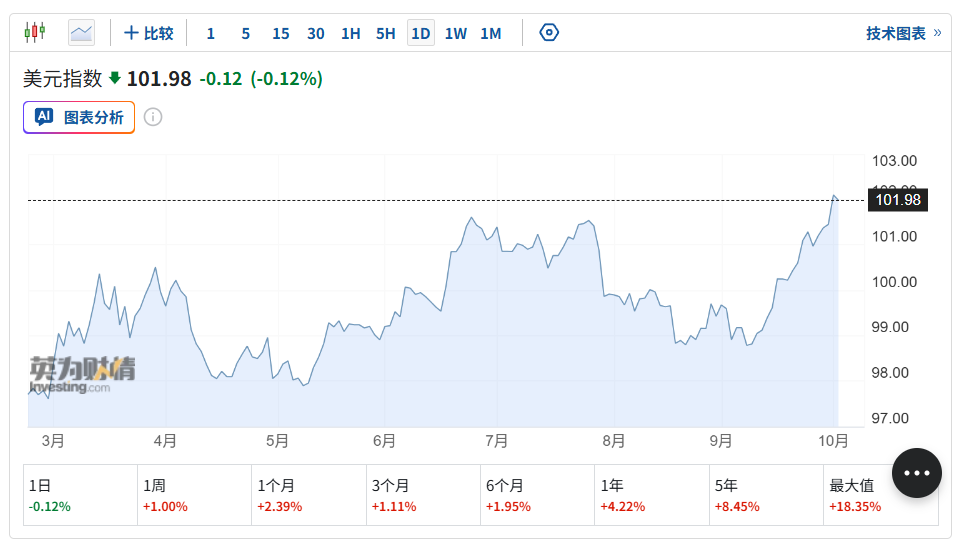
The Zhitong Finance App learned that on Friday, the US dollar hovered at a 17-month high and is expected to rise for the third week in a row. Against the backdrop of inflationary concerns being exacerbated by rising oil prices, the global bond market experienced large-scale sell-off, driving borrowing costs in various regions to their peak in decades, and at the same time boosting the dollar.
The global bond market dived sharply on Thursday, putting pressure on the market. The benchmark yield on US 10-year Treasury bonds once surged to 5.344%, the highest level since 2002. The market is waiting for the US employment data to be released. This report may influence the short-term policy direction of the Federal Reserve.
In early trading on Friday, the 10-year US Treasury yield fell back to 5.249%, and the rest of the global bond market stabilized at the same time.
EUR/USD was reported at 1.1245, hovering near the lowest level since May 2025. Concerns about France's fiscal situation continued to weigh on the euro. The yen remained around 158 against the US dollar. Earlier data showed that Tokyo's core inflation rate in September hit a 10-month high year-on-year high.
The US dollar index, which measures the trend of the US dollar against the six major currencies, is reported at 101.98. The cumulative increase is expected to reach 1% this week. This is the third consecutive week of increase. The last time this trend was in May 2025.
Charu Chanana, chief investment strategist at Saxo Bank, said that investors are facing a difficult combination: high inflation stickiness, huge government borrowing, and high bond supply.
She pointed out, “Even though the market's expectations of the Fed's immediate interest rate hike have cooled down, long-term yields have continued to rise. This shows that market drivers are increasingly biased towards term premiums and fiscal risk, not just the Federal Reserve's next interest rate decision.”
Data released on Wednesday showed that the increase in consumer prices in the US in August was lower than expected, and the July data was also revised down, prompting traders to cut their bets on the Federal Reserve's interest rate hike later this month.
Two senior Federal Reserve officials made an unusually clear statement this week, arguing that more data should be collected before deciding whether to raise interest rates again.
This changed the market's focus to the US non-farm payrolls report released later today. According to data expectations, employment growth slowed in September, and the unemployment rate is expected to remain at 4.1% for the third consecutive month.
Chris Weston, head of research at Pepperstone, said, “Given that the Federal Reserve is currently focusing only on inflation and price pressure, a hot salary data could have a particularly big impact on US interest rates, US debt, and the US dollar.”
In terms of oil prices, Brent crude oil futures are back above $100 per barrel, and traders continue to watch the deadlocked negotiations between the US and Iran to end the Middle East conflict.
GBP/USD reported 1.3187; AUD/USD fell 0.18% to 0.6918, and both currencies were near three-month lows. The New Zealand dollar fell 0.22% against the US dollar to 0.5591, hitting its lowest point since November 2025.
Prashant Nunaha, senior interest rate strategist at TD Securities, said: “Obviously, the market is not pricing the Federal Reserve's hawkish position. This was a safe-haven operation triggered by the European situation. Under this scenario, the US dollar index and yen are expected to strengthen at the same time.”
The recent strengthening of the US dollar is due in large part to the weakening of the euro. Increased political risk in Europe, compounded by the seven-month war in the Middle East brought about an energy shock, undermining market confidence in the euro.
EUR/JPY and the Swiss franc are also weak, while French treasury yields have soared to a 14-year high, and concerns surrounding France's unstable fiscal situation continue to ferment.
Pepperstone's Weston said the nature of the dollar's rise is changing. “There is growing evidence that the focus of this story is shifting from American exceptionalism to issues elsewhere, particularly Europe.”