
Bond traders are convinced that the Federal Reserve will continue to raise interest rates. The cooling of non-agricultural agriculture tonight may not shake the prospects for austerity
The Zhitong Finance App learned that bond traders are certain that the Federal Reserve will raise interest rates even more — even if employment growth is expected to slow down, it is unlikely to significantly change this outlook. According to an economist survey, the employment report released by the US Department of Labor on Friday is expected to show that the number of non-farm payrolls increased by about 90,000 in September, down from 162,000 last month.
However, this increase will be roughly the same as the monthly average since this year, indicating that the job market continues to be strong, thus leaving room for the central bank to continue to tighten monetary policy — the Federal Reserve is focusing on reducing inflation, which has been above target for the past five years.
“You need to grow close to zero or even negative — and I think you really need a downside in payroll data” — to push US debt higher, said Steve Boothe (Steve Boothe), head of investment-grade bonds and portfolio manager at T. Rowe Price Group. “If the job market is to become a catalyst for this round of growth, the threshold is actually quite high.”
The sell-off in the US bond market eased somewhat on Thursday, as market concerns about rising European debt burdens intensified, and investors poured in to take refuge in US bonds. At the same time, two Federal Reserve officials — Michelle Bowman and Philip Jefferson — suggested that policymakers should spend more time before deciding whether further interest rate increases are needed. This drove the 2-year US Treasury yield down about 10 basis points to below 4.8%, and pulled the 10-year yield back from a 24-year high.
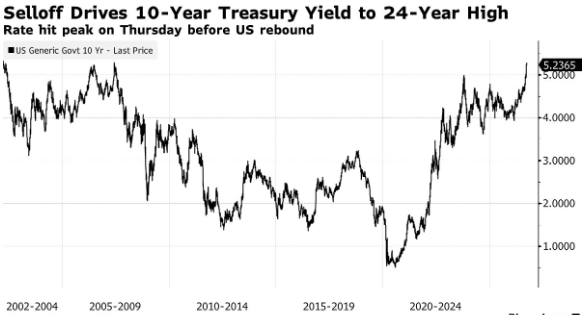
However, analysts said that this round of rebound had little to do with changes in the US outlook or the easing of pressure to push up yields. Oil prices hovered around $100 per barrel, and there was little sign of progress in ending the war with Iran. The federal government's massive deficit spending and the boom in artificial intelligence are fueling a steadily expanding economy. Inflation has jumped to more than 3% this year.
Although futures traders have slightly reduced the size of their interest rate hike bets — and the next rate hike isn't expected until the December meeting — they are still expecting at least three 25 basis point rate hikes through July.
However, the magnitude of this recent round of sell-offs has made it difficult to predict the bond market. US inflation data was released on Wednesday. The results were slightly weaker than expected. US bonds rose briefly, then returned to gains, and yields climbed back to a new high in decades. As positions become more biased towards higher interest rates, analysts said that if there is a sharp decline in employment data, investors will close some of their positions and may continue Thursday's gains.
“If the data we get is interpreted by the market as an early sign that the job market is under pressure, I think we may see a disproportionate increase compared to figures that are in line with expectations or are slightly stronger.” Ian Lyngen (Ian Lyngen), head of US interest rate strategy at BMO Capital Markets, said.
However, there is little confidence that this round of sell-off has peaked. Karen Manna (Karen Manna), a fixed income strategist and portfolio manager at Federated Hermes, said she has been less bearish since the Federal Reserve raised interest rates at the September 16 meeting, but she still doesn't believe that yields have peaked.
“Much of our argument that interest rates would rise to such a high level has already been fulfilled.” Manna said. However, she said that the yield “may continue to rise.”