
SoftBank's stock price diverges from the CDS trend: investors ignore credit risk and bet on AI upside
The Zhitong Finance App learned that SoftBank Group stock investors are putting aside concerns about the Japanese company's rising borrowing costs and focusing on the potential return of their AI bets.
SoftBank's stock price recorded its first monthly rise in four months in September. Previously, OpenAI's newly launched GPT-6 Astra model reignited market optimism that Sun Zheng would invest 65 billion US dollars in the ChatGPT developer. The stock rose 24% in four weeks, boosted by OpenAI's latest plan to raise $30 billion at a valuation of $1.4 trillion. The rebound in the stock price of its chip business Arm Holdings (ARM.US) has also boosted the market's confidence in the technology investment company's financing growing debt.
Meanwhile, SoftBank's credit default swaps (CDS) jumped to the highest level since 2023, and questions surrounding AI safety, soaring costs, and competition persist. This divergence between SoftBank CDS and stocks contrasts with the sell-off in Oracle's (ORCL.US) stock price — the latter has invoked force majeure clauses to protect itself from surging data center expenses.
“From a stock perspective, we are relatively less concerned with the technical details of how they raise funds.” David Dai (David Dai), managing director of Sanford C. Bernstein (Sanford C. Bernstein) in Hong Kong, said, “Assuming they can raise money, the stock story is actually good because they hold Arm, and Arm is the biggest beneficiary of the rise in intelligent artificial intelligence and the increase in server CPU usage.”
Chipmakers such as Arm predict that demand for central processing units will reach hundreds of billions of dollars by 2030. As users of services such as Meta Platforms (META.US)'s Muse increasingly require AI agents to execute code and use web browsers, general-purpose computing orders are increasing. David Day estimates that the market could grow to as much as $330 billion in size. He said that Arm's order prospects are just as optimistic.
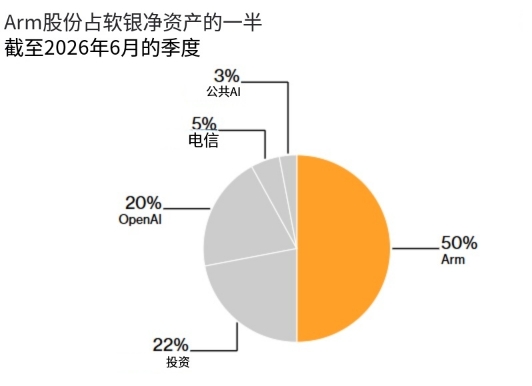
Arm shares are regaining their gains after a peak in June, with an increase of around 20% last month. This stabilized SoftBank's financial position — the latter holds nearly 90% of the chip architecture company's shares — and helped ease some concerns about spillover from the credit market. Arm accounts for a significant share of SoftBank's asset value.
In addition to Arm, Sun Zhengyi's diverse layout on the artificial intelligence landscape — from robots and data centers to energy — also made some stock investors feel at ease. Although the billionaire's increasing bets on OpenAI remain worrying, investors have taken comfort from SoftBank's plans to expand its presence in other AI fields — such as data centers, and plans to acquire ABB's robotics business — believing that no matter who wins the platform battle, these can provide room for upside.
SoftBank's broad portfolio also includes SoftBank Corp. (SoftBank Corp.), a telecom operator with millions of users. The wireless service provider now wants to benefit from the Asian country's thirst for artificial intelligence and is building data centers and providing a full range of enterprise services.
“If OpenAI didn't perform well, market sentiment would be much worse, but they do have assets in other areas.” Kirk Boodry, an analyst at Bloomberg Intelligence (Bloomberg Intelligence), said, “It's rare for a stock to be exposed to the global AI boom in this way, especially in the Japanese context.”
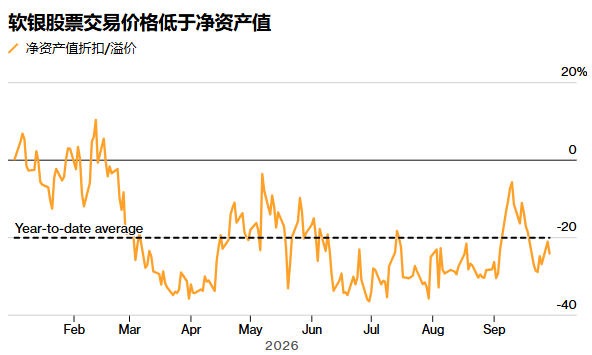
The growing discount compared to real-time net asset value (NAV) also provides an entry point for those who believe in AI growth. According to Bloomberg industry research data, as of September 29, SoftBank's stock price was discounted by 24% compared to its net asset value, which is higher than the average of 20% since the beginning of the year.
“I think these stocks certainly have the potential to be re-rated if the right catalyst comes along.” Asset Management One fund manager Nishida Takumi said and added that there have been discussions in the market about SoftBank trading at a premium above net asset value.
However, Nishida said that due to intense competition among AI developers and rising borrowing costs, he is more inclined to invest directly in AI hardware vendors, such as memory chip maker Kioxia Holdings Corp. (Kioxia Holdings Corp.). Compared to SoftBank's weight in the TSE Topix Index, he holds fewer SoftBank shares.
He is not the only one who thinks this way. Concerns about increased competition among AI models and surging debt are still factors suppressing SoftBank's stock price.
SoftBank last month raised $111 billion through a record-scale corporate junk bond sale to fund Masayoshi Sun's ambitious AI ambitions. Although subscription demand is sufficient to depress issuance pricing, overall borrowing costs are still higher than before.
Some investors are betting on SoftBank shares falling: the share of bears in tradable tradable shares rose to 2.36% this week, a record high for the year, according to S3 Partners data.
According to Han Jiho, an analyst at Sparx Asset Management, SoftBank's continued discount on net asset value indicates that the stock market is already pricing a certain degree of credit risk. “If CDS spreads continue to widen, further increases in NAV may have limited impact on stock prices.” he said.
Even so, after a sharp drop from its peak in June, the company's stock price recovered somewhat, rising about 52% during the year. According to the aggregated data, most analysts expect this trend to continue: 17 buy ratings, 6 hold, 1 sell; analysts' 12-month average target price was 9061 yen ($57.21), compared to the closing price of 6701 yen in Tokyo on Thursday.
In the June quarter, SoftBank achieved net profit, mainly due to its Intel shares. That gave the tech investment firm the courage to continue to wait for the return of its OpenAI bet and other multi-billion dollar AI projects.
“If the AI boom eventually turns out to be a bubble and bursts, the damage could be serious given their leveraged investments.” Hiroki Takei, strategist at Resona Holdings, said, “But given the latest results, rising borrowing costs are seen more as a tail risk, while financing through debt issuance is largely viewed as financing needed to grow investments.”