
Multiple negative raids! China is rumored to have suspended exports of refined oil products, the US military is increasing troops in the Middle East, and international oil prices have soared by more than 4% in a single day
The Zhitong Finance App learned that the international crude oil market was once again ignited by supply-side and geopolitical news on Thursday. Oil prices closed up sharply throughout the day, and Brent crude oil closed more than 4 US dollars higher. The market feared that China's suspension of exports of refined oil products and the US military increase in the Middle East might further worsen the already tight global fuel supply.
By the close, the December Brent crude oil futures contract settlement price on the Intercontinental Exchange was 102.31 US dollars/barrel, up 4.37%; the settlement price of US West Texas Intermediate Crude Oil (WTI) futures was 92.87 US dollars/barrel, up 2.45 US dollars, or 2.71%.
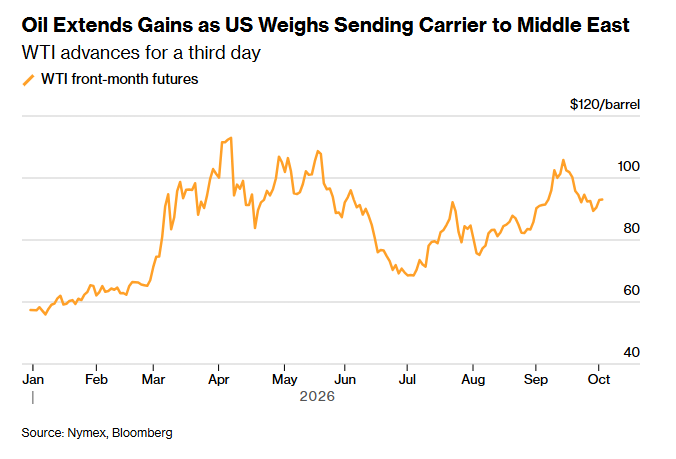
According to reports, the US is sending a third aircraft carrier and up to 10,000 additional military personnel to the Middle East because US President Trump is considering resuming attacks on Iran after the midterm elections. Trump told reporters before leaving the White House to participate in the election campaign that he was weighing his options for Iran. “Now I have to make a decision. They either sign a very fair deal or they won't exist anymore.” This statement has further fueled market concerns about the escalation of the conflict.
Meanwhile, four people familiar with the matter said that Chinese refiners have suspended exports of petroleum products to regions other than Hong Kong and Macau, China until further notice. The news became a key catalyst for oil prices to reverse the decline in early trading. Previously, oil prices fell by 1%, then rebounded strongly after news broke that exports of refined oil products had been suspended.
UBS analyst Giovanni Staunovo said that China's export ban shows market concerns about domestic refined oil supply; it remains to be seen whether the relevant measures will support higher crude oil imports after the recent decline in China's crude oil and fuel stocks.
On the supply side, crude oil continues to enter the market, but there is a continuing shortage of diesel and other refined oil products after damage to refinery infrastructure in the Gulf of Mexico and Russia. Global diesel stocks are already tight, and Russia, as a major exporter, has extended the export ban until October. Industry sources said the shortage is unlikely to end before next year.
Russian President Vladimir Putin said earlier that Russia will not supply diesel to the global energy market until sanctions against Moscow are lifted.
Hamad Hussain, senior climate and commodity economist at KITU Macro, pointed out that the impact of China's fuel export restrictions will not be as great as the loss of refined oil exports from Russia and the Middle East, but at a time when supply is severely limited, this is another source of pressure on the global fuel market.
To ease the pressure, two EU diplomats said the EU Energy Task Force will meet on Friday to discuss whether to release diesel stocks. The source also said that the Trump administration has asked Germany and France to use emergency diesel stocks, otherwise they may face a ban on US diesel exports. US Treasury Secretary Scott Bessent also urged European partners to help ease global shortages.
In terms of the geographical situation, diplomatic efforts to end the Iranian conflict have recently been relatively sluggish, and attacks continue. Shipping intelligence service Marisks said three Liberian-flag tankers were hit by unknown projectiles while passing through the Strait of Hormuz on Tuesday. The British Maritime Trade Action Office (UKMTO) also reported that an oil tanker was hit by an unknown projectile in the Strait of Hormuz, and the extent of damage and environmental impact are still unclear.
Sources said that if the US resumes large-scale military attacks, Iran is preparing a broader and stronger response while continuing diplomatic efforts, but Iranian officials privately believe that diplomacy is unlikely to succeed. Iran did not appear to have loaded crude oil into oil tankers in September, indicating that the US Navy blockade is cutting off its access to the energy market.
Since this week, oil prices have fluctuated sharply, and traders have weighed between improved supply in the Middle East and the risk of conflict escalation. Brent crude oil is still up nearly 70% this year. The US-Iran conflict has entered its eighth month, and there has been little progress in a diplomatic settlement.
ANZ analysts Brian Martin and Daniel Hynes said in the report that the oil market is prone to another sharp rise in prices. After six months of falling inventories, inventories are low, and investors are increasingly worried that Iran will respond to military build-up by attacking US assets and regional energy infrastructure. Wall Street analysts said earlier this week that supply flows in the Middle East are close to pre-war levels, but fuel supply has yet to return to the same level.
Despite heightened risks, some signs of improving supply are still showing. Saudi Arabia resumed loading tankers from Yanbu after restarting the east-west pipeline on Tuesday. Meanwhile, Goldman Sachs estimates that, including “shadow exports” that shut down the positioning transponder, Gulf oil exports have recovered to 23.3 million b/d in the past week, in line with the 2025 average, as exports doubled in September. Analysts also raised the 2026 average Brent crude oil price forecast to $89.05 per barrel, but pointed out that exports to the Middle East are gradually improving.