
Barchart- September’s Top Commodity Performers and Underperformers
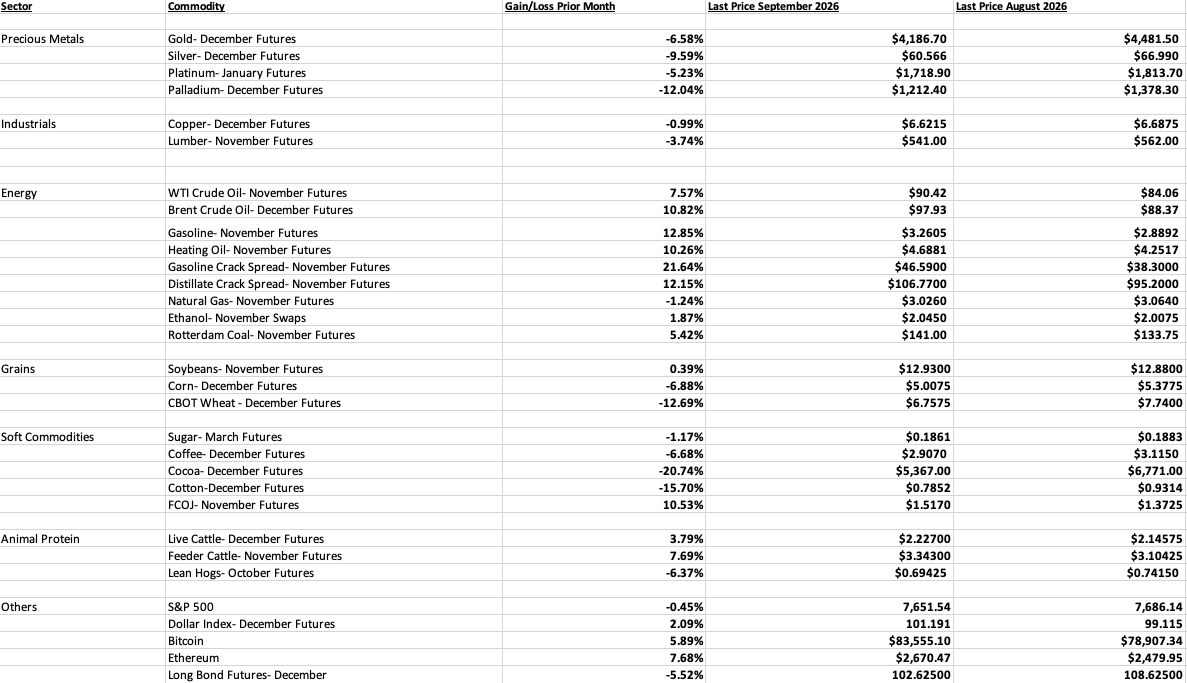
In the commodities asset class in September 2026, the gasoline crack spread rose more than 20%; Brent crude oil, RBOB gasoline, heating oil, the distillate crack spread, and frozen orange juice futures gained more than 10%. ICE cocoa futures fell more than 20%, ICE cotton futures fell more than 15%, and palladium and CBOT wheat fell more than 10%. The DJIA, S&P 500, and Russell 2000 indices were lower, while the tech-heavy NASDAW rallied. Long bond futures fell to their lowest level since July 2002. The December dollar index futures rose 2.09%. Long bond futures fell 5.52%. A higher dollar index and higher interest rates were bearish for commodity prices, and most raw material futures, except energy, posted losses. Long-term interest rates exploded higher, and the Fed raised the Fed Funds Rate by 25 basis points at the most recent September FOMC meeting.
Energy higher, stoking inflation
The lack of a settlement between Iran and the United States, along with a tightening of the economic noose around Iran, drove energy prices higher. At the end of September, tensions remained high, as the U.S. attempt to use economic weapons has caused backlash from Iran. Crude oil, oil products, crack spreads, Chicago ethanol swaps, and Rotterdam coal posted gains in September. Iran continued to stall for time, submitting proposal after proposal, but the U.S. has rejected the efforts as they do not include Iran’s agreement to abandon its nuclear aspirations, open the Strait of Hormuz, and stop its proxies from attacking Israel and Saudi Arabia near the Bab al-Mandeb Strait.
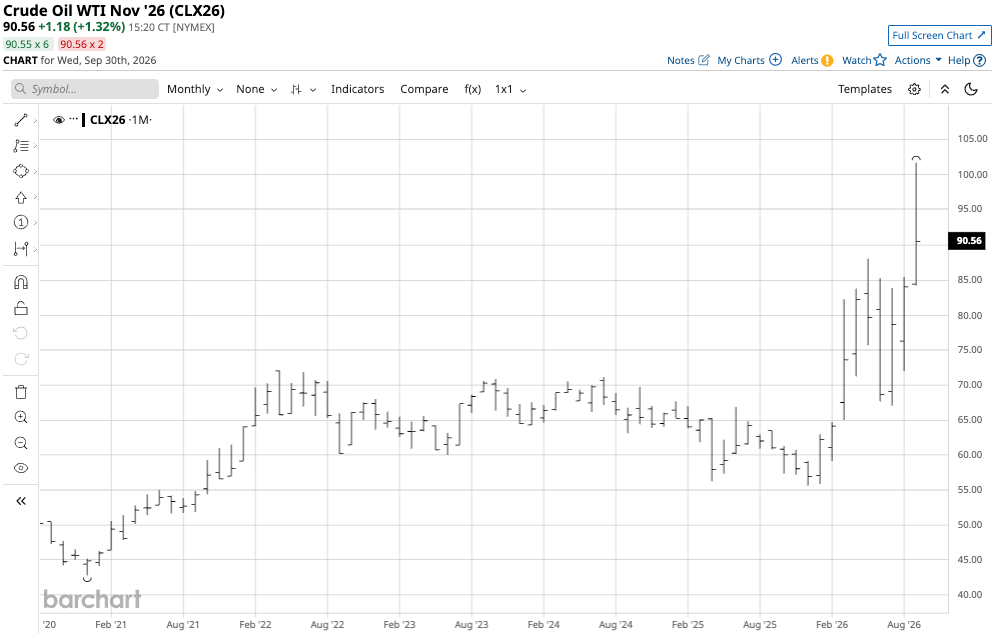
The monthly November NYMEX WTI crude oil futures chart shows that the price rose 7.57% in September. Brent crude oil, the benchmark for Middle Eastern petroleum, outperformed the WTI, posting a 10.82% monthly gain on the ICE December contract. Crude oil prices remained volatile in September, rising on events in the Middle East and around the Strait of Hormuz and the Bab al-Mandeb Strait, as well as the lack of a peaceful resolution.
Gasoline futures moved 12.85% higher, while heating oil futures, which are a proxy for other distillate fuels, rose 10.26%. The products rose more than crude oil as the lag between refinery stocks and crude oil supplies kept product prices elevated.
Crack spreads reflect the refining margins for processing crude oil into gasoline and distillate products. The November gasoline crack spread rose 21.64% in September, while the November distillate crack spread posted a 12.15% gain and reached a new all-time high during the month. Pump prices lag crude oil prices. Moreover, elevated crack spreads have caused products to far outperform crude oil prices, contributing to stellar earnings at oil refining companies.
November Chicago ethanol swaps, the biofuel additive to U.S. gasoline, rose 1.87% for the month, while coal for delivery in Rotterdam, the Netherlands, rose 5.42% in September. Meanwhile, November U.S. natural gas futures edged 1.24% lower as natural gas moves towards the peak season beginning in late November. European natural gas futures prices moved substantially higher in September on Middle Eastern supply concerns. U.K. natural gas futures prices for November delivery and natural gas futures prices in the Netherlands for November delivery rallied in September as concerns about winter supplies increased. The Middle East continued to drive European natural gas prices higher, which could put upward pressure on U.S. natural gas as European demand for U.S. LNG rises throughout the rest of 2026 and into early 2027.
Metals were mostly lower
Precious metal prices soared in 2025 and early 2026, but they ran out of upside steam in late January. In August, prices recovered, but they declined in September.
Gold, the leading precious metal, moved 6.58% lower in September. The volatile silver futures market fell 9.59%. NYMEX palladium futures fell 12.04%, while NYMEX platinum futures fell 5.23%. Despite the declines, precious metals remained above their June and July bottoms.
Copper, the leading nonferrous metal, edged only 0.99% lower on the December futures contract in September. December COMEX copper rose to a new record high of $6.9600 on August 6, 2026.
Nonferrous metals on the London Metals Exchange turned in mixed results. LME three-month copper forwards moved higher in September and reached a new record high. LME aluminum three-month forwards rallied amid turmoil in the Middle East. LME nickel forwards fell, LME lead forwards fell marginally, LME zinc prices declined, and LME tin forwards edged lower marginally in September.
Lumber and agricultural commodities fall, while animal proteins are mixed
The harvest season in the Northern Hemisphere got underway in September. The grain and oilseed markets faced fertilizer shortages due to issues at the Strait of Hormuz and rising conflicts around Black Sea ports; prices posted substantial gains in August. In September, prices were mostly lower. New crop November Soybean futures prices edged only 0.39% higher, while new crop December corn futures fell 6.88%, and December CBOT soft red winter wheat futures moved 12.69% lower. Russia and Ukraine are significant wheat producers. Soybeans were higher as biodiesel prices moved higher with crude oil and oil products.
Soft commodities were mostly lower in September. December cocoa fell 20.74%, and March 2027 world sugar futures edged 1.17% lower. Cocoa’s price fell as supply concerns eased, while sugar has followed developments in the Middle East, as Brazil depends on sugarcane for ethanol production. Sugar has followed crude oil and gasoline prices over the past months. Cotton futures for December delivery fell 15.70% in September, correcting after a rally that took the price over 90 cents per pound in August. December Arabica coffee futures fell 6.68%. The volatile November FCOJ futures recovered, rising 10.53% in September.
Physical lumber futures for November delivery fell 3.91% in September as the construction season ends and interest rates remain high, slowing demand for new homes.
The 2026 peak grilling season began in late May and ran through early September. Cattle prices rose in September after August declines, as the off-season got underway. The live and feeder cattle futures for December and November delivery rose 3.79% and 7.69%, respectively, in September. Meanwhile, lean hog futures for December delivery fell 6.37% for the month ending Wednesday, September 30.
Spotlight on natural gas
U.S. NYMEX natural gas futures could be a sleeping bullish giant over the coming weeks and months as the peak heating season, when inventories decline, begins in November.
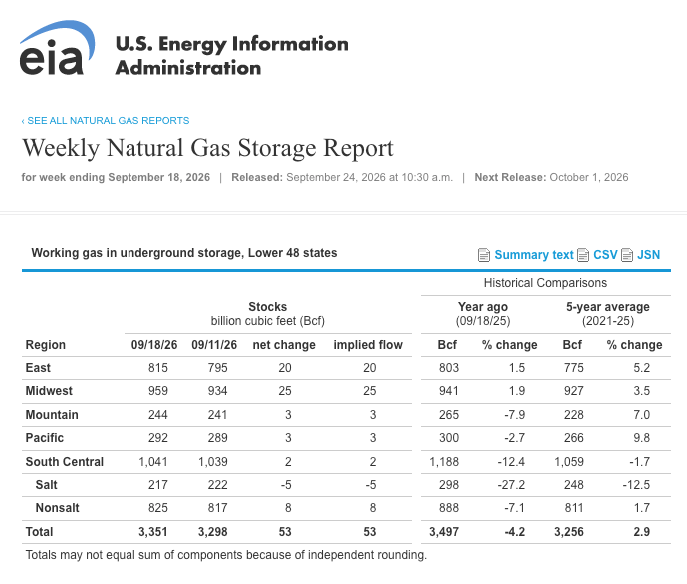
As of the week ending September 18, 2026, natural gas in storage across the United States was 3.351 trillion cubic feet, 2.9% above the five-year average but 4.2% below the mid-September 2025 level.
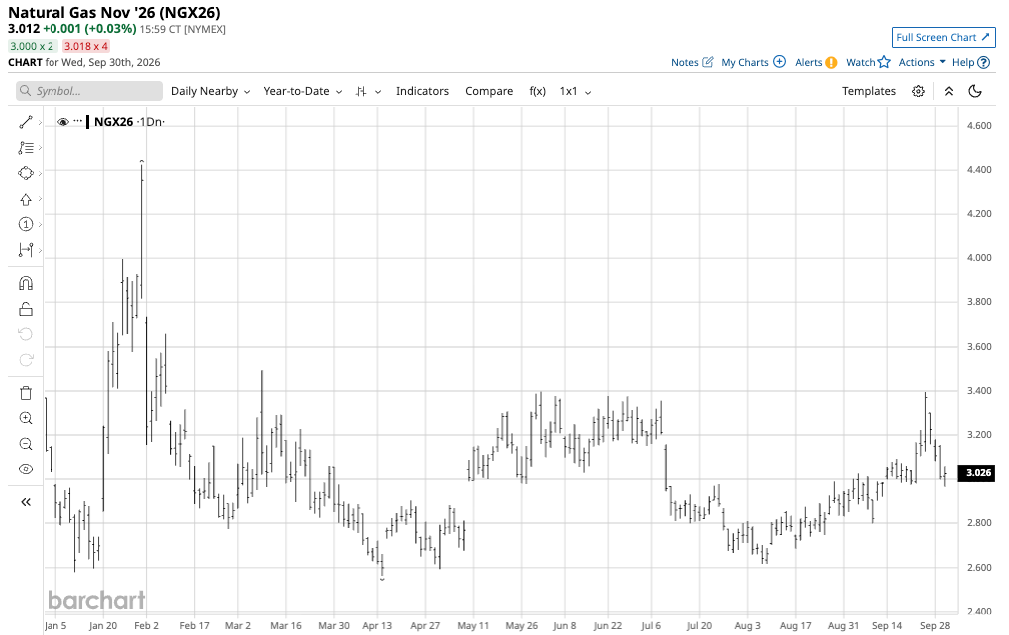
The daily continuous NYMEX U.S. natural gas futures chart shows a bullish pattern of higher lows and higher highs from mid-April 2026, at the end of the 2025/2026 peak demand season, to the most recent high of $3.395 per MMBtu on September 24, 2026. Natural gas futures ran out of upside momentum just below $3.40, but the coldest months are ahead. In January 2026, natural gas for November 2026 delivery rose to a high of $4.425 per MMBtu.
Meanwhile, the upcoming peak demand season in the U.S. is only one factor that could push prices higher, as demand from Europe could increase LNG shipments.
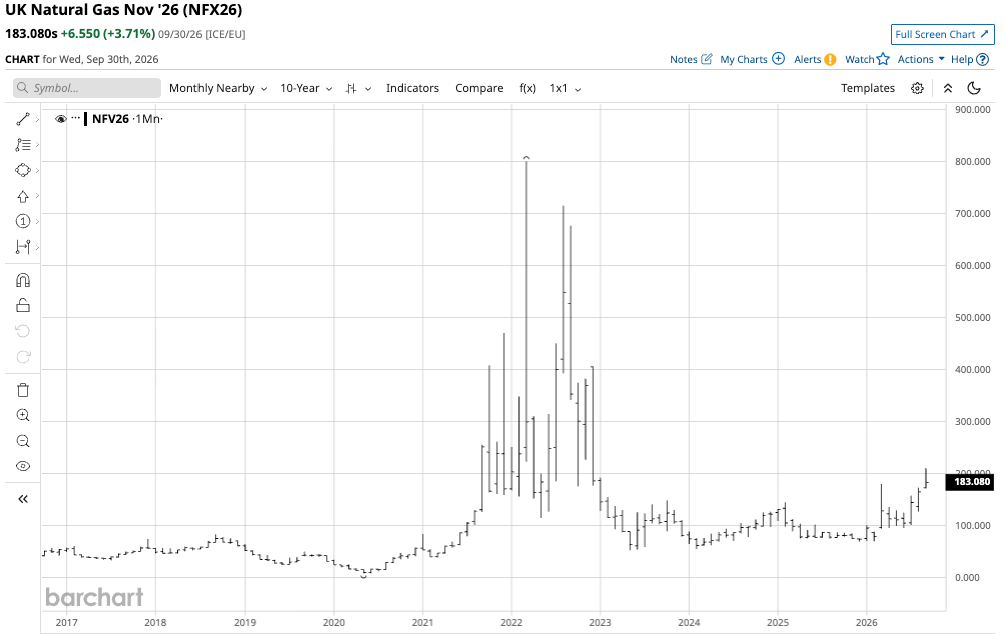
The monthly ICE U.K. natural gas futures chart shows that prices rose to their highest level since December 2022 in September.
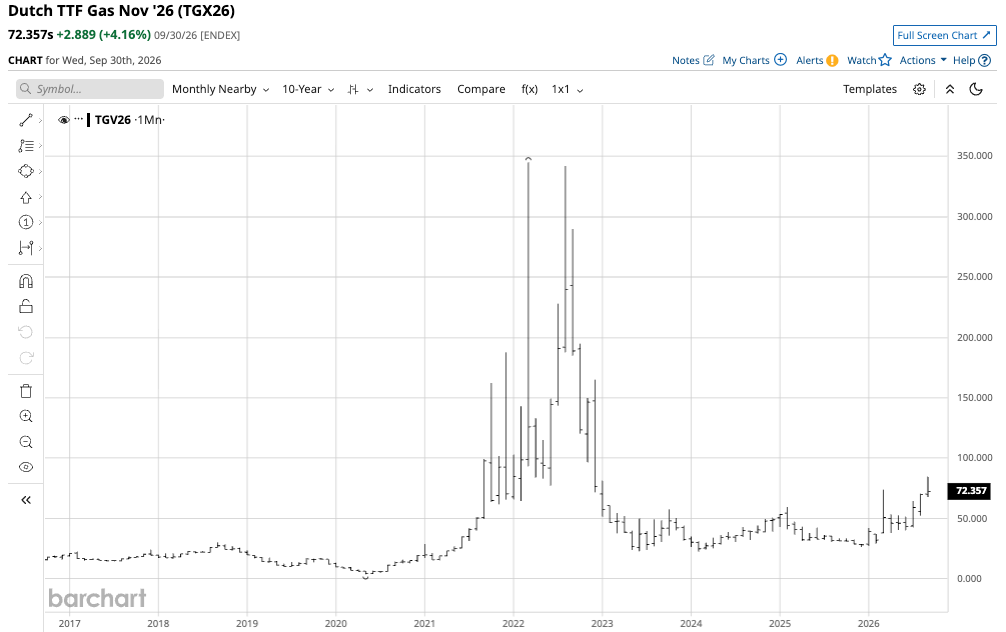
The monthly Dutch natural gas futures chart also shows that they rose to their highest level since December 2022 in September. In 2022, Russia invaded Ukraine, causing supply concerns due to sanctions on Russian natural gas through the pipeline system. In 2026, Russian sanctions continue, and the war in the Middle East has slowed LNG shipments from the region to a crawl. A cold winter in Europe will cause shortages as inventories are already low, and U.S. LNG could drain inventories, driving U.S. natural gas prices higher. NYMEX natural gas is a highly volatile futures market, and the potential for an explosive move is high.
Factors to watch in October 2026
As commodities move into October, they face continued uncertainty from the economic and geopolitical landscapes. Seasonality could support lower prices for meats and gasoline as the grilling and driving seasons have ended. We could see buying in natural gas as fall and winter approach and European prices are rising, pushing U.S. LNG demand higher. In crude oil, the U.S. SPR has declined to 283.8 million barrels, 430 million below capacity, which will limit continued withdrawals and could put upward pressure on oil prices.
The situation in the Middle East will continue to dictate the path of least resistance for energy and other commodity prices. Crack spreads remain elevated, translating to high oil product prices and highly profitable margins for refineries not impacted by the wars. The war between Russia and Ukraine and the situation with Iran have pushed grain and oilseed prices higher, which could keep prices elevated into 2027. Moreover, a potential Super El Niño weather pattern in 2027 could be extremely bullish for agricultural commodities.
The November 3 U.S. midterm elections could impact markets, as the administration’s policy initiatives depend on the outcome. Fractures within the opposition party between middle-of-the-road Democrats and Democratic Socialists could add to uncertainty during the election season as the DSA supports a total ideological remaking of the United States from a capitalist to a socialist country.
Cryptocurrencies are in bullish trends, but remain at levels that could cause two-way volatility. The dollar index is rallying, and bonds have broken down to a more than two-decade low, which is a bearish signal for commodities. Interest rates depend on inflation, and U.S. debt is now over $40 trillion. Moreover, the debt has forced buyers of U.S. government debt securities to demand higher yields as credit deteriorates. Elevated inflation has caused the Fed to raise the Fed Funds Rate in September, but wars could negate the impact of a hawkish central bank. Geopolitical events are bullish, while debt and currency markets are bearish for raw material prices as the markets move into October 2026.
The bull market in stocks continues, but the economic and geopolitical landscapes will determine the path of least resistance for U.S. stocks.
Expect continued volatility in the commodities asset class in October 2026 and beyond, and you will not be surprised or disappointed. The volatility creates opportunities, but any new trade or investment requires careful attention to risk-reward dynamics to enhance profits and protect capital. Be careful over the coming weeks, as October is historically a very volatile month across markets and asset classes.
On the date of publication, Andrew Hecht did not have (either directly or indirectly) positions in any of the securities mentioned in this article. All information and data in this article is solely for informational purposes. For more information please view the Barchart Disclosure Policy here.