
SPY vs. SPY: This Chart Says We’re Already in a Market Correction. Here’s My Trade Plan.
There’s an interesting anecdote out of the Wednesday summit of artificial intelligence (AI) leaders at the White House, according to The Wall Street Journal:
Behind the scenes, industry leaders including Jensen Huang of Nvidia had just questioned Anthropic’s Dario Amodei about his warnings about the dangers of AI, people familiar with the matter said.
The executives asked Amodei why he was being so extreme in public about the capabilities of AI models and risks they posed following a lunch in the East Room with about two dozen CEOs.
To a large extent, this reads like another instance of Huang “talking his book,” so to speak.
As noted in our recent analysis of the data center narrative, the Nvidia (NVDA) CEO has a multi-trillion dollar motivation to keep this investment train on the rails and moving forward – a task that becomes increasingly difficult in the face of doomsday warnings like those outlined in Anthropic’s leaked IPO prospectus.
The document reportedly dedicates nearly a third of its pages to outlining exotic dangers including, but not limited to, a “catastrophic or existential risk to humanity” – not exactly your standard IPO fare. The 80 pages of AI-related risks easily outweighed the 48 pages that covered Anthropic’s actual business model.
Another eye-catching figure: 2 customers account for roughly a quarter of the company’s revenue.
In our critical look at the data center economy – which has been compared to the railroad boom, the dot-com bubble, and other transformative industrial eras in American history – I wrapped up by sharing a chart that showed the stark performance disparity between the widely followed Invesco QQQ Trust (QQQ), which is weighted by market cap, and its close cousin, the Nasdaq-100 Equal Weighted Index ETF (QQQE).
Below, you’ll find the same comparison with the two S&P 500 Index (SPX) exchange-traded fund benchmarks – the SPDR S&P 500 ETF (SPY) and Invesco S&P 500 Equal Weight ETF (RSP).
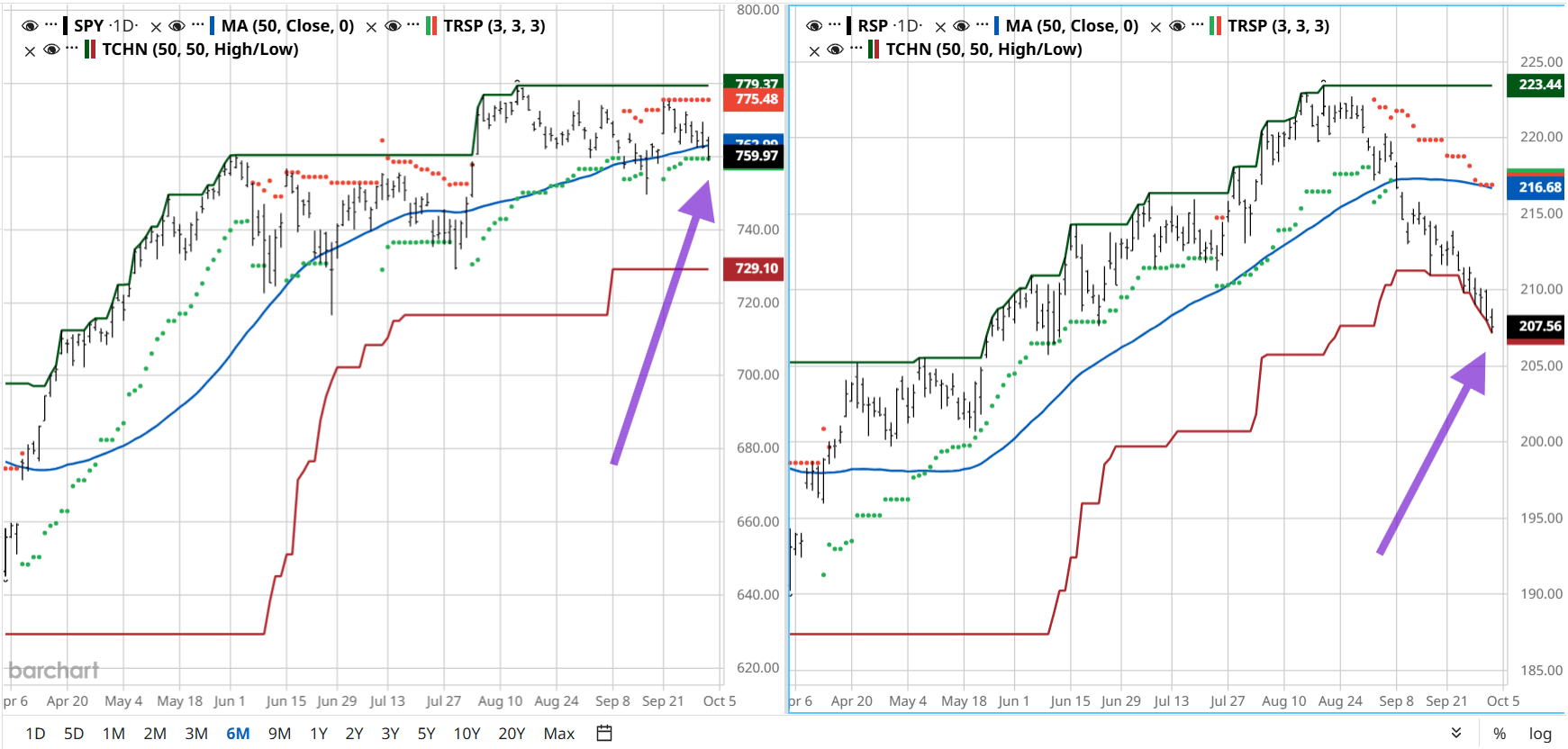
The story is that the market is already in a corrective phase, as evidenced by the equal-weighted charts.
The high concentration in the cap-weighted index doesn't reflect the correction because literally one stock – Nvidia – is holding the market up, since it's the largest holding by percentage in any tech- or broad-based market ETF.
(Over 800 of them, per ETF.com – and all of this as Nvidia has more or less become a bank stock whose “currency” is chips, with Jensen actively shifting his “currency risk” to large institutional insurers. If this plot line sounds familiar, think "too big to fail.")
Investors shouldn’t underestimate how much of that cap-weighted strength lies in NVDA being its own best customer by investing in companies that will buy their chips, and buying back billions of dollars of their stock.
In the meantime, the narrow market breadth means I’ll look for opportunities to tighten stops on my winners – which, outside of AI, aren’t many left – and wait for evidence in the downtrodden names that a positive rotation is about to commence.
– John Rowland, CMT, is Barchart’s Senior Market Strategist and host of Market on Close.
On the date of publication, Barchart Insights did not have (either directly or indirectly) positions in any of the securities mentioned in this article. All information and data in this article is solely for informational purposes. For more information please view the Barchart Disclosure Policy here.