
Dutch Bros Stock: How a Cup of Coffee Can Get You a 300% Payout
A good cup o’ joe is often necessary to get your day going — but it can also supercharge the risk-capital portion of your portfolio. I’m talking about Dutch Bros (BROS), one of the core competitors within the drive-thru beverage market. While it may be a crowd favorite, BROS stock unfortunately hasn’t lived up to the billing for investors, carrying an 88% Strong Sell technical opinion rating.
It looks ugly at the moment, there’s no denying that. In the trailing month, BROS stock is down 21%. On a year-to-date basis, the ticker has shed 37% of value. Still, it might be a mistake to ignore the name simply because of its poor technical performance.
Yes, I’m referring to the often-discussed theory of mean reversion. But I don’t really think it’s an empty proposition. Fundamentally, when a public security sees extended emotional trading, a number of developments may occur: such dynamics can change positioning, liquidity and how participants perceive the security, potentially altering the probabilities of what happens next.
Let’s say you saw a low-mileage Lambo in the second-hand market for only $20,000. Since a new one can easily exceed 10 times this figure, it would make sense to be tempted by the offer. But if you later found out that this exotic vehicle was caught in a flash flood, that’s almost surely going to affect the probability of you opening your wallet.
That’s what makes Dutch Bros stock so intriguing. If we were to view public securities not as scalar representations but rather discrete labels, we would universally say that BROS is currently structured in a behaviorally negative/pessimistic state.
Under this framework, the next question should be, what is the probability of transition to a different state? By finding out this answer, we may narrow down where Dutch Bros stock may end up over a defined period.
BROS Stock: Understanding the Logic Behind Transitions
From a quantitative perspective, what makes Dutch Bros stock an enticing name for speculation is the frequency of pessimism. In the last two months, there have been 10 weekly candlesticks posted. Within this period, only two of the sessions saw net positive price action, thereby leading to an overall downward slope across the last 10 weeks.
Put another way, 80% of the unit-wise volume suffered from net drawdowns. I think it’s a reasonable assumption that, no matter what investors think about BROS stock as a whole, the current perception is deeply negative. And thanks to this skepticism, this immediate sentiment should influence the ticker’s probabilistic trajectory.
That’s the heart of the Markov chain logic that may be used — under certain circumstances — to trade equities like BROS stock. Essentially, I operate under a basic presupposition that popular securities enjoy a baseline equilibrium, with bulls and bears negotiating their market value. Under such equilibrium, a public ticker may produce outcomes that resemble a random walk. As such, models that effectively capture the probabilities of random systems (like Black-Scholes) may be most appropriate.
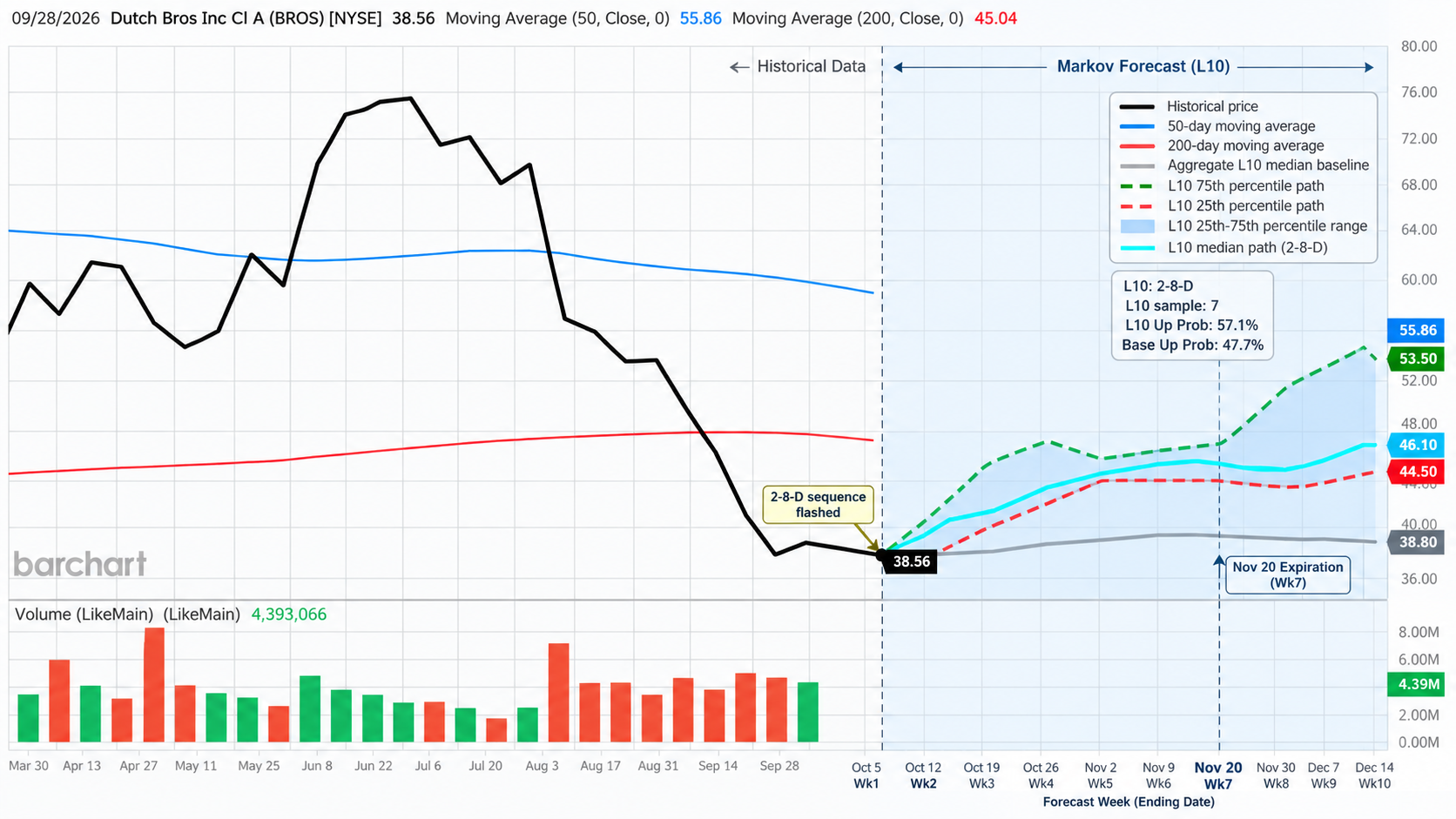
However, when an equity sees an order flow imbalance — such as the case with BROS stock and its heavily extended bearishness — I believe there’s a heightened probability of a transition from one state to another. And that’s where the Markov chain comes in, which basically asserts that the future state depends on the current state.
Right now, we may acknowledge that the current state of BROS stock is deeply pessimistic. Further, we have specified what kind of pessimism is quantitatively involved; that is, within the last 10 weeks, only two of the weekly candlesticks were positive.
We can then seek out this exact behavioral state from Dutch Bros’ historical data to see how its equity responded following the flashing of this signal. As it turns out, this behavioral state has materialized only seven times on a rolling basis since the public market debut of BROS stock.
Each time, though, we saw BROS bounce back sharply, which sets up an intriguingly inductive inference.
Why Dutch Bros Stock Options May Be Mispriced
Because of the extremely small sample size, there’s really no way of making a statistically confident bullish case for Dutch Bros stock. But what really drives the temptation is that, so far, every time BROS has flashed the aforementioned signal, the security has bounced higher.
This contrarian rebound effect would place BROS stock around the $46 level around the end of October as a median expectation. Because precise forecasts are incredibly difficult to make, so-called conservative speculators might consider the 42.50/45 bull call spread expiring Nov. 20. This vertical spread features a maximum payout of almost 178%, making it positively asymmetric.
However, if we were to take the inductive inference above at face value, the wild speculator might consider the 44/45 bull spread expiring Oct. 30. If BROS stock does actually hit $46 at the end of October, that would be enough to trigger the $45 second-leg strike for this spread.
Doing so would generate a max payout of 300%. Better yet, that’s on a net debit of only $25.
Now, the challenge to the trade is the probability of success. Breakeven probability is defined at 15.7%, whereas the probability of hitting $45 on expiration is only 12.32%. Those are terrible odds but they’re also calculated using random-walk assumptions.
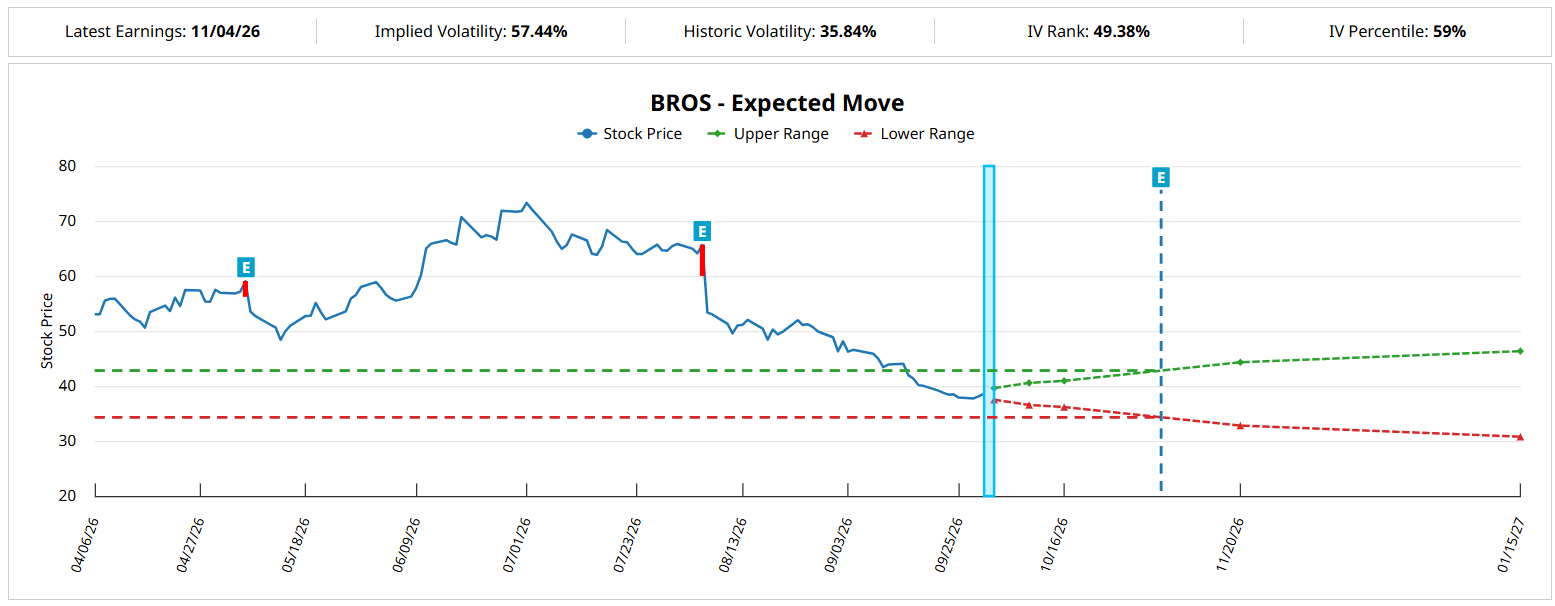
If BROS stock featured a balance between bullish and bearish pressure, I would be more inclined to accept the random-walk model and its implied probabilities. However, because BROS is clearly in a deeply bearish state, the historical tendency has been for a transition to a contrarian bullish state.
In other words, the data itself implies a nonrandom walk. Of course, that doesn’t mean that a nonrandom walk is guaranteed. But if nonrandomness is ultimately the catalyst, Dutch Bros stock would likely be mispriced as the wrong tools may be used for the job, so to speak.
And that, my friends, is the speculation. If you find the transitional logic credible, make sure to keep your eyes on BROS stock.
On the date of publication, Josh Enomoto did not have (either directly or indirectly) positions in any of the securities mentioned in this article. All information and data in this article is solely for informational purposes. For more information please view the Barchart Disclosure Policy here.