
Soaring Defense Spending Means Great News for These 2 Stocks
Key Points
RTX combines a record $289 billion backlog with growing exposure to defense production and commercial aerospace.
Lockheed Martin offers an attractive valuation after falling nearly 25% from its 52-week high.
Defense spending worldwide is soaring, driven by ongoing global conflicts, severe weapons stockpile depletion, and rising government funding. The 2027 National Defense Authorization Act proposes $1.1 trillion in defense and national security funding by the U.S., while a $350 billion reconciliation package could push defense spending to nearly $1.5 trillion.
Lockheed Martin (NYSE: LMT) and RTX (NYSE: RTX) are well positioned to benefit from growing defense budgets, thanks to their international presence and crucial air and missile defense businesses. These contracts are seeing backlogs surge from domestic and international orders, providing revenue visibility for years to come. Here's what investors need to know.
Missed Nvidia in 2009? This Rare Signal Is Flashing Again. In 2009, a "Double Down" signal flashed for a little-known chipmaker called Nvidia. For the first time in years, that same "Total Conviction" signal is flashing for a company 1/100th the size of Nvidia. Continue »
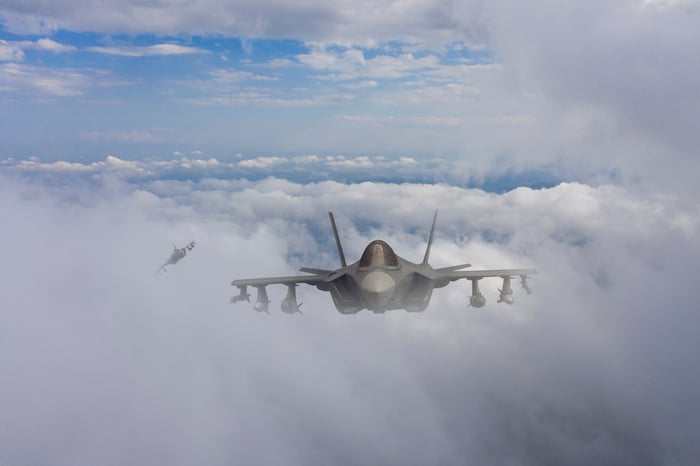
An F-35 Lightning II; Image source: Getty Images.
Lockheed Martin is a top defense stock that looks like a bargain
Lockheed Martin is an established defense contractor best known for its fighter jets. The F-35 Lightning II stealth fighter accounts for roughly 28% of total revenue and is produced at a rate of about 156 per year.
This helps generate high-volume manufacturing revenue for Lockheed. And these fighter jets will remain in service through at least 2070, providing it with decades of service revenue.
The company is also seeing healthy demand for its tactical missiles and air defense systems. On June 24, the Missile Defense Agency awarded a seven-year contract worth up to $35 billion to quadruple manufacturing rates for its Terminal High Altitude Area Defense (THAAD) system, designed to intercept and destroy ballistic missiles.
Frontline strike platforms are seeing strong demand with multibillion-dollar procurement awards for the Precision Strike Missile, Guided Multiple Launch Rocket System, and launchers for the High Mobility Artillery Rocket System. Lockheed Martin also plays a key role with its U.S. Space Force award to build Space-Based Interceptor prototypes for the Golden Dome missile shield.
The company's backlog is a record $230 billion, and Wall Street analysts have taken notice. UBS recently upgraded Lockheed to a buy rating, and it forecasts that munition and missile volume will drive 9% annual revenue growth through 2028. This comes amid rising global conflicts, notably in Iran and Ukraine, which have severely depleted stockpiles of missiles, counter-drones, and air defense systems.
Despite its strong growth outlook, the stock is down nearly 25% from its 52-week high and is priced modestly at 17 times this year's projected earnings. For investors seeking exposure to growing global defense budgets, the recent dip in Lockheed Martin looks like a smart buying opportunity.
RTX is ramping up production, and its backlog has reached an all-time high
RTX, through Raytheon, is another major defense contractor seeing rising demand. Under multiyear agreements with the U.S. Department of War (formerly the Department of Defense), the company is ramping up production of precision munitions, including Tomahawk cruise missiles and air-to-air missiles to at least 1,000 and 1,900 units annually, respectively. RTX is also a key player in the Golden Dome missile defense system, with sensor technologies such as 360-degree radar.
RTX's defense growth isn't limited to domestic sales. International orders make up 48% of Raytheon's $86 billion defense backlog. In the second quarter, Raytheon booked $5 billion in Patriot GEM-T missile interceptor sales, including $3.7 billion to Ukraine and $988 million to Poland.
What differentiates RTX from Lockheed Martin is its balanced business model, making it a powerhouse in both defense and commercial aerospace. The latter is anchored by Pratt & Whitney and Collins Aerospace, which together provide commercial engines, maintenance services, avionics, and flight control systems.
Between strong growth for commercial aftermarket repairs and defense awards, RTX's total backlog is a record $289 billion. Like Lockheed, the stock has fallen 17% from its 52-week high. With shares priced at 23.8 times this year's projected earnings, and with the U.S. and other governments worldwide, RTX is another top defense stock to buy right now.
Courtney Carlsen has no position in any of the stocks mentioned. The Motley Fool has positions in and recommends Lockheed Martin and RTX. The Motley Fool has a disclosure policy.