
Hehuang Pharmaceutical (00013): From the following sector to the outperforming sector, when will the new round of the market start after the fundamentals are confirmed?
Since hitting a phased low of 2938.07 in the intraday period on June 22, the Hang Seng Healthcare Index (800804) has been recovering for 3 months. Based on the intraday high of 4018.32 points on August 26, the biggest increase in the sector range has reached 36.77%.
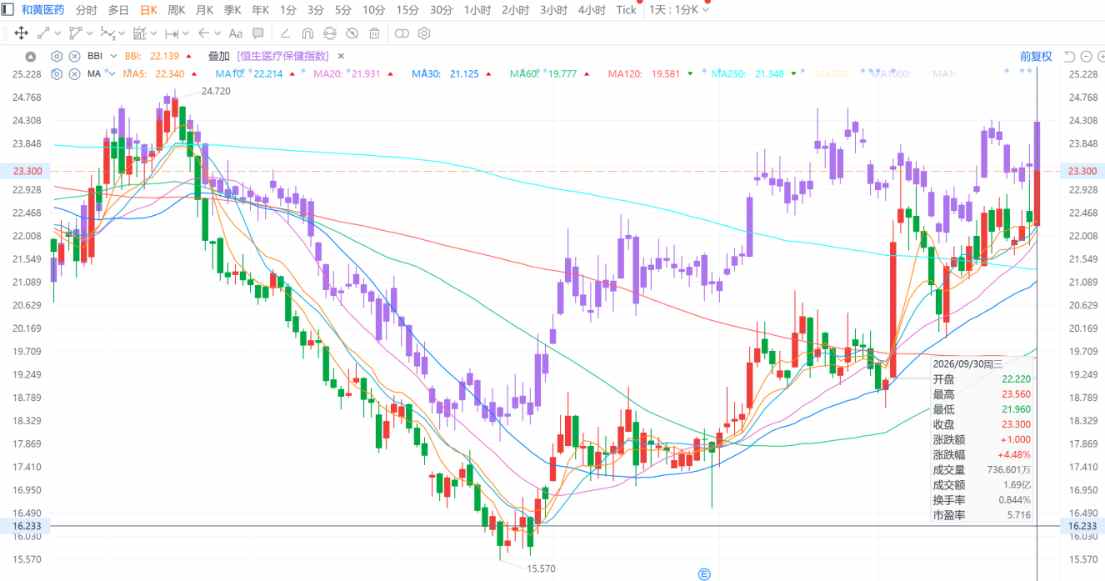
According to the Zhitong Finance App, as a target that rose and fell almost simultaneously with the sector's market, Hehuang Pharmaceutical (00013) also broke out of the Changyang market in this range, rising all the way from an intraday low of HK$15.57 on June 22 to an intraday high of HK$23.56 on September 30. The biggest increase in the range reached 51.32%, clearly outperforming the index.
From recovering from low stock prices to “fundamental confirmation”
From April 17 to June 22, due to the double influence of sluggish market sentiment and short-selling pressure on the market, Hewang Pharmaceutical's stock price once retracted by more than 35%. However, after June 22, Hewang Pharmaceutical's stock price began to rebound. This market performance is also highly correlated with sector trends over the same period.
Although the overall capital outflow from Hong Kong stocks continued at the time, the information technology and healthcare industries maintained net inflows, and since the AI sector was still fluctuating at a high level at the time, part of the capital began to seek valuation depressions to rebalance assets. Because of its defensive and growth attributes, the pharmaceutical sector has become an important direction for receiving spillover capital. And this also became one of the main reasons why Hewang Pharmaceutical's stock price began to recover from a low level.
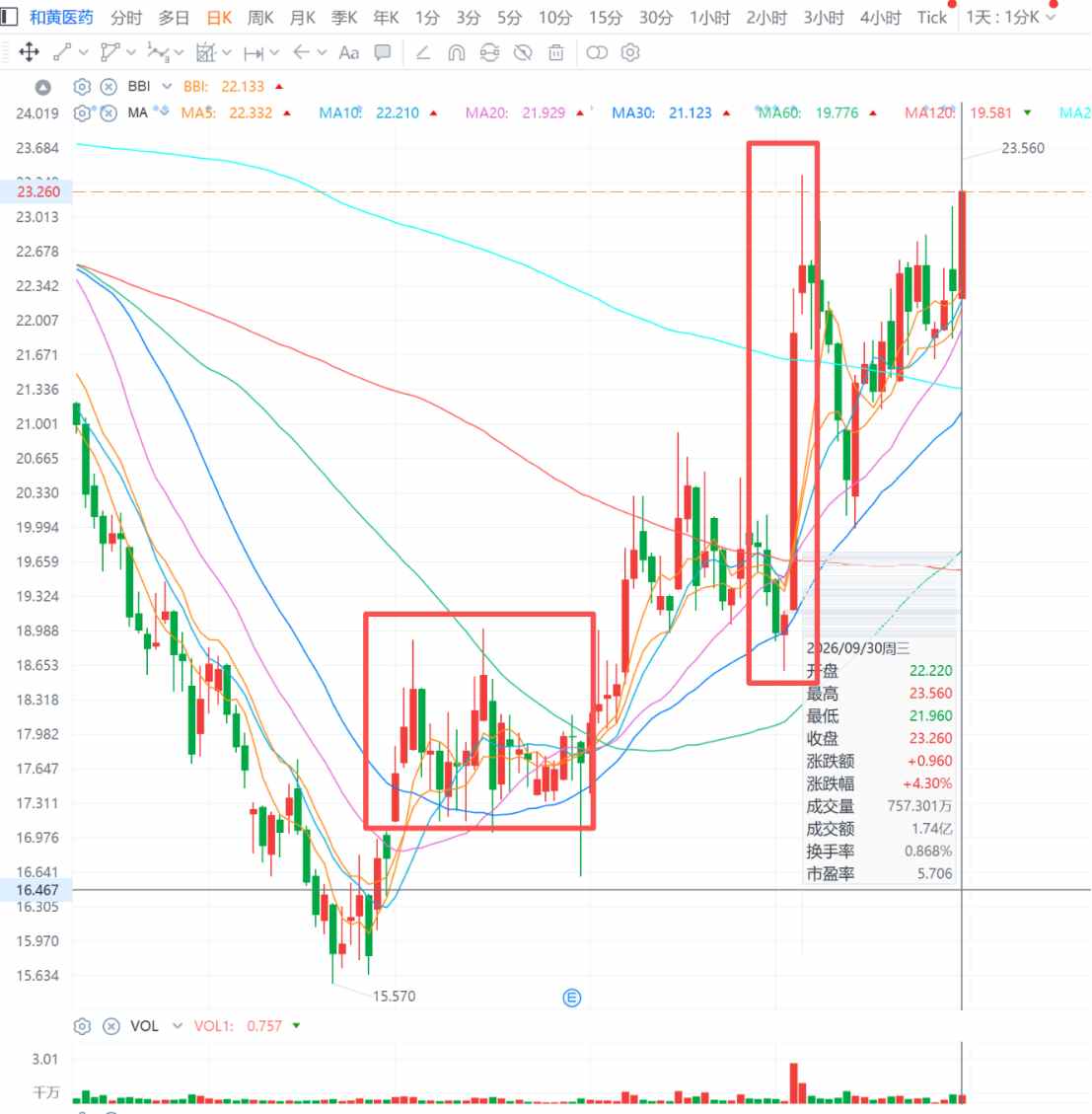
Driven by the sector-driven low recovery logic, HWong Pharma's stock price soared on July 16 and hit the 60-day EMA and BOLL line trajectory.
Although the company's PE valuation at the time was only 4.55 times, and PE performance of more than 20 times lower than the industry average was still overestimated, the overheated short-term performance still caused it to experience a brief correction after July 16, until the company disclosed the 26H1 financial report on July 30.
On July 30, Hutchison Pharmaceuticals officially disclosed its financial report for the first half of 2026. Financial reports show that the company achieved revenue of 278 million US dollars, an increase of 0.22% year on year; net income attributable to shareholders was 16.242 million US dollars, a decrease of 96.43% year on year.
The market's views on this interim report are clearly biased towards the positive.
On the one hand, the sharp decline in the company's net profit was affected by the one-time income from the sale of 45% of the company's prescription drug business (Shanghai and Huang) in the same period last year; on the other hand, in this financial report, Hewang Pharmaceutical confirmed benefits such as the recovery in sales of its current core products, promotion of the ATTC platform, late-stage clinical catalysis of sevolitinib, and sufficient cash reserves.
On the business side in particular, in the first half of this year, Hewong Pharmaceutical's comprehensive revenue for oncology and immunization products reached US$162 million, an increase of 13% over the previous year. Among them, fruquintinib increased about 70% year over year outside the US, driving its global sales to US$185 million. In the domestic market, sales of fruquintinib and surufatinib increased by 41% and 45%, respectively, year over year. The growth performance of the innovative drug business also to a certain extent shattered early market questions about whether Hewang Pharmaceutical's prescription drug business could grow steadily after “weaning”.
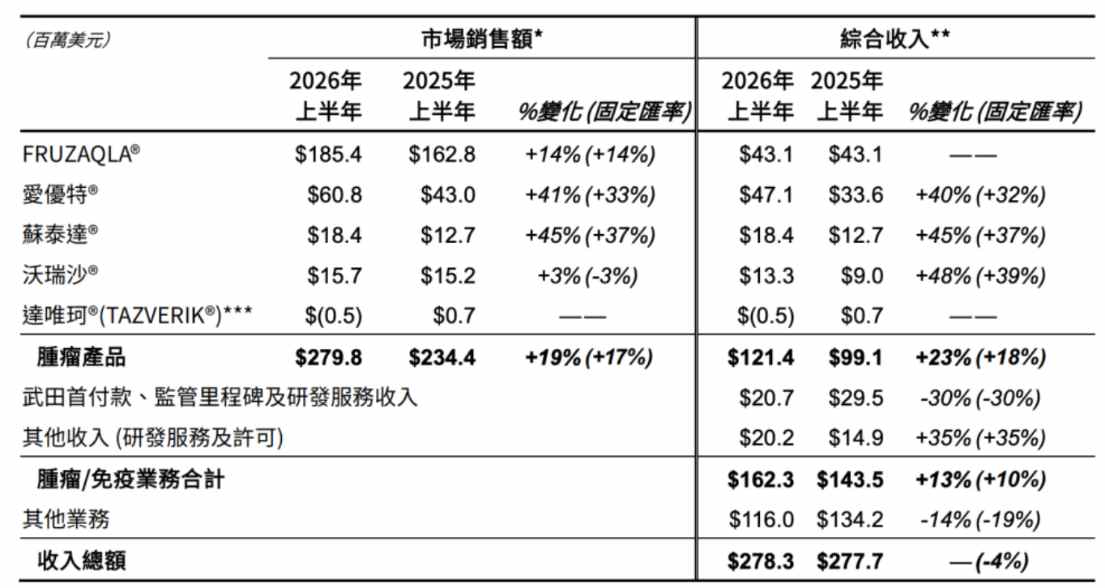
Simply put, Hewang Pharmaceutical's 26H1 financial report provided it with the basic foundation of “commercial recovery+cash security+pipeline catalysis”. And it also accelerated the mood in the field from disagreement to agreement.
In fact, the stock price of Hewang Pharmaceutical closed down 1.34% the day after the financial report was revealed, and the company's stock trading volume on that day also increased to about 2.78 times the average volume in the previous 5 days. This shows that after seeing a sharp drop in net profit, the market did not immediately give a “performance that exceeded expectations” pricing. However, at the same time, the long-term outlook for the day also showed that investors inside and outside the market accelerated the reassessment of their subsequent expectations after confirming that Hewang Pharmaceuticals had underpinned its performance, and this result was finally reflected on the market on August 7.
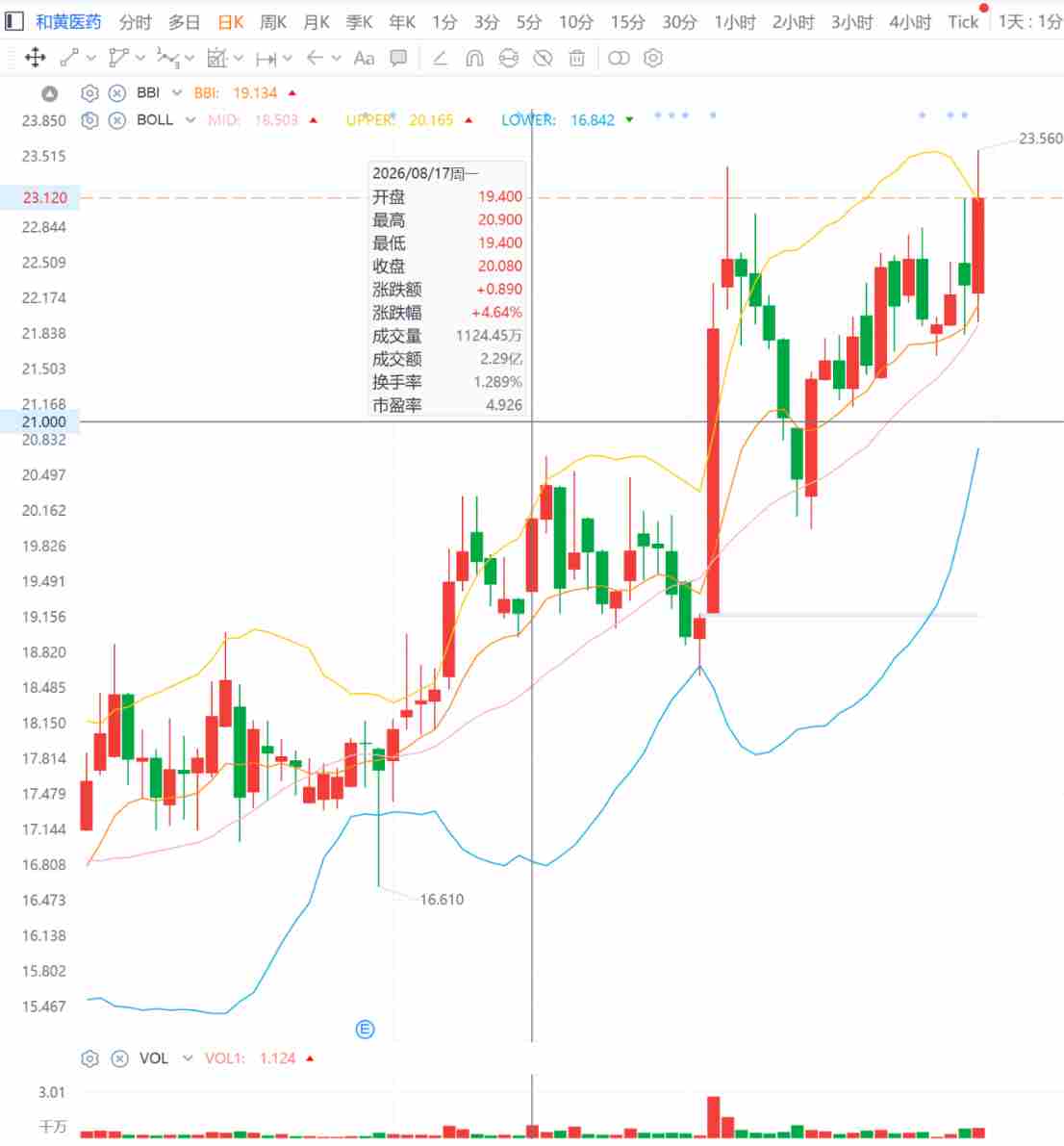
The Zhitong Finance App observed that on August 7, Hewang Pharmaceutical's stock price officially began to accelerate for the first time since the disclosure of financial reports. While the stock price closed up 5.53%, stock trading volume also reached 6.53 times the previous 5-day average, and the corresponding turnover rate rose to 1.25%; on August 17, the company's stock price closed up 4.64% again, and the trading volume further increased to 6.76 times the average volume for the previous 5 days.
When will it usher in a “main upswing” after the expected acceleration in fulfillment?
It is easy to see from the market after the Chinese report that the leading logic of Hewang Pharmaceutical's stock price increase in this round was not driven by traditional revenue and profit growth, but rather that the market re-priced its subsequent BD expectations after confirming that the company's commercial recovery was underpinned.
Therefore, it is easy for investors to see that Hewang Pharmaceutical's stock price performance from July 30 to now has not continued to rise steadily, but there has been a correction between August 19 and September 2.
Judging from the news, within the above range, Hewang Pharmaceutical announced the launch of the new drug Elindac® (Valagratinib) and the latest research data on the combination treatment of Warisha® and Teresa® on August 28 and August 31, respectively, but it was still unable to stop the correction trend in stock prices at the time. The company's stock price even hit the BOLL line for a while on September 2.
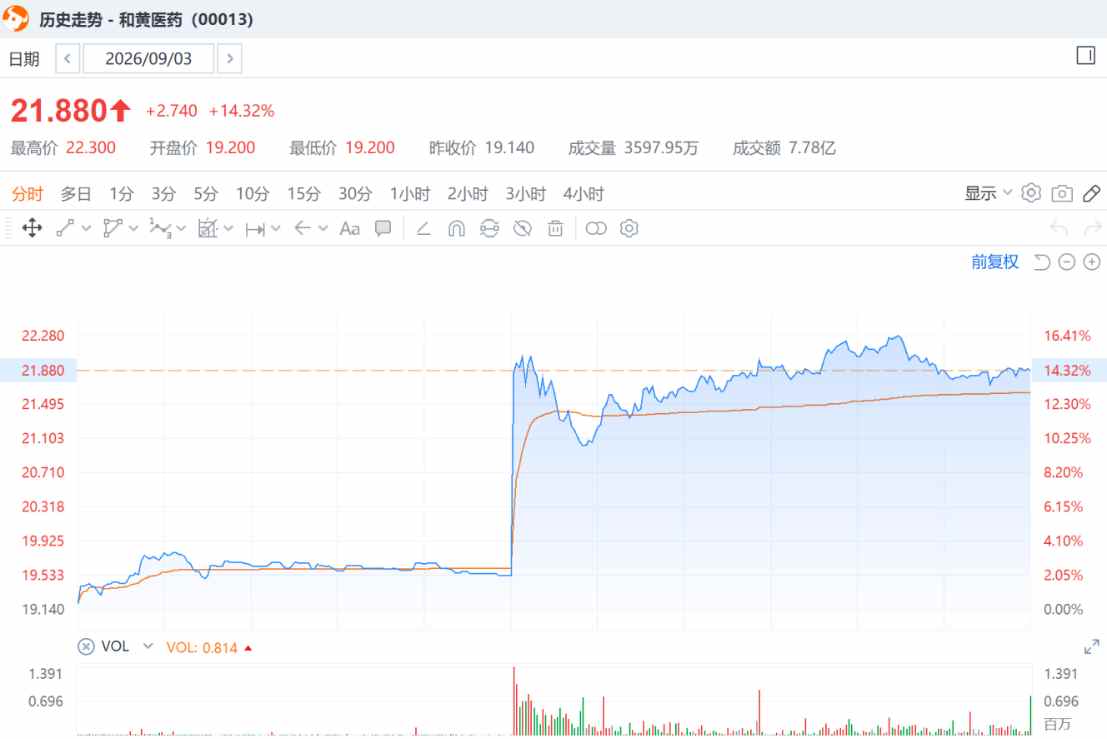
During the closing period at noon on September 3, Hewang Pharmaceutical issued an announcement announcing that the company and GlaxoSmithKline (GSK) had reached a global cooperation on the pre-clinical project HMPL-A830. According to the agreement, Hutchison Pharmaceuticals will receive a down payment of US$110 million and a total milestone payment of up to US$1,295 million, plus royalties based on sales.
It is worth mentioning that the project originated from the ATTC platform independently developed by Hewang Pharmaceutical, and as a result, it also became the first externally authorized drug candidate discovered and authorized by Hewang Pharmaceutical based on this platform.
After the announcement was revealed, in the afternoon of the same day, the market began to reassess the value of Hewang Pharmaceutical's ATTC platform and there was a phenomenon of concentrated fund-raising: the company's intraday stock price rose by 16.41% and eventually closed up 14.32%; in terms of energy, the company's stock trading volume reached 35.9.795 million shares on the same day, reaching about 6.97 times the average volume for the previous 20 days, and the corresponding OBV index rose to 44.3 million shares.
This quantitative and price performance shows that the direction of capital accumulation for the day is consistent with the direction of price breakout. This also shows to a certain extent that the day was not a simple emotional pulse market.
After disclosing the BD deal with GSK, Hutchison Pharmaceuticals also welcomed updated research reports from various institutions including Daiwa, Citi, Lyon, and CICC on September 4. Among them, Citi raised its revenue forecast for oncology/immunology products by 27%, while the target price was raised from HK$36 to HK$39; while Daiwa raised Hewang Pharmaceutical's rating by two levels from “hold” to “buy”, and the corresponding target price was raised to HK$28.5.
However, although the above institutional judgment further strengthened Hewang Pharmaceuticals's short-term trend, Hewang Pharmaceuticals's stock price showed a high level of divergence on September 4: it closed up only 3.02% on the same day, and the trading volume fell to 18.364 million shares. This was followed by “five consecutive losses” in its stock price and a subsequent restorative rebound.
The Zhitong Finance App observed that on September 14, Hehuang Pharmaceutical's stock price rebounded strongly again after the previous day's decline hit the middle track of the BOLL line, and then rebounded for about half a month until September 30. However, this does not mean that Hewang Pharmaceutical has entered a new upward trend.
Although the high intraday price of Hewang Pharmaceutical's stock price on September 30 broke through the high of HK$23.40 on September 4, the closing price of HK$23.00 on the same day was still lower than HK$23.40, which may indicate that there was real hedging and profit trading pressure in the HK$23.40-23.56 range within the market.
Also, the company's stock trading volume on September 30 was only about 53.6% on September 4, and the turnover was about 54.6% on September 4. Also, while the stock price hit a new high on the same day, the OBV index did not reach a new high at the same time. The cumulative strength of capital has not continued to expand, and it also verifies to a certain extent that there has been no large-scale relay of incremental capital in the current market.
However, whether it can rise to a high stock price in the subsequent closing, or become an important price indicator for investors to evaluate whether Huang Pharmaceutical is expected to launch a new round of major upward trends.