
Goldman Sachs: Samsung's 3Q26 operating profit and 2027 HBM revenue are both expected to exceed 100 trillion won, reaffirming the “buy” rating
The Zhitong Finance App learned that Goldman Sachs released the latest research report, reaffirming Samsung Electronics' “buy” rating. The bank believes that Samsung Electronics' fundamentals are still stable, storage demand continues to significantly exceed supply, and this gap is expected to expand further in 2027 and continue in 2028. The company's HBM business continues to improve. Revenue is expected to exceed 100 trillion won next year, providing strong support from a sharp rise in volume and price. Furthermore, shareholder returns have the potential to rise. The current stock price corresponds to 2027E with only 3.6 times P/E and 1.6 times P/B (ROE of 53%), which Goldman Sachs believes provides an attractive risk return.
Goldman Sachs said in the report that it lowered Samsung Electronics' operating profit forecast for the third quarter of 2026 by 5% to 106 trillion won, mainly reflecting the impact of a stronger than expected exchange rate of the won against the US dollar during the quarter — the actual average exchange rate was 1,418 won to 1 US dollar, compared to the previous assumption of 1,460 won. Despite the reduction, Goldman Sachs expects operating profit to exceed 100 trillion won for the quarter, mainly due to the strong fundamentals of the DRAM and NAND business, particularly the continued steady growth of the HBM business.
Goldman Sachs pointed out that the updated 3Q26E estimate is basically consistent with the market consensus (BBG), while the 2027-2028 profit estimate is 8%-17% higher than the market benchmark, mainly reflecting higher DRAM ASP assumptions (especially HBM), and its impact exceeds the drag caused by the reduction in traditional DRAM shipment estimates. Goldman Sachs believes that the company's focus on the HBM business will relatively limit the bit output of traditional DRAM, thereby further boosting the tight supply situation in 2027.
HBM's business is the core growth engine, and revenue is expected to reach US$74 billion in 2027
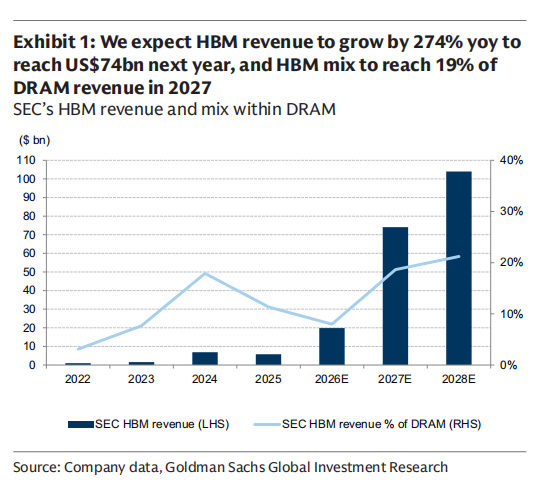
Goldman Sachs drastically raised Samsung Electronics' HBM ASP forecast for next year in the report. Currently, it is expected to be about 3.6 US dollars/Gb, an increase of 130% over the previous year; shipments have also increased by more than 60%, reaching about 21 billion Gb. Driven by this, Goldman Sachs expects the company's HBM revenue to grow 274% from 20 billion US dollars this year to 74 billion US dollars (about 100 trillion won) next year, and HBM's share of DRAM revenue will jump from 8% this year to 19%.
Goldman Sachs specifically emphasized that Samsung Electronics is actively expanding the HBM business with its strong position in ASIC customers such as Google (GOOGL.US) TPU and increasing market share in Nvidia (NVDA.US) HBM4 supply. According to industry chain research, the company has used its smooth production capacity to climb the slope to lock in significantly higher HBM pricing and shipments.
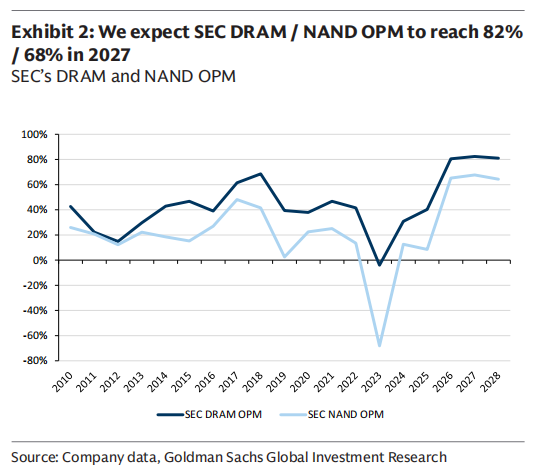
In terms of the DRAM business, Goldman Sachs expects 3Q26E DRAM bit shipments to increase 4% month-on-month and hybrid DRAM ASP to increase 14% month-on-month, which is basically the same as previous estimates. Among them, traditional DRAM bit shipments remained flat due to limited inventory levels, while HBM bit shipments increased nearly 50% month-on-month due to strong HBM4 shipments. Due to the negative impact of the exchange rate, the operating profit of the DRAM business is estimated to be reduced by 4% to 81.8 trillion won, and the operating profit margin remains high at 81%.
In terms of NAND business, Goldman Sachs expects 3Q26E NAND bit shipments to increase 7% month-on-month and hybrid NAND ASP to increase 17% month-on-month, which is basically in line with previous estimates. It is worth noting that demand for kV caches brought about by AI intelligent inference is driving an incremental increase in demand for ESSD, and Goldman Sachs raised the 2027E/2028E bit shipment volume and pricing estimates as a result. Although the 3Q26E NAND operating profit forecast was lowered by 4% to 26.8 trillion won (operating margin 67%) due to exchange rate factors, Goldman Sachs raised the 2027E/2028E NAND profit margin forecast because higher NAND ASP estimates were sufficient to offset the impact of the downward exchange rate assumption.
Foundation/system LSI and display, mobile and consumer electronics businesses
Additionally, Goldman Sachs expanded the 3Q26E operating loss estimate for Samsung's foundry and system LSI business from 1.2 trillion won to 1.7 trillion won, mainly reflecting negative exchange rate factors and higher-than-expected fixed cost burdens. However, Goldman Sachs still expects the business to gradually improve capacity utilization over the next few quarters, particularly benefiting from strong demand for advanced process foundry. Goldman Sachs expects the business's operating loss to narrow to 5 trillion won in 2027E, and is expected to turn a loss into a profit in the second half of 2027. At that time, the capacity utilization rate is expected to exceed 90%.
On the Samsung Display (SDC) side, Goldman Sachs kept its 3Q26E operating profit estimate unchanged at 1.0 trillion won. The unfavorable exchange rate was offset by a steady ASP brought about by improvements in the flexible and foldable OLED product portfolio. In the mobile experience (MX) business, Goldman Sachs lowered its 3Q26E operating loss estimate from 1.4 trillion won to 1.8 trillion won, mainly due to the greater impact of rising costs of components such as memory chips. In view of the 2027E/2028E higher DRAM and NAND ASP assumptions, Goldman Sachs cut the MX division's operating profit forecast for the next two years by 40%-50%. On the consumer electronics (CE) side, Goldman Sachs lowered its 3Q26E operating loss estimate from 0.3 trillion won to 0.4 trillion won, reflecting slower than expected demand tracking for TV and home appliances, as well as the potential impact of rising component costs.