
The increase in storage prices has not come to an end! Goldman Sachs: ASP forecast for the fourth quarter was higher than expected, and eSD accelerated, reaffirming the “buy” ratings of Samsung Electronics and SK Hynix
The Zhitong Finance App learned that Goldman Sachs proposed a judgment in “Korea Technology: Storage Price Tracking” released on September 30: TrendForce's forecast for storage contract prices for the fourth quarter of 2026 is higher than Goldman Sachs's own estimate across the board. PC DRAM, server DRAM, and NAND are high; only mobile DRAM is basically consistent with Goldman Sachs. The bank reaffirmed its “buy” ratings for Samsung Electronics (and included in the firm buy list) and SK Hynix.
Three price increase lines for the fourth quarter
According to Goldman Sachs quoting TrendForce's forecast, the average sales prices of PC DRAM, server DRAM, and mobile DRAM will rise 13%-18%, 10%-15%, and 0%-5%, respectively; NAND as a whole will rise 15% to 20% month-on-month, with enterprise-grade SSDs alone rising 23%-28%.
Compared to Goldman Sachs's own model: Under the average caliber of Samsung and SK Hynix, PC DRAM increased 9% month-on-month, server DRAM increased 10%, mobile DRAM increased 3% to 4%, and NAND rose 9%-11% in the fourth quarter. In other words, with the exception of mobile, which is basically the same, the other three pockets, TrendForce, are all more optimistic. Pay attention to caliber levels — According to TrendForce's official press release, conventional (conventional) DRAM contract prices rose 10%-15% month-on-month in the fourth quarter, and overall DRAM after HBM rose 15% to 20%. In the Goldman Sachs report, 13%-18% is the PC DRAM segment, and the two are not interchangeable.
Looking at the first quarter of 2027: TrendForce expects PC DRAM and server DRAM to rise 3%-8% month-on-month, and the server side is basically in line with Goldman Sachs's 3%-7%; mobile devices will regain momentum; LPDDR5X and LPDDR4X are expected to rise 13%-18% and 5%-10%, respectively.
Spot is tighter than contracts: DDR4 premium has reached 44%
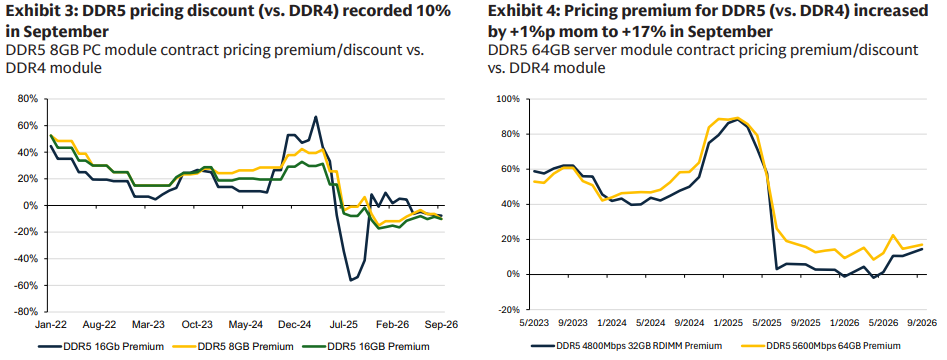
Looking at the September price, the price increase was not just written in the forecast. According to Goldman Sachs, citing TrendForce data, the DDR4 8GB contract price rose 4% to $148, DDR5 was flat at $133, and the DDR5 discount compared to DDR4 increased to 10% (6% in August); the server-side DDR4 64GB module remained flat at $1,295; the DDR5 64GB module rose slightly to $1,515 month-on-month, and the DDR5 premium rose from 16% to 17%.
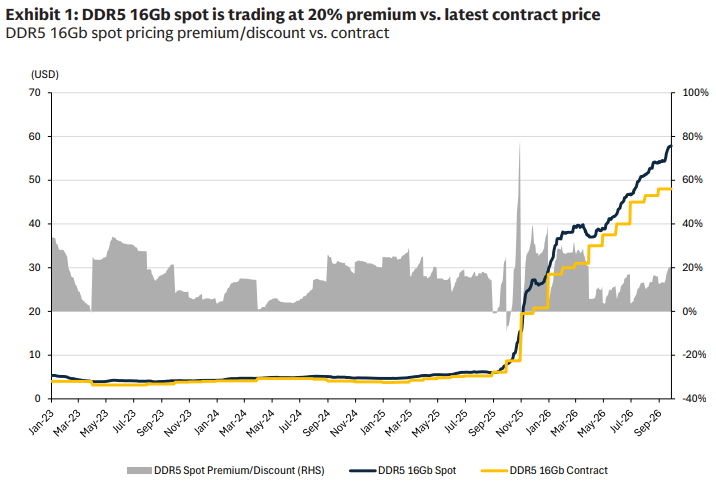
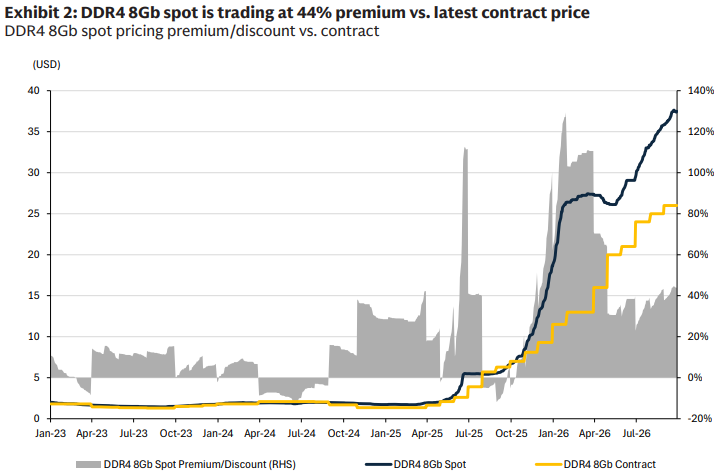
The real signal is in stock: DDR5 16Gb has a 20% premium over the latest contract price, and the DDR4 8Gb spot premium is as high as 44% — older generation products are particularly popular due to the gradual withdrawal of the original factory. Goldman Sachs pointed out that PC OEMs will maintain aggressive procurement throughout the fourth quarter to cope with a possible contraction in supply in 2027, which is the main support for prices.
The driving mechanism is not complicated: the original manufacturer continues to prioritize advanced process production capacity for high-performance server products, and the overall pattern of short supply has not changed; as CPU supply improves on the server side, cloud service providers and server OEMs add bit purchases to meet the RDIMM requirements of general-purpose servers in the agent-based AI (agentic AI) scenario, but the supply mix is still unable to match demand. TrendForce also suggests that some sellers will lag behind the market average in shipping growth due to the price range mechanism in the LTA (LTA) — a level that is easily overlooked when judging the actual performance of the original manufacturer.
Enterprise-grade SSDs: the only category that “grows faster”
There is significant differentiation within NAND. According to TrendForce, as cloud service providers continue to increase AI inference infrastructure, the demand for enterprise-grade SSD bits is expected to increase by more than 80% in 2026. The driving force for procurement has shifted from large-scale model training to actual AI deployment. The large-scale launch of proxy AI has multiplied the amount of real-time retrieved and cached data, and the penetration of QLC in vector databases has increased simultaneously; although the original factory has expanded the supply of QLC and high-capacity models, much of the new production capacity has been locked in advance by customers, and the influx into the open market is limited. As a result, enterprise-grade SSDs became the only storage category with accelerated growth in the fourth quarter.
Client SSDs are another story. According to TrendForce, PC OEMs can rely on the inventory and channel preparation established in the first half of the year to support fourth quarter shipments, and only need to supplement the sporadic shortage categories; brand manufacturers also lowered the SSD capacity of mainstream models in order to reduce the material cost of the whole machine, and the purchase volume contracted at the same time as the average load capacity. Buyers are holding inventory and purchasing volume is limited, and the original manufacturer's pricing attitude has become more flexible, and the increase has been suppressed. eMMC/ UFS is weaker - mobile phone brands mostly supported production in the fourth quarter with existing inventory, and the amount of new purchases made to the original factory was quite limited.
Mobile is the only exception, but it will make up for the increase in the first quarter of next year
Mobile DRAM rose only 0%-5% in the fourth quarter, making it the weakest category on the overall list. TrendForce explains that the high cost of LPDDR suppresses smartphone production. Coupled with the tightening of mobile phone quotas caused by the original manufacturer to shift production capacity to server products, the overall demand for bits was depressed; although the price increase was already established, the increase in the fourth quarter was reduced compared to the previous quarter because the increase was already reflected sharply ahead of schedule. Goldman Sachs attributed this to a structural squeeze of “supply being redistributed from mobile to server.” By the first quarter of 2027, this suppression is expected to reverse, with LPDDR5X and LPDDR4X rising 13%-18% and 5%-10%, respectively, month-on-month.
2027 is even tighter: HBM eats up production capacity, and cutting specifications won't save costs
What really determines the length of this cycle is 2027. According to research released by TrendForce on September 29, demand for AI servers continues to expand, making HBM and traditional DRAM continue to compete for limited advanced processes and wafer production capacity. Coupled with the time required for next-generation product yield and output to climb, storage supply will continue to be tight in 2027; the agency has revised the 2027 HBM price outlook, and estimates that blended ASP (blended ASP) will increase 121% year-on-year, reflecting an increase in the share of high-priced HBM4 and HBM4e in 2027 The volume was gradually released in the second half of the year.
There are clear figures on the production capacity side of the squeeze. According to Samsung Electronics Executive Vice President Kim Taewoo (Kim Taewoo) on September 29, HBM's share of the total wafer production capacity of global DRAM factories is expected to rise from about 20% now to nearly 30% in 2027; HBM shares the same set of wafer production capacity resources with traditional DRAM, and the expansion of HBM output will squeeze the supply space for traditional DRAM. A single HBM chip takes up about three times the wafer area of traditional DRAM, which means that the traditional DRAM supply may be squeezed out two to three times as fast as HBM's share.
Notably, the price reduction idea didn't work. GPU and ASIC vendors are discussing reducing HBM from 12 layers (12-Hi) to 8 layers to reduce costs, but TrendForce points out that each HBM needs to be equipped with a base die, and this cost does not decrease in proportion to the number of layers. 8-Hi can share the cost of base die with less DRAM capacity, and the converted cost per Gb is higher. The price per Gb of 8-Hi in 2027 may be 10% -20 premium over 12-Hi % - Reduced specifications can partially ease the pressure on GPU costs, but it cannot reverse the overall sharp increase in HBM's price.
Goldman Sachs's valuation and the risks it lists
Goldman Sachs's 12-month target price for Samsung Electronics is 490,000 won for common shares, using the 2026-2027 EV/EBITDA segment valuation (SOTP); the target price for preferred shares is 360,000 won, corresponding to a 27% discount on preferred shares (taking the average of the two-factor model discount and the average discount over the past month). Both common stock and preferred stock are “purchases”. There are three downside risks: sharp deterioration in storage supply and demand, sharp contraction in smartphone profit margins, and loss of mobile OLED market share.
The 12-month target price for SK Hynix is 3.5 million won. Using the 2026-2027 average price-earnings ratio method, the target P/E is 9.0 times. There are four risks: sharp deterioration in storage supply and demand and delays in technology migration; weakening demand for smartphones, PCs, and servers is dragging down traditional storage demand; Samsung's HBM business is progressing positively, impacting its HBM revenue and profits; and declining AI-related capital expenditure weakens HBM demand.
Why is the market still selling
What is intriguing is that as prices rise, Korean semiconductor stock prices are under pressure. According to Korean media reports, in order to reduce risk, global funds concentrated on selling large-cap chip stocks in emerging markets, and foreign investors once sold Samsung Electronics and SK Hynix for a total of about 49.6 billion yuan within 6 trading days; the Korean won strengthened sharply in the short term, giving foreign investors an opportunity to sell lucrative chip stocks and lock in exchange gains. At the same time, it raised concerns that the performance of major export giants fell short of expectations in the third quarter. Samsung Electronics previously announced a 15 trillion won repurchase plan, and SK Hynix plans to buy back and cancel 40 trillion won worth of shares.
Fundamentally, the third-quarter results are still at an all-time high. According to the brokerage consensus compiled by FNGuide, Samsung Electronics' operating profit for the third quarter is expected to be about 110.3 trillion won, an increase of more than 8 times over the previous year, and will become the first Korean company with operating profit exceeding 100 trillion won in a single quarter; SK Hynix expects about 78.1 trillion won, an increase of about 29% month on month; the two companies total about 188 trillion won. However, differences also exist — DS Investment Securities gave a conservative forecast of 104 trillion for Samsung and 70 trillion for SK Hynix. The core reason was that the won was significantly stronger than at the end of the second quarter (the USD/KRW exchange rate fell by about 11%): the two companies' revenue was almost entirely denominated in US dollars, and the appreciation of the won meant a contraction in revenue converted back to the won, offsetting some of the price increase dividends.
The latest footnote on the earnings side comes from Micron. According to its report for the fourth fiscal quarter of fiscal year 2026 released on September 30, revenue for the fourth quarter was $54.23 billion, up about 379% year over year, adjusted gross profit margin of 87.0%, and adjusted earnings per share of $33.42, all higher than market expectations; revenue guidance for the first fiscal quarter of fiscal year 2027 was approximately US$61.5 billion, also higher than analysts' expectations of US$56.8 billion. The stock fluctuated slightly after the financial report was released, and the stock's cumulative increase during the year reached about 273%, making it one of the best-performing stocks in the Philadelphia Semiconductor Index.
The core variable in this round of storage markets has always been the same: whether AI capital expenditure can continue. As long as the pace of construction of hyperscale cloud vendors continues, price increases can be transmitted; and once AI investment cools down, high-priced inventory that is now locked in long-term agreements, backlash will come very fast.