
3 Cash Flow Stocks Trading Below Fair Value By 25%
With US Treasury yields around 25 year highs and borrowing costs biting into weaker balance sheets, investors are punishing companies that rely heavily on cheap debt. That leaves a quieter pocket of opportunity in businesses where cash keeps flowing even as financing gets more expensive, yet share prices still lag valuations based on those cash streams. This article breaks down three such stocks that the screener flags as potentially mispriced.
The three stocks highlighted below are only a small sample, as the full screen on Simply Wall St surfaced around 40 more businesses with cash flow profiles and valuation gaps that look just as interesting but are not covered here.
To see the broader opportunity set and focus on ideas that match your own risk and return preferences, head straight into the Undervalued Stocks Based On Cash Flows screener to analyze, filter, and identify the cash flow driven setups that deserve a deeper look.
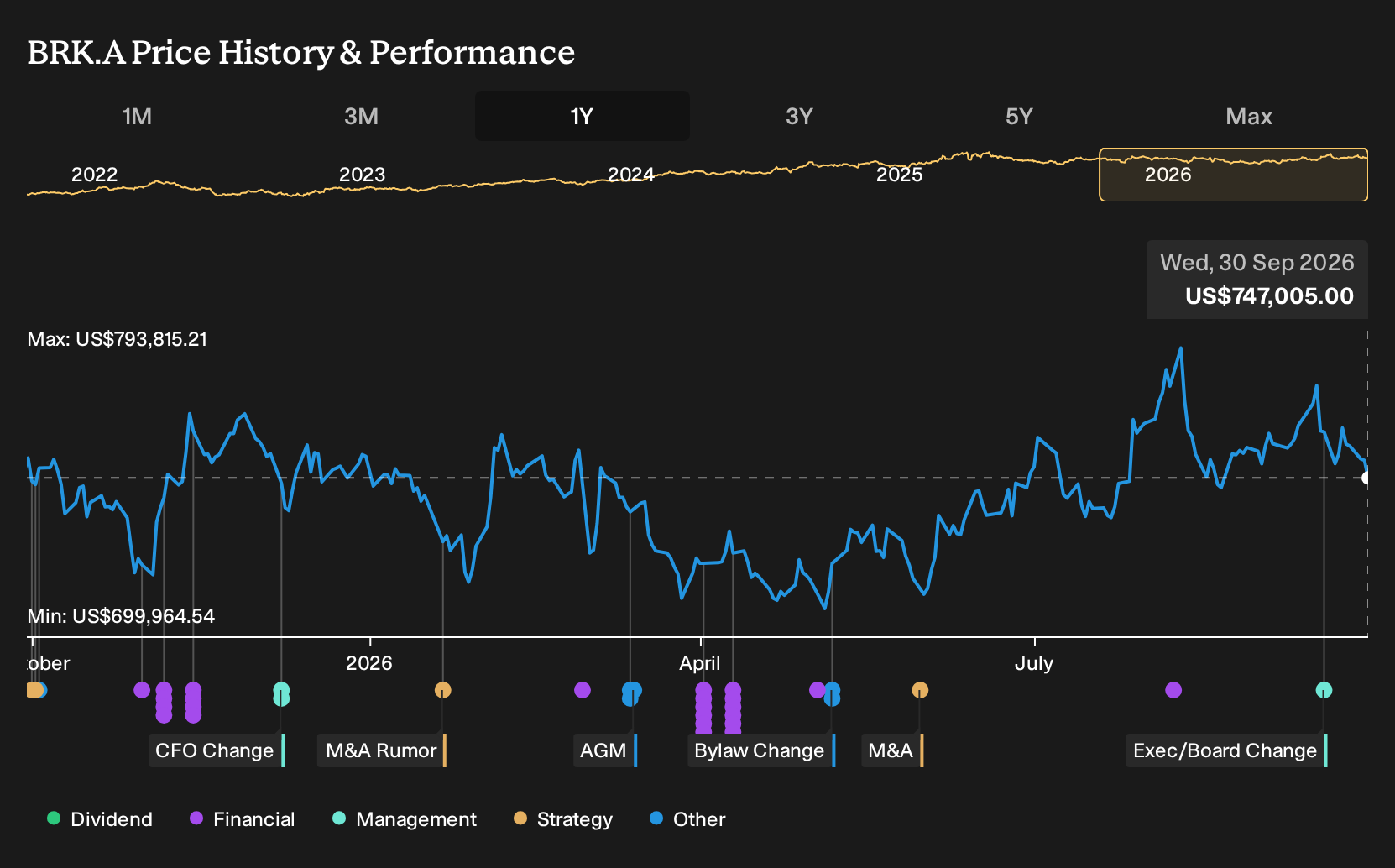
Berkshire Hathaway (BRK.A)
Overview: Berkshire Hathaway is a diversified holding company that owns large insurance operations, railroads, energy utilities, manufacturers, and a wide range of retail and service businesses.
Operations: Berkshire Hathaway generates most of its revenue from manufacturing at US$83.0b, alongside sizable contributions from GEICO at US$45.1b, Pilot Travel Centers at US$47.8b, McLane at US$50.3b, service and retailing at US$44.7b, BNSF at US$24.6b, Berkshire Hathaway Energy at US$26.9b, and its reinsurance and primary insurance groups together at about US$44.2b.
Market Cap: US$1.1t
For this cash flow focused screen, Berkshire Hathaway matters because its insurance operations generate recurring underwriting and investment inflows that support a large pool of internally funded capital. That capital is then allocated across rail, energy, and other subsidiaries to turn those cash streams into long life earnings.
"The Cash Fortress: Berkshire's cash and short-term Treasuries hit a staggering, record-breaking $397.4 billion."
What investors really need to watch now is how one quiet capital allocation shift ripples through future margins and free cash flow resilience.
That quiet shift is exactly what the full narrative for Berkshire Hathaway unpacks, showing how Berkshire Hathaway's cash fortress could be masking both emerging risks and accelerating optionality.
Broadcom (AVGO)
Overview: Broadcom is a digital infrastructure company that designs semiconductor hardware and runs VMware-based private cloud and enterprise software platforms that generate recurring cash flows.
Operations: Broadcom generates about US$59.4b from Semiconductor Solutions and around US$29.7b from Infrastructure Software, with subscriptions and support providing meaningful recurring revenue.
Market Cap: US$1.7t
Broadcom matters for this cash flow focused screen because its VMware-derived infrastructure software brings subscription-style predictability to a hardware heavy business. This gives value minded investors a clearer line of sight on future cash being generated, rather than just the next semiconductor cycle.
"Broadcom is generating substantial free cash flow, expanding its custom silicon business, strengthening its position in networking, and integrating software assets that further diversify earnings."
The real swing factor is how one subtle shift in long term customer commitments could change the balance between cash flow resilience and hardware cycle pressure.
That swing factor is exactly what the full narrative for Broadcom unpacks, revealing how Broadcom's cash engine, hardware cycles, and long term contracts could be quietly decoupling in investors' favour.

Alphabet (GOOGL)
Overview: Alphabet runs Google Search, YouTube, Android, and a growing Google Cloud AI platform that sells enterprise subscriptions and consumption-based services.
Operations: Alphabet generates about US$367.1b from Google Services, US$77.6b from Google Cloud, and US$1.5b from Other Bets across global markets.
Market Cap: US$4,190.3b
Alphabet matters for this cash flow focused screen because Google Cloud AI and Vertex AI sit on top of high fixed infrastructure, so incremental enterprise usage can translate into cash conversion once heavy data center spending settles into a steadier run rate.
"Google Cloud has gone from “meh” to money-maker. • Now #3 globally behind AWS and Azure, with over 11% market share."
What really decides how much of that AI-driven revenue turns into lasting free cash flow is how one huge, long term backlog is priced and fulfilled.
That pricing question is exactly what the full narrative for Alphabet tackles, mapping how Alphabet's AI, cloud backlog and cash flows could be quietly accelerating beyond headline search and YouTube stories.

Seeking Fresh Alternatives Before Others
Fresh opportunities do not sit still. While attention chases the latest headlines, some ideas build quiet breakout momentum under the radar for now. Do not get caught reacting late. Consider taking time to review potential options.
- Track strong income streams by scanning the 7 dividend fortresses that focuses on businesses aiming to keep cash distributions flowing even when sentiment drops.
- Hunt resilient balance sheets by reviewing the list of solid balance sheet and fundamentals (25 results) so you can focus on companies where financial foundations support cash generation when conditions shift.
- Explore the next automation wave by reviewing the 92 robotics and automation stocks that features businesses involved in real-world robotics momentum before it reaches broader attention.
This article by Simply Wall St is general in nature. We provide commentary based on historical data and analyst forecasts only using an unbiased methodology and our articles are not intended to be financial advice. It does not constitute a recommendation to buy or sell any stock, and does not take account of your objectives, or your financial situation. We aim to bring you long-term focused analysis driven by fundamental data. Note that our analysis may not factor in the latest price-sensitive company announcements or qualitative material. Simply Wall St has no position in any stocks mentioned.
Have feedback on this article? Concerned about the content? Get in touch with us directly. Alternatively, email editorial-team@simplywallst.com