
IPO Interpretation | From the “A+H” hearing of Voice Holdings (688036.SH) to a perspective on the second listing and breakthrough of “The King of African Mobile Phones”
As one of the few domestic consumer electronics giants with overseas markets as its basic market, Communication Holdings (688036.SH), which has the aura of “the king of mobile phones in Africa”, knocked on the Hong Kong Stock Exchange twice after seven years of listing on the Science and Technology Innovation Board, and passed the listing hearing in late September, only one step away from achieving an “A+H” dual listing.
In terms of sales in 2025, Communication Holdings ranked first in the world's emerging markets, with a market share of 20.0%, and even as high as 53.1% in Africa, surpassing all other rivals combined. At a time when the wave of consumer electronics price increases hit, this company, which relied on hardware to rise overseas, is trying to get rid of the inherent label of hardware manufacturers and move closer to intelligent ecosystem service providers in emerging markets.
Fluctuations in performance, due to “ice and fire” of price increases and volume contractions
For every two phones sold in Africa, one comes from a Chinese company. This company, called Communication Holdings, relies on the three brands TECNO, Infinix, and itel to firmly hold the title “King of African Mobile Phones”.
According to Frost & Sullivan data, in 2025, Communication Holdings ranked third in the global mobile phone market by sales volume, with sales volume of about 169 million units, with a market share of 11.8%; ranked eighth in terms of revenue, with revenue of about US$8 billion, with a share of 1.7%. In emerging markets, the company ranked first in terms of mobile phone sales, with a share of 20.0%; in the African market, it ranked first in terms of sales volume, with a share of 53.1%.
According to the prospectus, Audio's products cover the complete echelon, from low-cost feature phones to high-end smartphones. They are rooted in Africa based on deep localization capabilities, while continuing to penetrate a wide range of emerging markets such as South Asia, the Middle East, and Latin America. Currently, they have been sold to more than 100 countries and regions around the world, and the overseas layout has taken shape.
It is worth noting that in response to the special usage environment in emerging markets, Transom has detailed designs such as adapting multiple cards, resisting high temperature and humidity environments, and optimizing dark-skinned portrait shooting algorithms at the product level. Localized innovation is exchanged for users' trust, and has helped Transom firmly maintain regional market share for a long time.
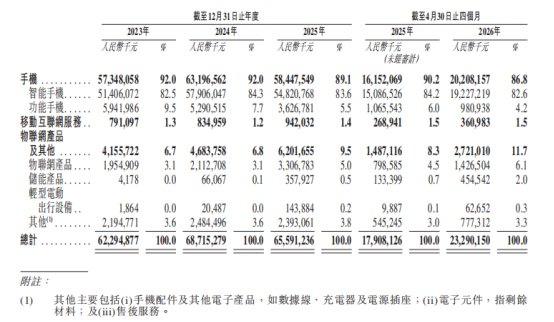
According to the data collection after the hearing, Communication Holdings achieved revenue of 62.295 billion yuan, 68.715 billion yuan, and 65.591 billion yuan in 2023-2025, respectively. Revenue for the first four months of 2026 was 23.290 billion yuan, an increase of about 30.1% over 17.908 billion yuan in the same period last year.
Looking at the revenue structure, in 2025, its mobile phone business revenue was 58.448 billion yuan, accounting for 89.1% of total revenue, of which smartphone revenue was 54.821 billion yuan; IoT products and other revenue rose to 6.202 billion yuan, accounting for 9.5%, and mobile Internet service revenue of 942 million yuan. In the first four months of 2026, IoT products and other revenue increased to 2,721 billion yuan, accounting for 11.7%. TECNO, Infinix, and iTEL accounted for 46.1%, 39.8%, and 13.9% of mobile phone revenue in 2025, respectively.
However, from the profit side, the recent wave of memory chip price increases has caused the company's profits to fluctuate violently. In 2023-2025, the net profit of Communication Holdings fell from 5.59 billion yuan and 5.60 billion yuan to 2.61 billion yuan. This is due to the sharp increase in demand for memory chips in large AI models. Suppliers are shifting production capacity to more profitable AI-related applications, and the supply of consumer memory chips has begun to tighten, and prices have risen across the board. Transmitted to the industrial chain, the average purchase price of memory chips began to “soar”, from 49.5 yuan per tablet in 2023 to 67.8 yuan in 2024, 70.3 yuan in 2025, and soared to 192.0 yuan in the first four months of 2026.
For Voice, which focuses on cost performance, this is an unavoidable cost storm: smartphone gross margin fell all the way from 22.5% in 2023 to 17.7% in 2025, and the overall gross margin slipped from 23.2% to 18.7%. The company was forced to slow down shipments in the second half of 2025 and pass on costs through price increases, causing annual smartphone sales to drop from 106 million units in 2024 to 96.81 million units.
In order to cope with cost pressure, Communication Holdings chose to “walk on two legs” in 2026. One is to raise smartphone prices from 2026 to transfer cost pressure downstream; the second is to lock in low-cost inventory in the first half of 2026 and still absorb the low price inventory it had previously hoarded. In the meantime, the low cost of old inventory continues to contribute to profits, and the high cost of new purchases has not yet been transmitted to the profit table. Benefiting from a “slow half-beat” on the cost side, in the first four months of 2026, the company's revenue rebounded 30% year over year, gross margin rebounded to 21.9%, and net margin rebounded to 5.8%.
Emerging markets are fiercely competitive, how can they continue to lead?
In fact, if we look at the future of Communication Holdings from the present point of view, what is more critical is the structural upgrade. The share of smartphones sold in Africa rose from 31.1% in 2023 to 43.8% in 2025. According to Frost & Sullivan's data, the mobile phone market in emerging markets increased from US$142.9 billion in 2021 to US$175.5 billion in 2025, with a compound annual growth of 5.3%. It is expected to reach US$266.7 billion in 2030, rising to 8.7%; the smartphone penetration rate in emerging markets is still climbing during this period.
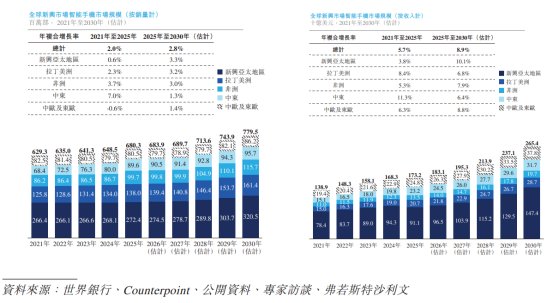
Judging from this, the transition from feature phones to smart phones is still halfway, which means that the room for stock switching and unit price increases is not over yet. This is a race track of “moderate growth in total volume and continuous structural upgrading”, and Transom continues to lead the way in emerging markets with its first-mover advantage over the years.
On the B-side of consumer electronics upgrades, competition in overseas markets is also intensifying. Domestic manufacturers such as Xiaomi, Honor, and OPPO continue to increase their investment in Africa and emerging markets. Some rivals are growing significantly faster than reported in African smartphone shipments. The former Blue Ocean market has turned into competition in the Red Sea. Therefore, Communication Holdings needs to find new business growth points, and it is exploring how to expand to high-value-added software, ecology, and multi-category hardware.
First, the answer given by Voice is to “embrace AI,” while opening up different growth paths based on years of understanding localized R&D and sales in emerging markets. It is clearly mentioned in the prospectus that the net capital raised by H shares this time is mainly invested in AI and terminal technology research and development, global brand channel expansion, mobile Internet and IoT ecosystem layout, and the remaining portion supplements daily operating capital.
Investment in AI is placed at the top of the financing flow. This is also a key word repeatedly emphasized in its prospectus and recent annual reports. However, unlike the big model line of leading domestic mobile phone manufacturers, Audio's AI development focuses more on implementation scenarios that meet the needs of emerging market users, such as small terminal models, multi-language localized AI assistants, voice noise reduction, visual recognition, etc., and adapts development for multi-lingual and multi-cultural overseas markets, and strives to embed AI capabilities into all categories of mobile phones and IoT terminals, enhance the differentiated competitiveness of hardware products, and break the internal dilemma of simply competing for hardware parameters and prices.
The second is global channel and brand upgrading. In the past, communication advantages were concentrated on sinking the mass market. itel focused on the ultimate cost performance ratio. TECNO and Infinix gradually tested the middle and high-end, but in emerging markets outside of Africa, there is still room to improve brand awareness. The funds raised will be used to improve offline distribution outlets and carry out localized brand marketing in an attempt to change the external world's stereotype that transmission “only makes cheap machines” and further open up the growth ceiling in the South Asian and Latin American markets.
The third major direction is mobile internet and IoT ecology. Currently, the IoT sector has covered TWS headsets, smart watches, tablets, home appliances, and even lightweight travel products. Among them, TWS headsets have achieved the highest sales volume in the African market. The mobile Internet business relies on self-developed TranssionOS to achieve monetization through application distribution, pre-installation, and advertising traffic. How to rely on hundreds of millions of existing terminals to turn hardware users into a source of revenue for Internet services and create a second growth curve will also become the core future proposition of Communication Holdings.
Taken together, Communication Holdings' “two sides in one” is relatively clear. The A side is a market-proven strong overseas localization capability, a stable base of end users, and a foundation for ecological transformation; the B side is the main hardware industry's profits under pressure, new businesses are still being cultivated, and external competition is becoming increasingly intense, and the A+H listing is probably only the starting point of its transformation.