
What Charles Schwab (SCHW)'s AI Client Assistant Means For Shareholders
- Charles Schwab recently launched Charley, a generative AI assistant that lets clients use voice or text to handle account queries, everyday tasks, and selected actions, with live handoff to human representatives when needed.
- The rollout of Charley, layered on Schwab’s existing AI portfolio insights and broad digital tools, points to rising technology spend aimed at deeper client engagement and more scalable service delivery.
- Now the focus shifts to how Charles Schwab’s investment narrative could be reshaped by Charley’s role in automating high volume client interactions.
Charles Schwab Investment Narrative Recap
For a shareholder in Charles Schwab, the core belief is that a scaled, low cost platform can keep turning record client activity into resilient fee and interest income. The recent Charley launch plugs directly into that idea by trying to route more everyday service and research queries through AI, which can support higher volume without always adding headcount.
Right now, the key near term swing factor is whether Schwab can keep expenses from running ahead of revenue as it invests heavily in technology, AI and new products. The biggest risk is that rising tech spend and higher regulatory and volume related costs erode the operating leverage that recent earnings strength has relied on.
The Charley announcement sits alongside Schwab’s AI powered portfolio insights rollout and the broader push to give clients more self service tools. That matters because management has already acknowledged that 2026 expense growth guidance is running above earlier plans, so any automation that holds down cost per account is very relevant to the story.
At the same time, heavier use of AI for client interactions and operations raises its own execution and risk questions, particularly around supervision, fraud detection and service reliability. For an investor tracking catalysts, the focus now is whether Charley and related tools actually support stable margins while Schwab contends with fee pressure and intense competition from digital first brokers.
What The Schwab Forecasts Assume About AI And Scale
Charles Schwab's forecast story is built on more than a headline AI launch. Analysts are tying Charley and the wider automation push into a bigger picture where technology is expected to support a scaled platform, higher digital engagement and tighter unit costs per client.
The current analyst framework assumes revenue growth of 10.2% each year over the next 3 years and profit margins moving from 37.4% today to 40.6% by around 2029. That margin shift is linked to the idea that tools like Charley can take on high volume servicing, which may limit how fast support headcount and other operating costs need to rise as activity grows.
On earnings, the consensus view points to US$9.7b today and US$14.2b by roughly 2029, which is an increase of about US$4.5b in profit. For an investor watching the AI rollout, the question is how much of that change is supported by automation and digital workflows versus more traditional drivers like interest income, asset management fees and trading related revenue.
Valuation work in the same report links those assumptions to a forward P/E of 18.1x on the projected 2029 earnings, compared with 18.7x today and a higher multiple for the wider US capital markets peer group. That gap leaves some room for investors to form their own view on how effectively Schwab can convert tools like Charley, AI powered portfolio insights and private markets access into earnings without letting expense growth get away from it.
Charles Schwab's narrative projects US$34.9b revenue and US$14.2b earnings by 2029. This rests on a 10.2% yearly revenue growth rate and an earnings increase of about US$4.5b from US$9.7b today.
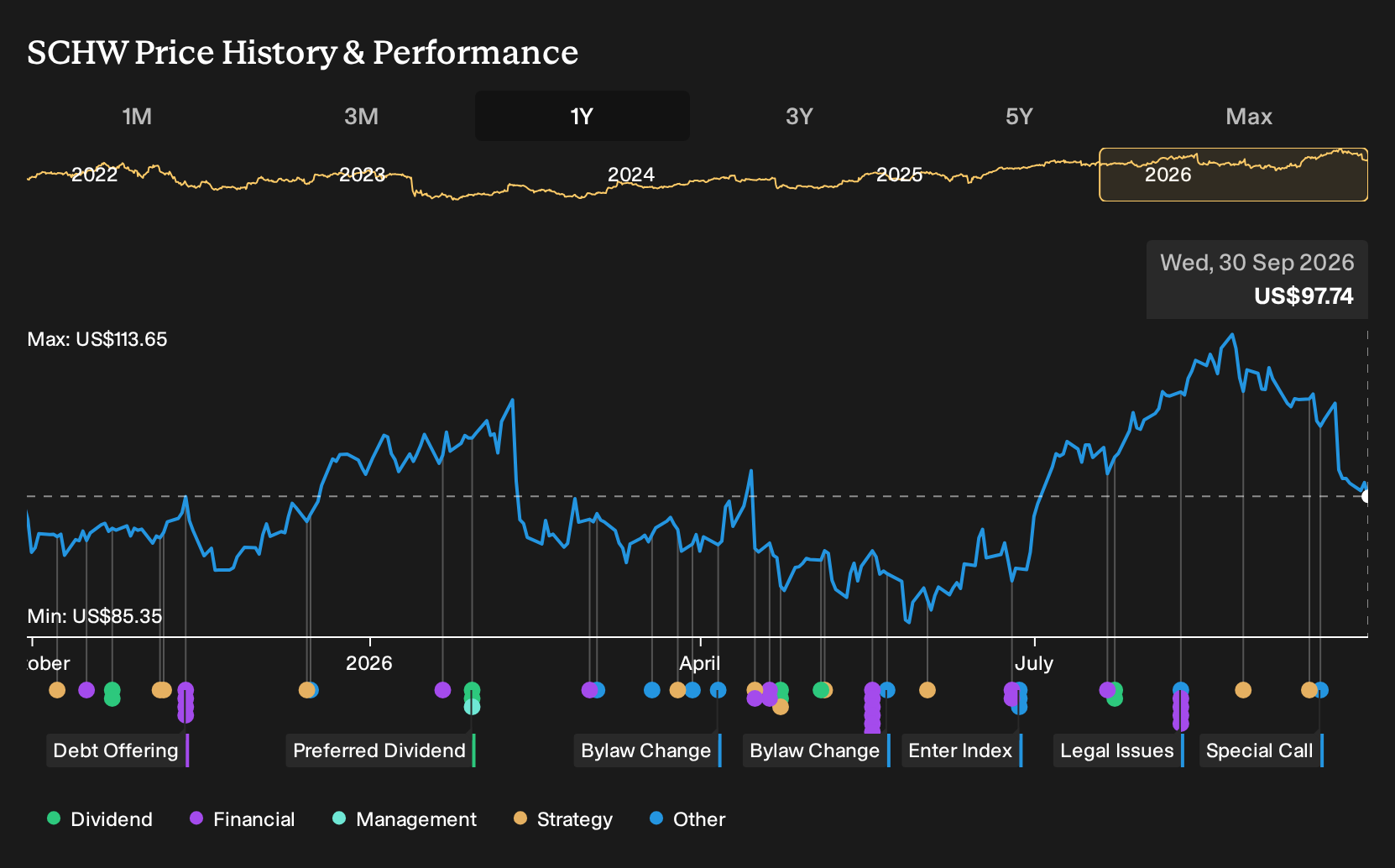
Discover how Charles Schwab's fair value indicates a 28% potential upside to its current price that may not last much longer.
Exploring Other Perspectives
One alternate view fixates on the risk that Charles Schwab’s heavy AI and tech spend, including Charley, locks in structurally higher costs. The most cautious analysts were already penciling in about US$34.5b of 2029 revenue and US$14.0b of earnings before this news. That is a much tighter story than the consensus. Use that spread in expectations as a reminder that reasonable people can read the same numbers very differently, and treat Charley as a fresh input that may push these narratives in new directions.
Explore 3 other Charles Schwab fair value estimates, including one that suggests it could be worth just $122.76!
Decide For Yourself
Don't just follow the ticker. Dig into the data and build a conviction that's truly your own.
- A great starting point for your Charles Schwab research is our analysis highlighting 5 key rewards and 1 important warning sign that could impact your investment decision.
- See our latest analysis for Charles Schwab. The report includes a comprehensive fundamental analysis summarized in a single visual, the Snowflake, making it easy to evaluate Charles Schwab's overall financial health at a glance.
Looking For More Investment Ideas Beyond Charles Schwab?
Once you have formed a view on Charles Schwab, it can help to compare that thesis with opportunities elsewhere so you are not anchored to a single story. The Simply Wall St Screener lets you filter the market by financial strength, valuation or income profile, then track a shortlist that actually fits your risk tolerance.
- If you care most about quality at a reasonable entry point, start with a curated set of 31 high quality undervalued stocks that combine solid fundamentals with more modest pricing.
- For investors who like steady balance sheets and fewer surprises, focus on a list of solid balance sheet and fundamentals (25 results) that can handle tougher conditions without stressing the finances.
- If you are hunting for underfollowed opportunities, cast a wider net with a 19 high quality undiscovered gems that screens for strong business metrics before the crowd pays attention.
This article by Simply Wall St is general in nature. We provide commentary based on historical data and analyst forecasts only using an unbiased methodology and our articles are not intended to be financial advice. It does not constitute a recommendation to buy or sell any stock, and does not take account of your objectives, or your financial situation. We aim to bring you long-term focused analysis driven by fundamental data. Note that our analysis may not factor in the latest price-sensitive company announcements or qualitative material. Simply Wall St has no position in any stocks mentioned.
Have feedback on this article? Concerned about the content? Get in touch with us directly. Alternatively, email editorial-team@simplywallst.com