
PayPal Could Still Get Acquired. How to Play PYPL Stock Amid New Takeover Rumors.
Payments network operator PayPal (PYPL) saw its stock drop sharply after a consortium of buyout firm Advent International and payment processor Stripe walked away from a $53 billion (or $60.50 per share) bid after being rebuffed.
Now, PayPal has been embroiled in rumors of another takeover bid. Traders reported that an “uncooked” alert from Betaville suggested a U.S. technology company headquartered on the West Coast could be considering an all-stock acquisition of the fintech company. Reportedly, PayPal is looking for an all-cash offer. While nothing is confirmed, PayPal might not accept an offer that is not meaningfully above $70 per share, as Bernstein analysts estimate.
Meanwhile, PayPal is looking to turn around from slowing fundamentals under its new CEO, Enrique Lores. To achieve this restructuring, the company has made multiple workforce reductions as a cost-saving measure. Agentic AI also offers a unique growth opportunity for a firm like PayPal, given its existing customer base.
While the takeover bid rumors are not yet conclusive, let's take a look at PayPal's current state.
About PayPal Stock
PayPal Holdings runs a worldwide payments network that connects consumers and businesses across digital and physical channels. Its brands, including PayPal, Venmo, and Xoom, allow users to make purchases, transfer funds, receive payments, and access various financial services.
The company works with consumers, small businesses, global retailers, online marketplaces, and other corporate customers. In addition to processing payments, PayPal offers fraud management, payment authorization, and business analytics solutions designed to help merchants improve transactions and customer engagement. Headquartered in San Jose, California, the company has a market capitalization of approximately $46.43 billion.
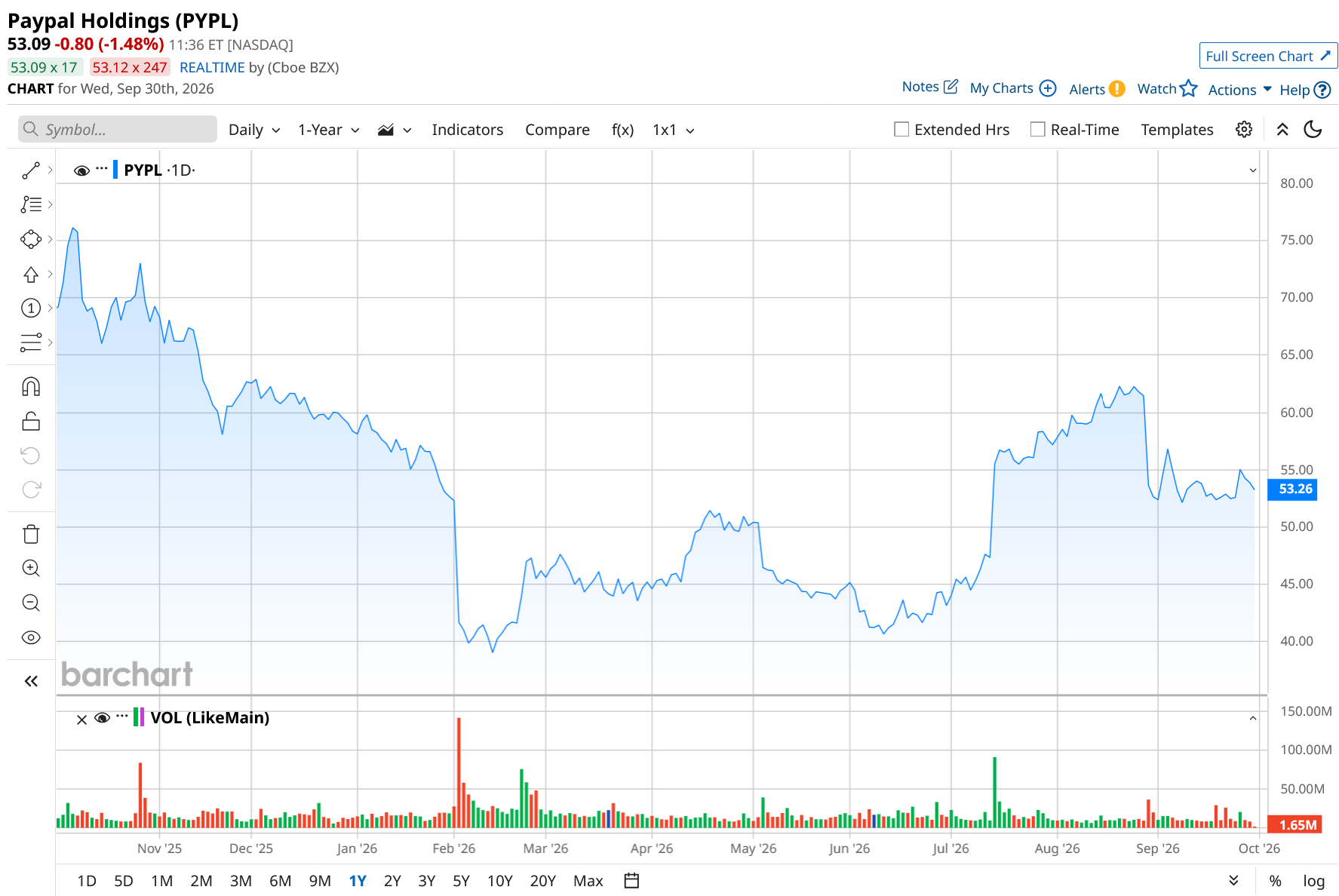
PYPL stock has fallen 20% over the past 52 weeks, mainly because investors remain concerned about slowing growth, intense competition, and uncertainty over the company’s turnaround. It reached a 52-week low of $38.46 in February but is up 39% from that level. However, the stock rose 24% over the past three months as investors saw signs of improvement. Reports of the potential takeover bid supported the stock by highlighting PayPal’s strategic value.
On a forward-adjusted basis, PayPal’s price-to-earnings (non-GAAP) ratio of 10.07x is lower than the industry average of 10.96x.
Revenue Growth in Q2 Raises Full-Year Profit Guidance
In the second quarter, PayPal reported 10% year-over-year (YoY) growth in total payment volume to $486.45 billion, while quarterly revenue rose 5% YoY to $8.68 billion. As operating cash flow improved sharply and capital spending remained modest, the company’s free cash flow climbed 157% YoY to $1.78 billion. However, PayPal’s adjusted operating margin dropped by 248 basis points to 17.4%. Adjusted EPS declined by 1% YoY to $1.38.
PayPal raised its fiscal 2026 non-GAAP EPS forecast to about $5.38, slightly above the $5.31 figure it recorded in fiscal 2025. In its last guidance, the company expected non-GAAP EPS to decline in the low single digits or increase slightly. For the current year, Wall Street analysts expect PayPal’s EPS to increase by a modest 1.3% YoY to $5.38, followed by a 7.8% improvement to $5.80 in the next year. However, for the third quarter, EPS is projected to decrease 1.5% YoY to $1.32.
What Do Analysts Think About PYPL Stock?
In August, analysts at Piper Sandler raised the price target on PYPL stock from $42 to $59 while maintaining a “Neutral” rating, following reports that PayPal is negotiating a higher takeover bid from Stripe and Advent. The analyst saw this development as a potential strategic validation of the company’s asset base. However, later reports suggested that the group is no longer pursuing the takeover after their initial offer was rebuffed. This led analysts at Truist Securities to lower PayPal's price target from $62 to $53 while keeping a “Hold” rating on its shares.
Contrarily, RBC Capital analysts raised PayPal’s price target from $65 to $70 and maintained an “Outperform” rating as part of a broader research note on Fintech & Payments as RBC updates its valuation framework.
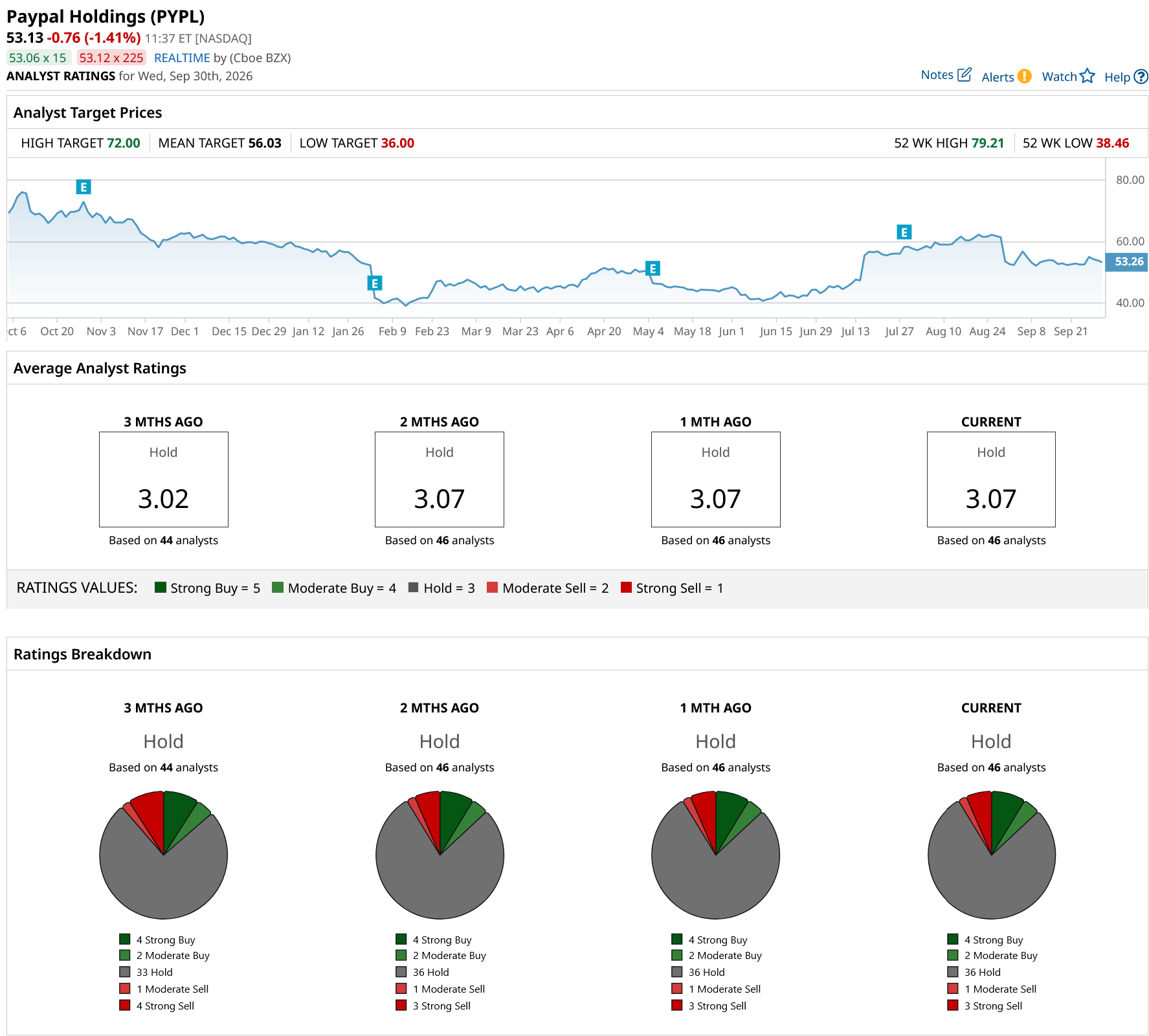
Wall Street analysts are taking a cautious stance on PYPL’s stock now, with a consensus “Hold” rating overall. Of the 46 analysts rating the stock, four analysts gave a “Strong Buy” rating, and two analysts rated it “Moderate Buy,” while a majority of 36 analysts are playing it safe with a “Hold” rating; one analyst suggested “Moderate Sell,” and three analysts gave a “Strong Sell” rating. The consensus price target of $56.03 represents a 5% upside from current levels. The Street-high price target of $72 implies a 36% upside.
On the date of publication, Anushka Dutta did not have (either directly or indirectly) positions in any of the securities mentioned in this article. All information and data in this article is solely for informational purposes. For more information please view the Barchart Disclosure Policy here.