
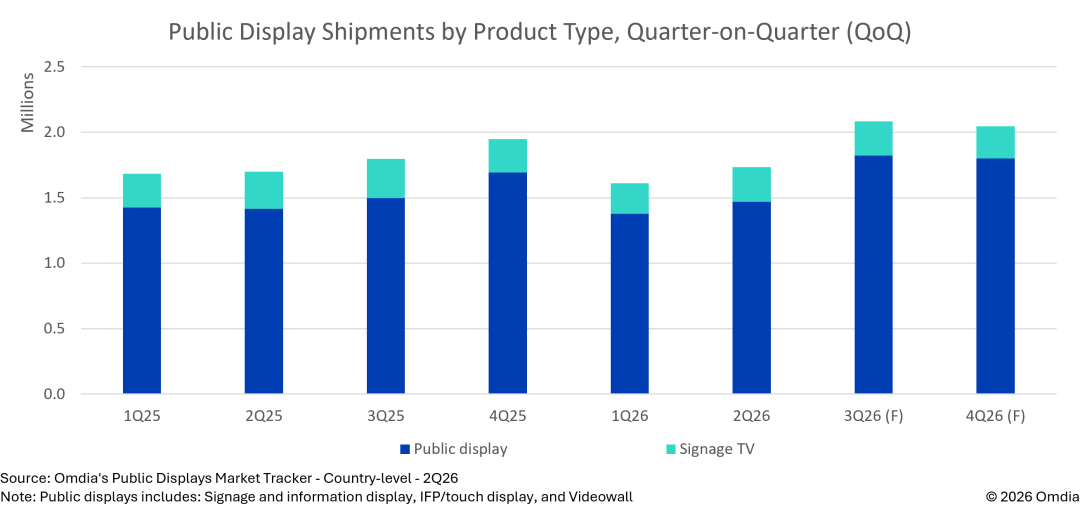
Omdia: Global shipments of public displays and signage TVs exceeded 1.73 million units in the second quarter, leading the way in IFP/touch screens
The Zhitong Finance App learned that Omdia's latest “Public Display Market Tracking” study showed that global public display and signage TV shipments in the second quarter of 2026 exceeded 1.73 million units, up from 1.61 million units in the previous quarter. Among them, IFP/touch displays led the market growth, and shipments increased 13.7% month-on-month and 0.7% year-on-year.
With the exception of Asia and Oceania (including Japan), almost all regions achieved month-on-month growth in the second quarter of 2026. The North American market grew by 68.0%, achieving double-digit growth; followed by Latin America and the Caribbean, which grew by 13.3%; and Western Europe, which grew by 11.6%. In the North American market, leading IFP/touch display brands such as BenQ, Newline, SMART Technologies, and ViewSonic together accounted for more than 60% of IFP/touch screen shipments in the quarter.
Education promotion in Indonesia is expected to accelerate demand for IFP/touch displays
Omdia anticipates a significant increase in IFP/touch screen shipments in the second half of 2026, mainly due to the Indonesian government's plan to install interactive flat panel displays for nearly 77,000 schools in 2026, followed by plans to cover 100,000 schools in 2028 and 2029, respectively. Omdia expects Indonesia's IFP/touch screen shipments to reach 250,000 units and 330,000 units in the third and fourth quarters of 2026, respectively, driving the Asian and Oceania markets to achieve 46.0% year-on-year growth in 2026.
In the long run, IFP/touch displays will face increasing competition from integrated LED displays (AIOs) with touch functionality, particularly in the corporate and conference room markets. Competition among LED display manufacturers is also fierce, and rising inventory levels and price pressure are affecting manufacturers' gross margins.
AI applications help China's signage display market grow
In the second quarter of 2026, signage and information display shipments maintained steady growth, up 2.5% month-on-month and 7.9% year-on-year. Among them, Samsung, LGE, and NewLine together accounted for nearly 65% of global signage and information display shipments in the quarter. Shipments of many Chinese brands also achieved month-on-month growth. Previously, due to the impact of the Spring Festival holiday, market performance in the first quarter was relatively weak.
In the mainland China market, short- and medium-term growth opportunities are expected to come from increasing adoption of AI functional products in retail, public space, and enterprise sectors. In the enterprise sector, domestic hardware (including key components) and expanding software capabilities supported by smart industry policies are also expected to drive market growth.
Omdia further anticipates that display upgrades in cultural and tourism scenarios will further drive market demand for AI features. However, the 2026 market budget is still limited, particularly in the retail sector. As a result, Omdia anticipates that the widespread application of AI display solutions in education, corporate environments, and public spaces will accelerate in 2027 and the next few years.
World Cup and conference room upgrade demand supports commercial display (ProAV) market growth
Public display shipments in the US, Canada, and Mexico are partly benefiting from investments related to the 2026 FIFA World Cup. Host cities in North America and Latin America have invested in large LCD and LED display systems to meet various audiovisual (AV) needs such as broadcasting, security, and fan interaction. IFP/touch displays and live streaming technology are also widely used during the event to enhance the spectator experience and audience interaction.
In the broader commercial display (ProAV) industry, demand for broadcast audiovisual technology is also growing, including multi-camera production systems, switchers, and audio equipment, particularly in enterprise and workplace environments. As companies expand the production of live and recorded video content, it is increasingly common for corporate studios, universities, and live event venues to be equipped with internal broadcast capabilities. Omdia expects this trend to continue until the rest of 2026 and 2027.
Corporate and conference room upgrades remain an important area of investment, particularly in North America and Western Europe. However, many companies are adopting more prudent technology investment and upgrading strategies. Budgets are increasingly focused on medium to high spec products in the video conferencing and collaboration ecosystem rather than large-scale office deployments and upgrades.
Omdia expects commercial display market demand to remain stable for the rest of 2026 and 2027 as businesses and universities continue to invest in more intelligent conference rooms and teaching spaces. In Europe, as energy costs rise, the importance of energy-efficient signage displays is increasing, driving the market to replace traditional displays and other AV devices with more energy efficient products.
Kelly Lum, chief analyst of Omdia's commercial display business, said, “Since this year, the overall commercial display industry has maintained steady growth, which has improved compared to 2025. Like other industries, the commercial display market still faces many uncertainties such as tariffs, supply chain pressure, rising memory costs, geopolitical tension, and the macroeconomic environment. Furthermore, differences between regions have significantly reshaped the commercial display industry over the past few years.
However, as plans for the next generation of commercial display spaces become more clear, there are still plenty of opportunities for various vertical industries. Customers are increasingly focusing on the overall solution to not only meet technology requirements, but also reduce operating costs, increase usage and engagement, simplify deployment and expansion, and provide greater flexibility.”